Thursday, 30 December 2021

Facebook Lead Ads: What They Are and How to Use Them

Facebook Lead Ads: What They Are and How to Use Them

It has 2.89 billion monthly active users, a global presence, and a massive influence on consumer buying decisions.

What am I talking about? Facebook, of course!

Given its broad audience, marketers and businesses can’t afford to ignore Facebook if they want a fresh pool of prospects to target.

However, there’s another reason why you should use Facebook: they provide many innovative tools to help anyone drive more attention to their products and services by targeting specific audiences.

One of those tools is Facebook lead ads.

What Are Facebook Lead Ads?

Facebook lead ads allow marketers to generate leads on Facebook among users who might be looking to buy your product or services.

Rather than the traditional landing page, these ads keep users on social media while the prospect fills out a simple lead form with basic details such as their name, email address, and other contact information.

When a prospect completes an “Instant Form”, they get added to the company’s email list where they receive updates and offers (if you have an active mailing list).

Alternatively, you can customize Facebook Instant Forms—making it easier to target your audience (and filter out non-relevant customers).

With Facebook lead ads, you can choose from several campaign types, including:

  • demos
  • downloads, like PDFs
  • discounts
  • event advertising

Facebook users will then see lead ads in different site areas, including news feeds, Messenger, and even articles.
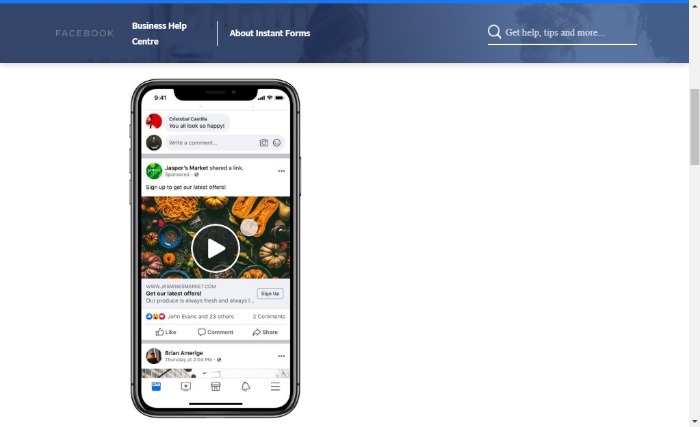
facebook-lead-ads-facebook-business-center

How Facebook Lead Ads Work

Facebook lead ads work in much the same way as other advertising. You can create your adverts by going to Facebook’s Ads Manager.

Once there, you establish your budget while adding your descriptions, images/videos, and other design elements for a successful ad. You can also customize your ad by using specified interests or demographics to target your ideal audience.

Ads then get shown in users’ feeds, where they can respond to your offer, helping your ability to generate more leads.

From a user’s perspective, Facebook Lead Ads don’t look different from other link ads. Once clicked, they take the Facebook user to a form rather than a website, like in the example below.
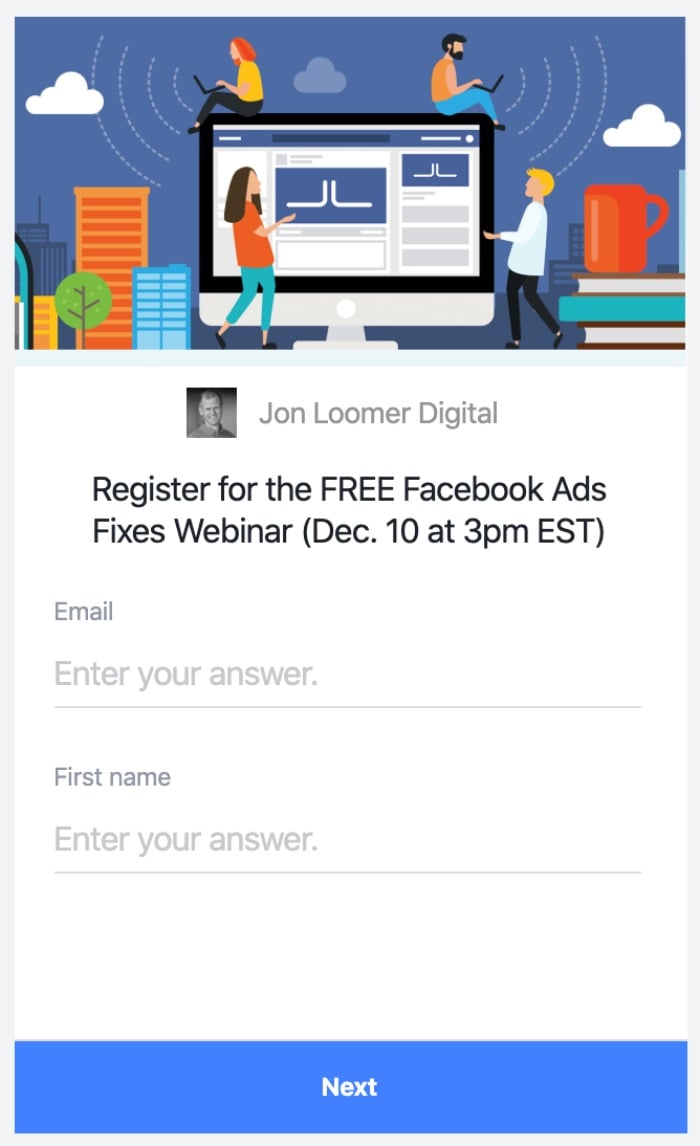
facebook-lead-ads-form-example

When creating the Facebook lead ad form, you get to decide what information you’d like to ask for. Aside from the pre-filled data, you can also select from a list of custom questions types such as:

  • multiple choice
  • short answer
  • store locator
  • conditional
  • appointment request

Benefits of Facebook Lead Ads

The most obvious benefit of Facebook lead ads is that they give prospects an easy way to provide their information—especially if you choose the pre-fill option—allowing you to collect leads in a more efficient and straightforward way.

As for marketer and small business owner benefits, you can customize questions for your forms, have a better chance at increasing conversions, and access a mix of new lead generation campaigns.

Some other significant benefits of Facebook lead ads are:

  1. targeted audience segmentation
  2. easy data collection
  3. mobile responsiveness
  4. a better understanding of your customers

As you can see, you’ve got plenty of reasons to explore these ads and get to know how they may work for you in your business.

Why Should Marketers and Small Businesses Use Facebook Lead Ads?

The reality is marketers and small business owners are busy and can’t be everywhere at once, even if you might want to be.

That means you need to focus your marketing efforts on maximizing success.

That’s why it makes sense to use tools like form-driven ads to capture leads efficiently and dynamically (without too much effort and time commitment on your part).

You can use Facebook lead ads in any number of ways, including:

  1. finding prospects for your products/services
  2. gathering subscriber details for newsletters
  3. gaining insights into consumers behaviors
  4. encouraging people to sign up for courses and events

Facebook Lead Ads Best Practices

There are plenty of ways to make the most of your Facebook lead ads. Let’s start with the basics.

A few best practices include:

  • ensure your ads are in line with your business goals
  • make sure your ad messaging is consistent with your brand
  • create a clear and effective call to action (CTA)
  • use CTAs that speak to your specific audience
  • keep the ads simple
  • spell out the benefits

Facebook has a heap of helpful suggestions too. These include:

  1. Decide on the right budget and use ad scheduling.
  2. Create lookalike audiences to help find your ideal customers.
  3. Reach previous prospects with the Engagement Custom Audience feature.
  4. Run ads on both Facebook and Instagram.
  5. Add an engaging image/video.

Just a quick note: it’s definitely worth reading up on Facebook-published articles for a wealth of tips on increasing conversions from Instant Forms.

Before moving on, here are a few more things to consider:

  • Find the right leads: By pairing Facebook lead ads with the platform’s audience selection and optimization tools, you can reach the right audience at the right time every time.
  • Ask the right questions: Only you know what information you’re looking for from your audience. Ask the most important questions up top to ensure that you get the information you’re angling for.
  • Integrate your CRM: Rather than losing your leads, you can integrate Facebook lead ads directly with your CRM, allowing your system to immediately reach out to interested parties.

Now you know what makes a great ad, let us look at some examples.

Examples of Great Facebook Lead Ads

Many brands in different niches are using Facebook lead ads to their advantage and, as you can see from the following examples, there’s a ton you can learn from them.

Let’s start with the Wealth Factory.

The Wealth Factory

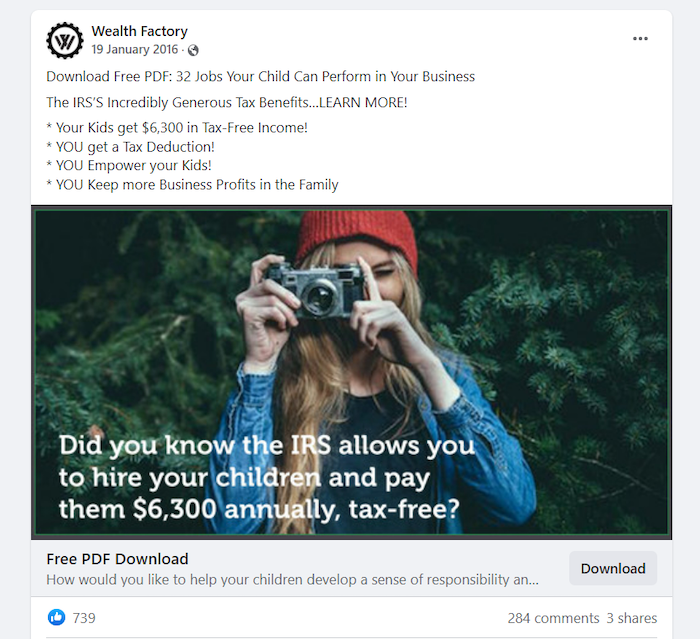
Let’s face it. If someone is going to click on a link, they want to know what’s in it for them. When the benefits are clear, and they can see what they gain from clicking through, they are more likely to take that extra step.
facebook-lead-ads-Wealth-Factory

That’s what The Wealth Factory does so well with its Facebook lead ads. The free PDF details the IRS’s tax benefits and lists 32 jobs that your child can do to help you in your business.

As you can see from the ad, the benefits include a sizable tax-free income for your child and a tax deduction for you as a business owner.

To find out more, Facebook users complete the super-short form and click send. It doesn’t get much easier than that.

This is an approach you can adapt for your campaigns.

Make the benefits clear and bullet point them, so people see at a glance what they’re set to gain, and you can encourage Facebook users to click through with a clear CTA.

Boux Avenue

Another proven technique guaranteed to inspire consumers to spring into action is offering a discount. After all, who doesn’t love a bargain?

facebook-lead-ads-Boux-Avenue

That’s what Boux Avenue does with its Facebook lead ads form. Like the Wealth Factory, it’s very clear about the benefits of signing up (a 20 percent discount and a regular newsletter).

To make the decision even easier, Boux Avenue makes signing up a snap with pre-filled information and a CTA button.

Offering a discount is something most businesses can do, and by simplifying form completion, you’re increasing the chances of prospects clicking. Bear that in mind with your ads, and add a time limitation to discounts to create urgency.

How to Set Up Facebook Lead Ads

Creating Facebook lead ads involves some basic preparation.

First, Facebook advises businesses to familiarize themselves with the terms of service and its advertising policies. If you want to list some questions on your form, Facebook suggests you ask your legal team to look them over first.

Then there’s just one more bit of prep: you need the link for your privacy policy as it will appear on the form.

With all that done, you’re ready to start creating your first ad. It’s simple to do. Just follow these steps:

Creating a Successful Facebook Lead Ad

  1. Log into your Facebook business account and click on “Publishing Tools.”
  2. Go to the “Forms Library” on the left-hand side of the page and click.
  3. Next, click “+Create”.
  4. Select “New Form” or “Duplicate” if you already have a form.
  5. Go to the “Create Form” window and fill out the “Form Name” box.
  6. Now, go to the “Form Type” field and select which form you’d like. There are two choices: Selecting “More Volume” lets you make accessible fillable forms suitable for mobile users. While setting “Higher Intent” allows users to review and confirm their details first.
  7. Next, go to the “Intro” section and create an introduction screen. Facebook has details on how to complete this stage. Here, you can add your images, headlines, and descriptions about your products/services.
  8. Go to “Questions” and choose + “Add Question.” Facebook lets you list up to 15.
  9. Next, move to the “Prefill Questions Section.” Fill out the description and explain how you intend to use or share the information people give you. Remember, you can’t use the info you gather for any other purpose other than the one you state.
  10. Select any pre-filled information you want for your form. Select categories by clicking “+ Add Category.”
  11. Go to “Privacy” and include your link text and the URL to the “Privacy Policy” box. You can also add a custom disclaimer by clicking “+Add Custom Disclaimer.”
  12. Move to “Completion.” Put in your headline, descriptions, CTA button, and add a link. You can include up to 60 characters for Headlines and CTAs.
  13. Click on the arrows on the top of “Form Preview.”
  14. Select “Publish” or “Save Draft” if you want to edit later. Ensure all your details are as you want them because you cannot edit your Instant Form once you’ve published it.
  15. Choose “Boost” to send out your form as an ad. Select your image/video, text, audience, length of publication, and budget.
  16. Click “Promote.”
  17. Congratulations! You’ve just created your first Facebook lead ad.

Frequently Asked Questions About Facebook Lead Ads

How much do Facebook lead ads cost?

Compared to other platforms, Facebook ads are not wildly expensive. On average, Facebook advertising costs $0.97 per click and $7.19 per 1000 impressions. These low numbers make advertising on Facebook extremely attractive to marketers across industries, with over seven million advertisers actively trying to engage consumers on the platform.

What are dynamic Facebook lead ads?

Dynamic Facebook lead ads are a cost-effective way to create and test ad variations and choose which one performs best. They allow advertisers to show different offers, images, and CTAs to each individual. Dynamic Facebook lead ads offer greater personalization and let you create locally relevant ads to enhance lead quality and increase sales.

What is the format of Facebook lead ads?

Ads come in-text links and carousels, and appear on different areas of the site, like feeds. Users see them labeled as “sponsored.”

Are there any tools for testing Facebook lead ads?

Marketo has a Facebook lead ads testing tool for checking functionality and Hevo Data has a similar tool. You can also measure parameters by adding them to your lead form.

Don’t forget to do some A/B testing as well to see which ads work best for your ideal audience.

Conclusion: Facebook Lead Ads

Facebook has a massive reach, which is why it makes sense for marketers and business owners to explore the available tools to get your products and services in front of a considerable audience. One of those tools is Facebook lead ads.

With the ability to create custom leads, Facebook lead ads provide significant advantages to advertisers.

Marketers can customize form fields, capture more prospect information, and target more relevant audiences while making the experience as simple as possible for users.

Aside from customization, Facebook lead ads offer many other advantages including increased conversions and getting a better understanding of your customers—making them an important part of any lead generation strategy.

Do you use Facebook lead ads? How are they working for you?

This marketing news is not the copyright of Scott.Services – please click here to see the original source of this article. Author: Neil Patel

For more SEO, PPC, internet marketing news please check out https://news.scott.services

Why not check out our SEO, PPC marketing services at https://www.scott.services

We’re also on:
https://www.facebook.com/scottdotservices/
https://twitter.com/scottdsmith
https://plus.google.com/112865305341039147737

The post Facebook Lead Ads: What They Are and How to Use Them appeared first on Scott.Services Online Marketing News.


source https://news.scott.services/facebook-lead-ads-what-they-are-and-how-to-use-them/

Google: No Difference In SEO Value Between Nofollow, UGC Or Sponsored Link Attributes

Google’s John Mueller confirmed what it has I believe said before, that there is not difference in terms of SEO value between the three link attributes. Google supports nofollow and also UGC and sponsored link attributes. In terms of the difference in SEO value, there is no such thing, they all do the same thing – which is not pass any link value from the source page.

This marketing news is not the copyright of Scott.Services – please click here to see the original source of this article. Author: barry@rustybrick.com (Barry Schwartz)

For more SEO, PPC, internet marketing news please check out https://news.scott.services

Why not check out our SEO, PPC marketing services at https://www.scott.services

We’re also on:
https://www.facebook.com/scottdotservices/
https://twitter.com/scottdsmith
https://plus.google.com/112865305341039147737

The post Google: No Difference In SEO Value Between Nofollow, UGC Or Sponsored Link Attributes appeared first on Scott.Services Online Marketing News.


source https://news.scott.services/google-no-difference-in-seo-value-between-nofollow-ugc-or-sponsored-link-attributes/

Google Office Old City Streets Like Hallway Theme

Google Office Old City Streets Like Hallway

This marketing news is not the copyright of Scott.Services – please click here to see the original source of this article. Author: barry@rustybrick.com (Barry Schwartz)

For more SEO, PPC, internet marketing news please check out https://news.scott.services

Why not check out our SEO, PPC marketing services at https://www.scott.services

We’re also on:
https://www.facebook.com/scottdotservices/
https://twitter.com/scottdsmith
https://plus.google.com/112865305341039147737

The post Google Office Old City Streets Like Hallway Theme appeared first on Scott.Services Online Marketing News.


source https://news.scott.services/google-office-old-city-streets-like-hallway-theme/

COVID-19 stories: Marketers are using this time build community

The massive disruption of COVID-19 is forcing many of us to rethink everything we do. Our community has been sharing their ideas on how to manage this overwhelming situation.

Here is another installment (read more here and here) of encouraging stories from marketers who have been adapting to our current reality.

Raise awareness about our customers’ biggest needs

The Challenge: As a talent acquisition suite, we help customers attract and hire the best talent and engage and retain their top employees. Our customers are either overwhelmed by huge, urgent hiring needs right now (like our healthcare and e-commerce customers) or they’re having to pivot and support their newly-remote internal teams and identify how they can be used for evolving business roles. Both need our help in ways they haven’t before.

The Solution: For our customers with urgent hiring needs, we started a blog we’re updating regularly listing job openings for our partner organizations and anyone who comes across the blog. For our customers who are pivoting to a remote workforce and new internal mobility efforts, we’re sending them digital e-cards to help with their remote journeys and information about nurturing and growing their current employees for new responsibilities and opportunities.

The Impact: While we were initially planning to update our “Companies Hiring” blog weekly, we’ve received so many requests from our current customers and readers of the blog that we’re updating it daily. We’re in the process of starting to send the e-cards, but our first emails prepping our customers for their gifts have yielded a lot of great engagement around starting an internal mobility strategy meant to serve the organization and recognize and reward great employees.

– Ashly Stewart is the Content Marketing Manager at Jobvite

Securing press coverage during COVID-19

The Challenge: Almost all of our clients come to us for digital PR in some capacity. When COVID-19 began to dominate the news cycle seemingly overnight, it became extremely challenging to secure coverage in any vertical. Many publishers were pulling reporters off of their typical beat (e.g. CBD) for an undetermined amount of time just to keep up with COVID-19 stories.

The Solution: We had to take a multi-faceted approach. For campaigns that were already produced, we really leaned into any COVID-related angle that made sense in order for the content to seem more timely to publishers. If campaigns were mid-production or still in a brainstorming phase, we altered the concept to include a concrete tie back to COVID (primarily in verticals like finance and health). Lastly, we expedited campaign production of brand new COVID-related ideas so that we could help our clients take advantage of the current news cycle.

The Impact: Using our last approach as an example, we were able to secure coverage on top-tier publications (e.g. Marketwatch) for a sleep-related COVID campaign. It’s also reaffirmed the publishers don’t necessarily need grand campaigns in order to cover them – it’s all about timeliness. Lastly, it’s been inspiring to see our team come together and completely pivot away from how they would normally produce and promote content in order to adapt to the changing news landscape. We’ve given them even more freedom with process and trust in owning their work end-to-end, and seen positive results.

– Ryan McGonagill is the VP of Services at Fractl

Trivia, happy hours and games – keeping company morale high

The Challenge: Due to COVID-19, our company is even more spread out than ever with 100% of our employees working from home. It’s hard enough to connect a cohesive team with offices across the country, this situation makes it even harder to stay connected.

We are also seeing companies step back and really taking a deeper look at marketing spend. With economic uncertainty, it’s difficult to justify ANY spend right now. However, it’s proven that brands that continue to advertise during recessions bounce back faster and have a quicker recovery than brands that halt advertising.

The Solution: To better connect our staff, each day we host Zoom breakfast, lunches and even happy hours! We figured the best time to bond with our team is over a meal — even if we aren’t in the same place! We use this time to talk about what everyone is going through and not focus on work. It helps us bond as a team and stay more connected. Our CEO likes to give us trivia quizzes or have some kind of interactive team building activity once a week during these virtual meetups.

We are also continuing with fun cross-company morale-boosting activities like digital trivia games and competitions —

Rather than forcing the offices into Pictionary each month, everyone is split into one of four Houses (think Hogwarts). CEO & Co-Founder, Jeremy Fain, acts as Cognitiv’s ‘Dumbledore’ deciding each month how the teams would compete and the points up for grabs. Every House had to come up with a name (Related to Neural Networks of course), their traits and design a crest. The “Houses” were established a couple of years ago but the company felt it was especially important to maintain this team building initiative even in a virtual setting.

The houses and traits are:

  • The Nodes of Ranvier – creative, rigorous and bold
  • The House of Rage Against the Machine Learning – Confidence, Teamwork, Aggressive
  • The House of Backpropagate That Azz Up – Explores & Exploiters, Bimodal Distributors, Deep Embedders
  • The House of Gaussbusters – Godly, Fearless, Humanitarian

We are also implementing several new resources to get clients up and running faster, such as webinars, learning opportunities and giving them hands-on resources.

The Impact: Our staff is in a great place — we all feel supported and connected even though we are spread out all over the country. We are even hiring people right now so that is helping keep us motivated as well! We just brought on 3 additional people in Seattle and are planning to add several more in our New York office.

Our clients have been appreciative of all of the “extras” we have implemented also.

Justine Frostad is the VP of marketing at Cognitiv

Keeping community through digital agility

The Challenge: The Benefitfocus One Place Conference is the culminating moment for our community. As customers, partners and associates, we come together to experience what being a part of Benefitfocus is all about – from our corporate values to our technology. The annual event does more than educate our audience on our solutions, it brings everyone together for deep conversations around industry dynamics and innovative solutions to create a better employee experience.

But, with the current situation, we soon understood that meeting in person in March wouldn’t be possible. For the well-being of our community, we had to figure out how to bring the spirit of the event into a virtual environment.

The Solution: We assembled a dedicated team to transform our in-person event into a digital one. In just eight business days, we worked fast and alongside ON24 to make the digital event possible.

Together, our agile team delivered an engaging and inspiring virtual conference. And, for the first time, all the content created during the event is available to our audience on-demand. We produced our key sessions in highly produced videos to ensure our message and delivery was in-line with the live event, only from the safety of our community’s home offices. This experience now acts as an all-year catalyst for ongoing awareness, lead and demand generation and content creation. And, all from the same event.

The Impact: By pivoting to a digital-first event strategy, our virtual conference saw a 200% growth in attendance and engagement from registration for the physical event. The ON24 platform continues to deliver a robust look at our customers’ digital body language and overall immersion in the event. It’s compelling and exciting to report metrics that go way deeper than just attendee numbers to our executives. We know a majority of attendees gave the experience a high rating. We also know, down to the minute, what content they consumed and which sessions had the most people raising their virtual hand to learn more.

While we missed gathering together in person, virtualizing our event has proven that digital elements and strategies improve the audiences’ experience. We are challenging ourselves to continue to design integrated event strategies to keep our marketing and community going strong, now and in the future.

– Hunter Smythe is the director of events marketing at Benefitfocus

Be available on the weekends

The Challenge: The COVID-19 situation is causing a disruption in all of our schedules right now. Clients are overwhelmed and don’t know who to turn to.

The Solution: Clients need to feel like they can count on you. They may have urgent questions come up on the weekends that need answering. By allocating an hour or so on Saturdays and Sundays to client work you are showing your clients you are there for them when they need you the most.

The Impact: Incredible trust-building opportunity.

– Gabriela Covay is the owner and CEO of Bright Valley Marketing

Share your own story

Share your creative thinking around how you’re pivoting and managing your work right now. It can be client-facing or something you’ve tried with your staff. We’ll round up some of the best and share them. Submit here >>


About The Author

Wendy Almeida is Third Door Media’s Community Editor, working with contributors for Search Engine Land, Marketing Land and MarTech Today. She has held content management roles in a range of organizations from daily newspapers and magazines to global nonprofits.

This marketing news is not the copyright of Scott.Services – please click here to see the original source of this article. Author:

For more SEO, PPC, internet marketing news please check out https://news.scott.services

Why not check out our SEO, PPC marketing services at https://www.scott.services

We’re also on:
https://www.facebook.com/scottdotservices/
https://twitter.com/scottdsmith
https://plus.google.com/112865305341039147737

The post COVID-19 stories: Marketers are using this time build community appeared first on Scott.Services Online Marketing News.


source https://news.scott.services/covid-19-stories-marketers-are-using-this-time-build-community/

Wrapping up 2021 with our top 10!

Wrapping up 2021 with our top 10!

30-second summary:

  • 12 months, several curveballs, and some masterstrokes
  • If you missed out, today is a great day to look through the Search Engine Watch lens for the year gone by
  • Key themes that were front of mind in 2021 – Google’s updates, cookie death counter-strategies, mastering customer experience elements, trust-building, and alternatives for search marketing and ranking

As the world, people, and of course businesses motored through a year of uncertainties – these crackers of articles gave your strategies an unfair advantage.

#1 – Google Page Experience update is all set to launch in May 2021 – Webmasters, hang in there!

You asked, “What is Page Experience, anyway? Do we really need to have an overflowing to-do list?” – and we answered everything around this enigma. This piece touched upon every aspect, angle, and action point that SEOs needed to know.

#2 – The search dilemma: looking beyond Google’s third-party cookie death

The ad tech and search industry continued to remain precarious that Google will use the cookie deprecation as a new way to establish market dominance to feed its own interests. Google expert, Susan Dolan drew from her rich experience and detailed realities of the search scape. She also shared insights and predicted future key themes that rose out of the 3p cookie death.

#3 – Everything you need to know about the Google MUM update

As the industry bid farewell to BERT, Google’s Multitask Unified Model (MUM) update in June 2021 opened new search experience dimensions. The cranked-up competition for search visibility between businesses and advertisers – left SEO practitioners and agencies with yet another burning question, “How will we win MUM’s good graces?” Joe Dawson’s comprehensive guide left no stone unturned.

#4 – Why killing your content marketing makes the most sense

“Kill your darlings”, yes, we said it! Though it sounded outlandish, this piece held wise and valuable advice from best-selling author Joe Pulizzi on why this could be one of the best business decisions you could’ve made in 2021.

#5 – Quora and Reddit: Powerhouses for SEO and marketing in 2021

Everyone is obsessed with Google, but did you know Reddit is the seventh most popular website in the US while Quora has a DR of 91? This guide shone a light on how your search strategy could take advantage of these platforms with diversification, tap into great brand-building opportunities, and enhance your E-A-T standing.

#6 – Now is the best time to stitch your search marketing loopholes before 2022

The third-party cookie still stands at a crucial intersection between digital marketing, SEO, paid media, web design, and several business tangents. The industry needed to think hard and think differently for a contingency plan. SEO pioneer, serial entrepreneur, and best-selling author, Kris Jones helped weave a tight SEO and search marketing strategy way ahead of 2022. Why? Because a stitch in time saves nine.

#7 – Seven first-party data capturing opportunities your business is missing out on

The internet continued zigging in a privacy-focused direction as a response to consumers’ increasing demand for a transparent, responsible, and ethical outlook towards their data. First-party data became indispensable and consumer trust, invaluable. While the playing field inched closer to the great reset, we revealed some hidden first-party gems every business could use to redesign their search marketing strategies.

#8 – UX: an important SEO ranking factor

The story of SEO and UX began almost 20 years ago with both making a foray into the market in the 1990s. Since then, SEO practitioners saw seasons change and the Page Experience, paired with data analysis finally etched UX as a key ranking factor. Atul Jindal condensed years of his experience working with fortune 50 companies into this SEO guide to help you win at SEO and search experience.

#9 – Cross-channel marketing: why you shouldn’t put all your eggs in the Google basket

The pandemic didn’t let us forget that while every business is unique, budgets too took a hit, making allocation stringent. But why did so many businesses still stick to the “big guns” when allocating spending? Adzooma CEO Rob Wass and Cambridge University’s Akanshaa Khare joined forces to challenge this notion. They produced some truly unique insights that would make stakeholders rethink their media spending habits.

#10 – Core Web Vitals report: 28 Ways to supercharge your site

Everyone remembers the chaos surrounding the Core Web Vitals in early 2021. SEO folks were keen to get ahead on optimizing their site and Twitter threads were full of speculation. Armed with information, we shared a 28-point checklist on action items to spot, optimize, and embrace the inevitable rollout of these new ranking factors.

Thank you for being valuable supporters throughout our journey. Team Search Engine Watch wishes everyone a happy year-end and an adventurous 2022!

*Ranked on page views, time on page, and bounce rate.


Subscribe to the Search Engine Watch newsletter for insights on SEO, the search landscape, search marketing, digital marketing, leadership, podcasts, and more.

Join the conversation with us on LinkedIn and Twitter.

The post Wrapping up 2021 with our top 10! appeared first on Search Engine Watch.

This marketing news is not the copyright of Scott.Services – please click here to see the original source of this article. Author: Kamaljeet Kalsi

For more SEO, PPC, internet marketing news please check out https://news.scott.services

Why not check out our SEO, PPC marketing services at https://www.scott.services

We’re also on:
https://www.facebook.com/scottdotservices/
https://twitter.com/scottdsmith
https://plus.google.com/112865305341039147737

The post Wrapping up 2021 with our top 10! appeared first on Scott.Services Online Marketing News.


source https://news.scott.services/wrapping-up-2021-with-our-top-10/

Piling on: State AGs intend to launch their own antitrust investigation against tech biggies

A coalition of about 12 state attorneys general is getting ready to launch an antitrust investigation of U.S. tech giants, the Wall Street Journal reported Monday. The specific companies were not identified in the report, but they are likely Google, Facebook, Amazon and possibly Apple. 

This would be a separate inquiry from the current federal and Congressional investigations going on. According to the report the focus will be whether “a handful of dominant tech platforms use their marketplace powers to stifle competition.”

Bi-partisan state effort. The group is reportedly bi-partisan and probably includes Texas, North Carolina and Mississippi, among others. A formal announcement is expected next month. It’s not clear whether the federal and state investigations, assuming the latter goes forward, would be coordinated in any way or independent. 

Previously the Department of Justice (DOJ) and Federal Trade Commission (FTC) reached agreement on antitrust investigations of the four companies, with the DOJ pursuing Google and Apple and the FTC taking jurisdiction over Amazon and Facebook. 

Breakup on the table. And last week, FTC Chairman Joe Simon said that the government would consider breaking up companies “to restore competition,” although that was not the FTC’s immediate or preferred approach. Specifically, the government might “unwind acquisitions” made by one or more of the companies.

Facebook is seeking to more closely integrate its flagship app, Instagram and WhatsApp. One explanation is to create a unified platform for marketers. However, some critics see an attempt to pre-empt any potential breakup of the company. Indeed, the FTC acknowledged that operationally merged companies are much harder to break up. 

Outcomes unpredictable. The outcome of these various active and emerging investigations is not at all clear. It could and will likely be years before any resolution. And any decision by the government to break up one or more of the companies — the potential remedies could be very different by company — would be litigated in court. 

In 1999, Microsoft was formally determined to be an abusive monopoly by Judge Thomas Penfield Jackson. Jackson also recommended the company be split in two: one company for Windows OS and the other for everything else.

The split never happened, in part because Jackson’s remedy was rejected on appeal and partly because the incoming Bush administration had a very different perspective on competition and the market. In 2001 Microsoft settled with the DOJ, leaving the company intact.

As with Microsoft the 2020 election could also have an impact on any active antitrust investigations, though that’s now harder to predict than in 2000. All of the targeted companies have issued statements arguing they face a strongly competitive market and that they contribute to the economy. 

A taxing situation. On another front, U.S. tech companies now face a 3% tax on revenues generated in France. This applies to companies making more than 25 million euros in France and more than 750 million globally. This would include all the major technology companies. The tax was approved in July. Beyond the immediate concern over the tax itself, it’s possible that more countries could follow France’s lead, seeing U.S. technology firms as a source of new revenues.

Why we should care. Even though a resolution is probably years away, these investigations could result in structural changes to the U.S. digital market. Alternatively, nothing much might change. That was the case with the original FTC antitrust investigation of Google, which closed after Google agreed to modest changes to some of its practices.

The antitrust framework that U.S. regulators have used to determine whether to approve acquisitions or mergers is an evaluation of potential “consumer harm.” In that context, most of the big tech companies have convincingly argued that they are delivering convenience or lower cost to consumers.

The Europeans have been less persuaded by these arguments. And there are some indications that U.S. antitrust law and theory may be in flux. 


About The Author

Greg Sterling is a Contributing Editor at Search Engine Land. He writes a personal blog, Screenwerk, about connecting the dots between digital media and real-world consumer behavior. He is also VP of Strategy and Insights for the Local Search Association. Follow him on Twitter or find him at Google+.

This marketing news is not the copyright of Scott.Services – please click here to see the original source of this article. Author:

For more SEO, PPC, internet marketing news please check out https://news.scott.services

Why not check out our SEO, PPC marketing services at https://www.scott.services

We’re also on:
https://www.facebook.com/scottdotservices/
https://twitter.com/scottdsmith
https://plus.google.com/112865305341039147737

The post Piling on: State AGs intend to launch their own antitrust investigation against tech biggies appeared first on Scott.Services Online Marketing News.


source https://news.scott.services/piling-on-state-ags-intend-to-launch-their-own-antitrust-investigation-against-tech-biggies/

Wednesday, 29 December 2021

Technical SEO: The Definitive Guide

This is a complete guide to technical SEO.

In this all-new guide you’ll learn all about:

  • Crawling and indexing
  • XML sitemaps
  • Duplicate content
  • Structured data
  • Hreflang
  • Lots more

So if you want to make sure that your technical SEO is up to speed, you should get a lot of value from today’s guide.

Technical SEO: The Definitive Guide

Chapter 1:Technical SEO Fundamentals

Technical SEO Fundamentals

Let’s kick things off with a chapter on the basics.

Specifically, in this chapter I’m going to cover why technical SEO is still SUPER important in 2020.

I’ll also show you what is (and isn’t) considered “technical SEO”.

Let’s dive in.

Chapter 2:Site Structure and Navigation

Site Structure and Navigation

In my opinion, your site’s structure is “step #1” of any technical SEO campaign.

(Yes, even coming before crawling and indexing)

Why?

First off, many crawling and indexing issues happen because of poorly-designed site structure. So if you get this step right you don’t need to worry as much about Google indexing all of your site’s pages.

Second, your site structure influences everything else you do to optimize your site… from URLs to your sitemap to using robots.txt to block search engines from certain pages.

The bottom line here is this: a strong structure makes every other technical SEO task MUCH easier.

With that, let’s get into the steps.

Chapter 3:Crawling, Rendering and Indexing

Crawling, rendering and indexing

This chapter is all about making it SUPER easy for search engines to find and index your entire site.

In this chapter I’ll show you how to find and fix crawl errors… and how to send search engine spiders to deep pages on your website.

Chapter 4:Thin and Duplicate Content

Thin and Duplicate Content

If you write unique, original content for every page on your site then you probably don’t need to worry about duplicate content.

That said:

Duplicate content can technically crop up on any site… especially if your CMS created multiple versions of the same page on different URLs.

And it’s the same story with thin content: it’s not an issue for most websites. But it can hurt your overall site’s rankings. So it’s worth finding and fixing.

And in this chapter I’m going to show you how to proactively fix duplicate and thin content issues on your site.

Bonus Chapter:Technical SEO Case Studies

Technical SEO Case Studies

Let’s cap off this guide with a set of brand new technical SEO case studies.

Specifically, you’ll see how four Backlinko readers increased their Google rankings with:

  • Date Schema
  • Internal linking
  • FAQ Schema
  • Website migration best practices

So without further ado, let’s get right into the case studies.

This marketing news is not the copyright of Scott.Services – please click here to see the original source of this article. Author: Brian Dean

For more SEO, PPC, internet marketing news please check out https://news.scott.services

Why not check out our SEO, PPC marketing services at https://www.scott.services

We’re also on:
https://www.facebook.com/scottdotservices/
https://twitter.com/scottdsmith
https://plus.google.com/112865305341039147737

The post Technical SEO: The Definitive Guide appeared first on Scott.Services Online Marketing News.


source https://news.scott.services/technical-seo-the-definitive-guide/