Top-ranking SEO performance requires attention to many metrics, including traffic, backlinks, and social shares — to name just a few. Our guide gives you insights into some of the most relevant and timely search engine optimization trends to anticipate for 2021, allowing you to prepare your SEO strategy accordingly.
Disclosure: This content is reader-supported, which means if you click on some of our links that we may earn a commission.
Collaboration software has become a must-have tool for businesses today.
With teams scattered across different locations working remotely, these tools ensure that everyone can communicate and collaborate effectively. From simple check-ins and real-time status updates to ongoing project management, collaboration software can accommodate businesses of all shapes and sizes.
Your organization can even use collaboration software to improve the way you work with clients, contractors, and stakeholders in your business.
By leveraging collaboration tools, everyone will benefit from improved workflows and have greater access to crucial information.
But in order to take advantage of these benefits, your first task will be finding the right collaboration software for your business—and there are a ton of options out there.
To make your decision easier, use the buying guide and recommendations that I’ve reviewed in this post.
How to Choose the Best Collaboration Software For You
As previously mentioned, there are lots of different collaboration tools available on the market today. With dozens, if not hundreds of options to choose from, narrowing down the best option for your business can feel like a tall task.
To ease the buying process, I’ve identified the top factors that must be considered as you’re evaluating different options. I’ll quickly explain each one in greater detail below.
Software Type
Collaboration software comes in all different shapes and sizes.
You’ll come across solutions built for project management, while others are made specifically for instant messaging or video conferencing. There are even some all-in-one solutions on the market today.
The best option for you will depend on the needs of your business. Some of you might just need an internal messaging tool, as opposed to a platform for document storage or task management. We’ll discuss the different types of collaboration software in greater detail a bit later in this guide.
Business Size
How large is your company?
In addition to the number of people on your team, the amount of teams, departments, and other segments should also be taken into consideration.
For example, you might want to have a tool that every single person within your organization can use to contact another employee. But files being shared by the accounting team or human resources department shouldn’t be available for your marketing team to access. Your sales staff shouldn’t be able to access sensitive financial records.
So make sure the software you’re considering allows you to create different groups for each department or project. You’ll also want to look for features to manage permissions and access for each individual user.
Usability
Collaboration software should be making your life easier, not more difficult.
There are some tools out there that are undoubtedly more complex than others. Depending on your needs and the technical skill level of the end-users, that’s fine. Any time you’re using new software, there will always be a learning curve. So you’ll need to keep that in mind.
However, after the first couple of weeks or months using the software, your entire team should be fairly proficient. If not, it could add complexity to your processes, as opposed to boosting performance and productivity.
I strongly recommended that you take advantage of demos and free trials. This will truly give you a better understanding of which options are the easiest to use.
Organizational Tools
This piggybacks off of our last point. The best collaboration software will make it easy for you to stay organized.
Depending on the software in question, there might be task cards, folders, groups, or other ways to keep everything in order. How can you jump from one project to another? Will users easily be able to find a file or document that was shared by a coworker? Can supervisors and project managers keep track of everything at a higher level?
At scale, the way everything gets organized within your collaboration software is amplified. If you’re just running a small team with five users working on a single project, this may not be important. But when that number jumps into the hundreds or thousands, staying organized becomes critical.
Integrations
Your collaboration software should seamlessly integrate with other tools and software that your company is using.
From CMS to CRMs, email software, cloud storage services, and more, make sure you check out those integrations before you finalize your decision. It’s easier to use collaboration software if everything can be managed and accessed from a single platform. Otherwise, users will have to bounce back and forth between different tools, which isn’t ideal from an efficiency standpoint.
The Different Types of Collaboration Software
Before we jump into the reviews and recommendations, I want to clearly identify and explain the different types of collaboration tools on the market today. Here are some of the options that you’ll come across as you’re browsing around:
Project Management Software
As the name implies, project management software is designed for teams that are working on different projects. A project can be defined as something with a clearly defined start and end date.
This could be anything from a full-scale app development project to a smaller marketing campaign.
Project management tools allow your teams to work on projects collaboratively while sometimes automating tasks. If this is what you’re looking for, make sure you find a solution that fits your project management style (lean management, agile management, Kanban boards, Gantt charts, etc.).
Lots of project management tools are branded as an all-in-one team collaboration solution.
File Sharing and Document Storage
Some solutions are made specifically for sharing files and documents.
With these tools, team members can transfer, distribute, and customize access to shared files. A file could be anything from an image to a PDF or even larger files like software, videos, or ebooks.
It’s much easier and more secure to manage files and collaborate with a cloud tool as opposed to transferring files via email.
Instant Messaging
Messaging tools are ideal for teams that want to benefit from real-time communication. If you need a quick answer or want to communicate back and forth with a coworker, an instant message is definitely more efficient than an email.
These are also great for group chats where multiple members can communicate in real-time with each other. Again, it’s a better alternative to traditional email.
Some collaboration tools will have built-in instant messaging features, while others specialize in instant messaging specifically. Not every collaboration software includes team messaging.
Conference Calling Software
Conference calling software takes real-time communication to the next level.
Aside from instant messaging (or in addition to instant messaging), these tools allow teams to collaborate using voice and video chat. You can even benefit from extra features like screen sharing, presentation mode, etc.
Businesses use conferencing calling software for both internal collaboration, as well as collaboration with clients, contractors, stakeholders, and more.
Coordination Tools
Generally speaking, coordination tools are a component of collaboration software.
I’m referring to features like time tracking, scheduling, calendars, status updates, etc. For example, a collaborative calendar can help you understand everyone’s availability in real-time without having to disturb them. It improves efficiency when scheduling meetings or similar tasks.
Most collaboration software will have features for real-time status updates as well. So when someone completes a task, they won’t have to notify everyone about their progress. That information will be available within a general feed.
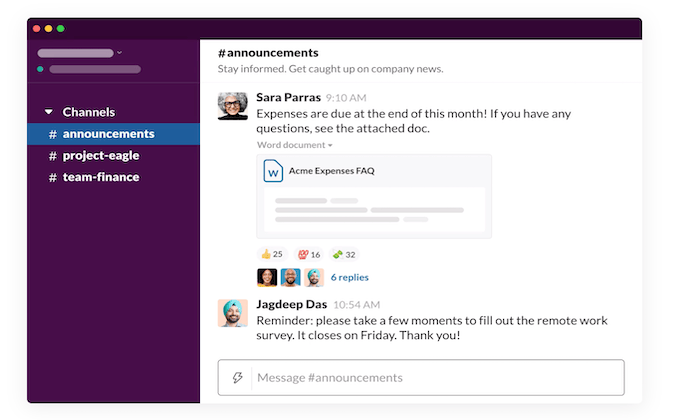
#1 – Slack Review — The Best For Team Messaging
Slack is a name that many of you might already be familiar with. It’s quickly become the go-to platform for internal business messaging over the past few years.
Whether you’re working remotely or in a traditional office environment, Slack will be a great option to consider.
More than 750,000 businesses trust Slack for team collaboration. Here’s a quick overview of some of its noteworthy features and highlights:
Stay organized using Slack channels for projects, teams, or topics
File sharing capabilities
Audio and video calls with screen sharing
2,200+ Slack apps for integrations (Zoom, Jira, Salesforce, Google Drive, etc.)
Create your own time-saving workflows
Use Slack API to integrate your internal tools
Enterprise-grade scalability and security
Collaborate with partners like clients, contractors, vendors, etc. by adding them to channels
Plans start at just $6.67 per user per month. All plans come with unlimited messaging. Regardless of your team size or industry, Slack is the best collaboration tool for team messaging.
#2 – Trello Review — The Best For Simple Task Management
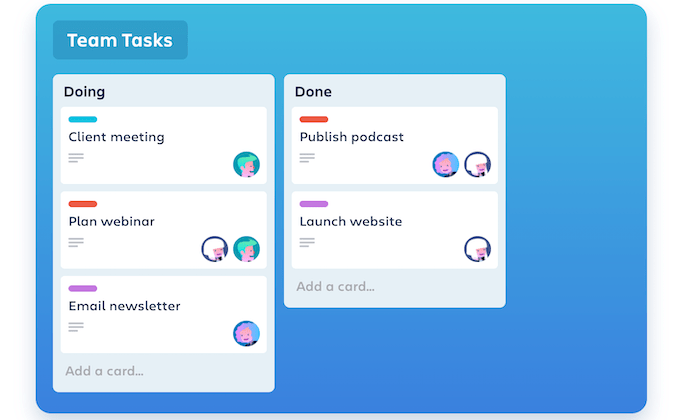
Trello is a simple solution for task management. For ongoing work and projects alike, it’s one of the best ways for your entire team to collaborate and stay organized.
With the help of Trello’s boards, cards, and lists, businesses across any industry can use this platform to improve productivity.
Here’s a quick explanation of what you can accomplish with Trello’s collaboration software:
Add comments, attachments, and due dates to cards
Create boards to separate projects and teams
Built-in workflow automation (rule-based triggers, due dates, etc.)
Add lists to create a unique workflow for each project
Integrate with third-party apps that you’re already using
Collaborate from anywhere using the Trello mobile app (iOS and Android)
Notifications and team tagging
Easy to assign tasks or cards to one or more users
Trello is powered by Atlassian, a global leader in the software and project management space. So you know that it’s a solution you can count on. That’s why more than one million teams across the globe rely on Trello.
This collaboration software is free for up to 10 boards with unlimited cards and lists. Paid plans start at $9.99 per user per month.
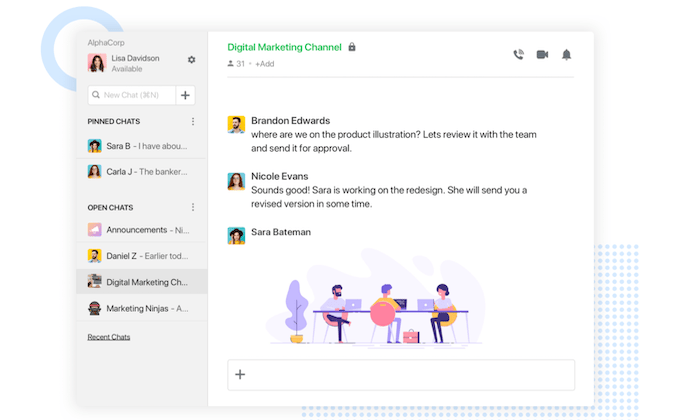
#3 – Flock Review — The Best For Remote Work
Flock is another collaboration tool with a primary focus on messaging. But it’s a little bit more advanced than Slack in terms of the features and capabilities.
The software is great for teams that work collaboratively from remote locations.
With Flock, you can keep all of your messages, apps, and productivity tools organized from the same place. Here are some of its features that are worth highlighting:
For small teams, Flock is free with 10 channels included. You’ll also get unlimited 1:1 and group messages. Paid plans start at just $4.50 per user per month, which is a great value.
Try Flock for free with a 30-day trial.
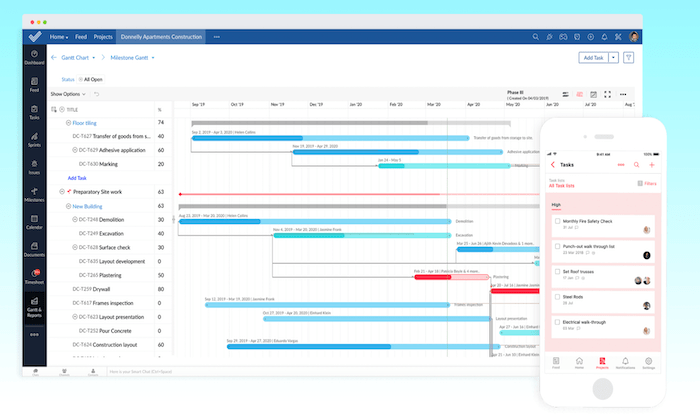
#4 – Zoho Projects — Best Feature-Rich Collaboration Software
Zoho Projects is one of the most popular and easy-to-use collaboration tools on the market today. The software makes it easy for teams to collaborate, plan, and track work more efficiently.
As a cloud-based solution, you can use Zoho Projects to collaborate and manage tasks from anywhere.
Compared to other tools out there, Zoho Projects is loaded with robust features. Here’s a quick overview of some of my favorites:
Task management with Kanban boards
Set dependencies between tasks based on the order they are completed
Map your entire workflow
Gantt charts
Task reports
Time tracking tools
Issue tracking
SLA management
Automations
Zoho Projects even has industry-specific solutions for categories like software development, real estate, construction, marketing, education, and more.
Plans start at just $3 per user per month (with a minimum of six users). You can try it for free with a 10-day trial.
#5 – Wrike Review — Best All-in-One Project Management Tool
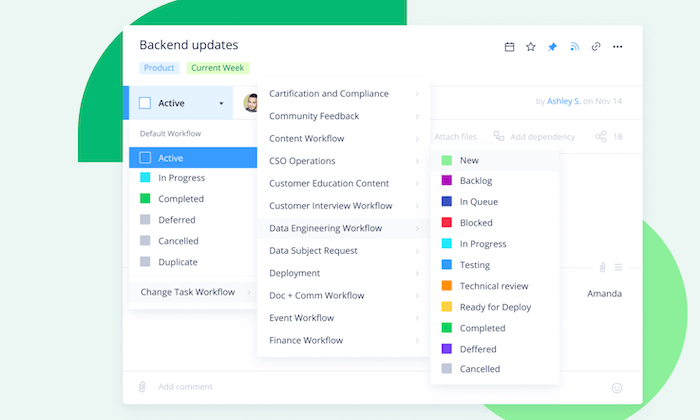
Wrike is a powerful and versatile project management solution. The software makes it easy to give your team complete control and visibility over projects and tasks.
If you’re looking for collaboration software with a primary emphasis on project management, this will be a top choice for you to consider.
Wrike is trusted by 20,000+ companies across the globe, including some big names like Dell, Google, Airbnb, and Siemens. Let’s take a closer look at some of its features and benefits:
Agile project management
Custom dashboards and workflows
Process automation
Real-time comments and editing
Notifications
Live editing and dynamic reports
Easy to share information with stakeholders
End-to-end visibility and real-time updates
Enterprise-grade security
File sharing and attachments
Wrike is a popular choice for marketing teams, creative professionals, and product development teams. However, it’s versatile enough to accommodate the needs of really any business type.
The software is free for up to five users. But you’ll need to upgrade to a paid plan to take full advantage of the project planning and collaboration features. These start at $9.80 per user per month. Try it free for 14 days.
#6 – BlueJeans Review — Best For Audio and Video Conferencing
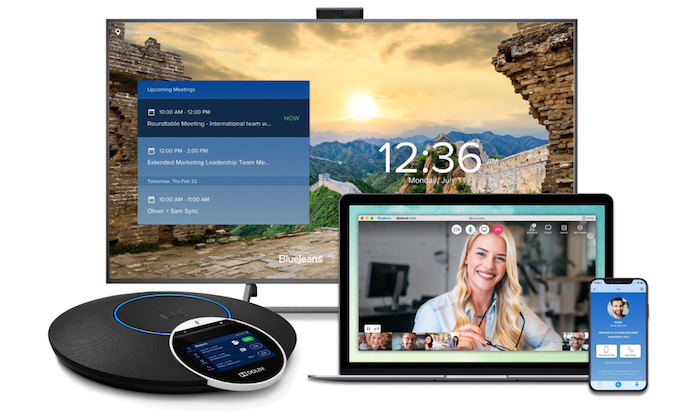
For those of you who need collaboration software for conference calling, look no further than BlueJeans. It’s a simple and safe way to empower your remote staff with audio and video conferences.
Brands like Zillow, Facebook, ADP, Intuit, and National Geographic all trust BlueJeans for team collaboration.
Let’s take a closer look at what makes BlueJeans so great for collaboration:
Collaborate with video, audio, and web conferencing from any device
Live meeting controls and automated alerts
Meeting highlights and transcriptions
Enterprise-grade security
Single-touch interoperability
Exceptional call quality with HD video and Dolby Voice audio
Dynamic content sharing
App network of software integrations (Microsoft Teams, Slack, etc.)
Support 24/7/365
Unlimited 1:1 meetings
Unlimited group meetings
Plans start at just $9.99 per host per month. If you’re not quite sold just yet, you can have unlimited access to BlueJeans and all of its features for free with a 7-day trial.
Summary
Collaboration software makes it easy for your entire business to stay organized and connect with each other in real-time.
To find the best software for your business, start by reviewing the buying guide I highlighted at the begging of this article. Then go through the recommended options above to narrow down the best tool for you.
Facebook is alerting Page owners that it is removing a number of fields from Page info starting August 1, 2019.
The fields to be removed include Company Overview, Biography, Affiliation, Personal Interests and maybe more, according to a tweet from Matt Navarra (who spotted the changes via Facebook Marketing expert Mari Smith).
Facebook is notifying Page owners that some fields will no longer be available in the Page info section.
Why we should care
Anyone managing a Facebook Page will need to revisit information listed in the fields scheduled to be removed, and add the information they want to remain visible to the Page’s description.
The fields being removed are listed under a Page’s “About” section and, most likely, will not impact a Page’s performance. Page owners can access the fields from “Page info” under Settings. SMBs and public figures whose primary online existence are their Facebook Pages may have important information in those fields. Editing the Page description to include the soon-to-be deleted information will make sure those details remain intact.
More on the news
We’ve asked Facebook for a full listing of the fields being removed from Pages, but have yet to receive a response. We’ll be sure to update this story as soon as we know more.
One Page owner responded to Matt Navarra’s tweet showing that the “Mission” field for Pages is also scheduled to be deleted.
Amy Gesenhues is a senior editor for Third Door Media, covering the latest news and updates for Marketing Land, Search Engine Land and MarTech Today. From 2009 to 2012, she was an award-winning syndicated columnist for a number of daily newspapers from New York to Texas. With more than ten years of marketing management experience, she has contributed to a variety of traditional and online publications, including MarketingProfs, SoftwareCEO, and Sales and Marketing Management Magazine. Read more of Amy’s articles.
Recent data from Roku shows that85%of Americans are now streamers. Making them feel excited about some new CTV app is not a piece of cake but also not totally unfeasible.
In the dark, dark woods of AdTech, Connected TV (CTV) apps are a dime a dozen. This may sound spooky enough for a proper Halloween horror story.
The market is currently dealing with many potentially brilliant content creators having cold feet when thinking of launching their own CTV channels.
Alex Zakrevsky, CEO ofAllroll, helps you overcome these fears.
In the dark, dark woods of AdTech, Connected TV (CTV) apps are a dime a dozen. This may sound spooky enough for a proper Halloween horror story. In reality, the impressive growth of the CTV market strengthened the competition and endowed it with many “survival of the fittest” features. As a result, the fact that the number of connected TV devices in the US reached400 millionthis year, as per Leichtman Research Group, is not that appealing and comforting for channel owners anymore. The market is currently dealing with many potentially brilliant content creators having cold feet when thinking of launching their own CTV channels. To overcome these fears, it’s important to embrace them first.
1. Failing to start
There is a belief that developing a channel from scratch requires either proficient coding skills or paying a fortune to those who have such skills. So, instead of starting, let’s say a Roku channel, content producers tend to be terrified of the prospect of coding or not being able to make ends meet. To lower the level of anxiety, it’s always useful to look at available options.
If watching someone building a channel for you is the most preferable model, specialized agencies are the best choice to make. These companies usually have their own in-house developing teams and charge a set price or a revenue share, which gives room for maneuver. Alternatively, there are freelance developers whose price tag normally starts from $25/hour on Upwork.
The downside of both solutions is that they will depend on developers’ availability and may eventually turn out to be slow-moving and quite pricey. Yet, they will definitely help have less on one’s plate. At the same time, there are ways of developing a CTV app without going bankrupt or going full-on with programming languages.
In addition to custom channel development, some CTV platforms, such as Roku or Amazon Fire, offer their no-coding solutions for channel owners. Roku, for example, has its on-the-house model called Direct Publisher. Yes, this tool limits customization, monetization, and third party analytics options, but it does save time, money, and, more importantly, keeps channel owners with no coding experience sane. As a compromise between basic and advanced features, there’s a moderately-priced service for developing Roku channels that is cloud-based and code-free. Instant TV Channel costs $45.95/month. It creates and maintains a video feed as well as offers a range of customization opportunities. Consequently, if coding isn’t a channel owner’s strong suit, it’s needless to pay millions or spend months trying to make sense of programming. What’s crucial is the idea that drives a publisher and the content that will drive potential viewers.
2. Being mediocre
As CTV ad spend is surging and has already increased by19%this year, based on IAB’s figures, more and more publishers are getting on board each day. This makes creating original content pretty challenging. Ultimately, channel owners are surrounded, on the one side, by fears of meeting their channel-doppelganger and, on the other side, being ‘eaten alive’ by channels-giants, like Netflix, Animal Planet, and others. Sounds quite dramatic, doesn’t it? If someone is still wondering whether there’s any space left for new apps in the CTV universe, it’s worth checking on how many people delightfully watch channels, which others would not even think of, in the screensavers or special interest sections on the Roku platform.
As for the chances of becoming a copycat of your own concept, great minds do think alike but most of the time not so literally. Therefore, becoming a successful channel owner calls for out-of-the-box thinking, doing some research, and being generally both strategic and brave.
3. Having zero installs
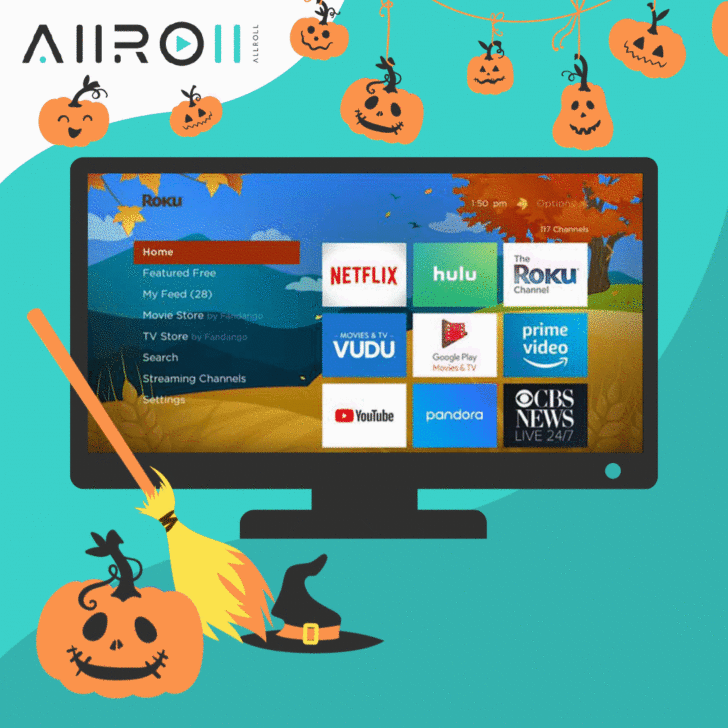
Recent data from Roku shows that85%of Americans are now streamers. Making them feel excited about some new CTV app is not a piece of cake but also not totally unfeasible. So, if there is a genuine fear that no one will ever install a new Roku channel, here are severalpromotional techniquesfor not letting this happen.
First of all, it’s essential to make as many people as possible aware of a new channel via a website, emails, and social media. This is absolutely free, a bit time-consuming but worthwhile. Secondly, it’s important to attend online/offline events and accept all networking opportunities where a channel owner can meet potential viewers and introduce a channel to them. Then, it’s good to think of collaborating with like-minded channels so as to make friends with indirect competitors and promote each others’ content.
Additionally, it would be beneficial to be included in one of those guides with top new channels one should install. For this purpose and in general, getting feedback on the content from influencers can be really game-changing. Finally, in case there’s a request to level up the current promotional approach, it’s time to consider monetization.
Roku has its self-serve platform for growing publishers’ audiences using the tailored display and video ads. While its CPM rates can range significantly with no guaranteed number of installs, the platform is quite flexible in terms of budgets and can meet various needs and wants. What’s more, there’s theAllrollmarketing platform aimed to drive viewers to Roku channels by the means of advanced targeting options and personalized advertising messages. It provides higher apps’ exposure and, ultimately, + 60% installs with the same budgets as those required for the native platform. So, there’s definitely a lot one can do to enhance the channel’s results without getting overwhelmed.
4. Surrendering to YouTube
When talking about video channels, there is always an elephant in the room. This elephant’s name is of course YouTube. Some publishers are still skeptical about CTV platforms, thinking their videos will never perform there as well as they do on good old YouTube. They might as well imagine having to stick to one platform to have windfall gains. In fact, there’s much more to this than meets the eye.
No matter how successful, YouTube is just a service. At least for a content owner and not an employee of YouTube. Thus, there is no need to choose between different stages on which to play the content. On the contrary, it is better to use as many platforms as one can manage to reach out to as many viewers as possible. This is the smart way of promoting video content, raising brand awareness, and maximizing profit in the soaring digital space.
5. Getting lost in streaming obscurity
It’s not particularly a secret that the world of streaming is currently run by four major operating systems: Roku, Amazon Fire, Android TV/Google TV, or Apple TV. The first two have the biggest share of100.2 million(Roku) and72.7 million(Amazon Fire) users, according to eMarketer. The rest of the players are of somewhat a lower caliber. Picking one platform for an app may seem like a tough job, bearing in mind their characteristics resemble each other in so many ways. For instance, Roku uses Audience Network with broad geolocation options for targeting and a revenue share model for monetization within its Direct Publisher mode. In the meantime, Amazon Fire’s code-free Amazon Creator offers extensive data on consumers’ preferences collected from Amazon devices and a commission-based monetization. This may rightly seem quite confusing.
The reasonable tactic for not getting puzzled by the best bets is to follow the audience. People mainly prefer streaming platforms that relate to an operating system they are plugged into in their everyday lives. So, if they have an Amazon Prime account that they actively use or they are fond of Alexa, these consumers are likely to go for Amazon Firesticks in their streaming experience.
Similarly, Apple products’ adepts will favor Apple TV, whereas Android users will stand for Android TV. Roku is sort of a black sheep in this family, as it has always been solely TV-oriented. Though, it’s extremely user-friendly, very affordable and its devices were voted the best of this crowd on numerous occasions. Without beating about the bush, knowing your audience is the key.
Takeaways
The CTV market has been on the rise offering publishers more advanced opportunities to reach their viewers. Meanwhile, the stakes of being bog-standard or outdated got higher, as the competition became more severe. This left some content producers panicked about their chances to succeed instead of being focused on bringing new creative ideas to life. After all, living in fear is counterproductive. Hence, the best method of facing fears is to meet them in person. The launch of a new CTV app will consist of a series of important rendezvous on each of the steps: a platform or platforms to use, development strategy, content ideas, promotional tools, and monetization models. It’s vital to pay attention to every single decision throughout this journey. Now, time to get down to business.
Alex Zakrevsky is the CEO of Allroll marketing platform for CTV/OTT channel owners. Innovator, product lover, CTV, and programmatic enthusiast. He believes that the quality of the product always wins.
Over the past few years, content has exploded on the web. Most businesses are struggling just to get in the race, much less keep up.Unfortunately, the ever-growing demand for content doesn‘t always result in the original quality the search engines (and users) are searching for. If you take liberties with the words of other websites, you may sink your own SEO.Here are some common issues you might have missed…and how to fix them.