Thursday, 28 February 2019

PPC Campaign: How to Identify a Winning Formula (An Agency Experience)

PPC mistakes can prove costly, in the truest sense of the word. Knowing that any small action can lead to a boost — in sales or in cost per sale — is real pressure. For a PPC consultant or strategist, identifying whether a campaign is going to be a success or not seems a daunting challenge.

So, to determine how to conduct effective paid search online, we spoke to an agency who
regularly launches lots of PPC campaigns.

A couple of months ago, we presented the success story of UK agency, morphsites, who helped several clients to grow their traffic from zero and boost their customer base. Based on precious insights from Dan Drummond, Head of Paid Search, we figured out what you need to do to make a paid search campaign successful.

1. Explore the Niche Inside and Out

A new niche is like a new language you need to learn to be on the same page as the client. Fortunately, it takes a little less time. However, the cost of a mistake can be higher than mixing up kazoku and kaizoku, so let’s run through some important aspects to analyze for any campaign.

Note: This is important for an in-house PPC strategist too. Sometimes competitive research provides precious insights; you may find that you’re competing with your own retailers and partners or you may discover that a competitor is using your brand name in their ad copy.

To explore a niche thoroughly, you will need to do the following:

Understand the Budgets

“We are planning to do PPC this year, and we have allocated $10k monthly for the campaigns.”

‘This is the sort of thing we often hear from clients approaching a new agency. Chances are there is very little research behind these figures, especially if this is their first step into the world of PPC. That’s why we use SEMrush right from the outset,’ Dan Drummond explains. ‘Using SEM rush, we can determine whether competitors are already utilising PPC and work out roughly what sort of budget they have. This allows us to get customers onside and provide valuable insights.’

PPC Campaign: How to Identify a Winning Formula (An Agency Experience). Image 0

Useful tip: Often the budgets provided by competitive research tools are underestimated. Keep in mind that the advertisers are probably spending more. There are three reasons for this:

  • Google confirms that 15% of all searches are completely new. So even when you are using SEMrush, with its biggest keyword database in the world (9.4 bln keywords as of March 2019), it won’t contain all the queries.

  • Paid SERPs change much faster than organic ones, so it’s impossible for any tool to spot every ad from your competitor.

  • The ads are only analyzed at a national level. However, you can set up Position Tracking to see what’s happening in your locale.

Understand the Budgets on a Local Level

Competing at a national level makes sense for advertisers like Amazon or eBay (or anyone else with a similar budget), but this can be hard for those with a smaller budget. For those that need to compete nationally, it is helpful to explore how CPCs change across different regions and cities.

You can use the CPC Map tool to see where your region or multiple regions stand in terms of paid advertising costs:

PPC Campaign: How to Identify a Winning Formula (An Agency Experience). Image 1

Using your niche’s average CPC as a benchmark, it’s also possible to calculate how many potential clicks you’ll get within the budget provided.

Industry: Real Estate

State: Texas

Budget: $10,000 per month

Average CPC: $2.85

Expected monthly clicks: about 3500

Bonus: Based on historical data you can gain insights into how the campaign will perform in the near future.

PPC Campaign: How to Identify a Winning Formula (An Agency Experience). Image 2

Armed with all these figures, you will be able to determine if the budget is sufficient to meet the client’s goals. Or in cases where no expectations have been set, how many clicks it is possible to get.

Estimate the Search Potential

The next step is to analyze whether the volume of searches is sufficient to support a campaign.

Not all niches are created equal. The average search volume in the Home & Garden niche is 23x higher than for Internet & Telecom (US data):

PPC Campaign: How to Identify a Winning Formula (An Agency Experience). Image 3Source: the CPC Map tool

The search volume can also depend on seasonality and general trends in the niche. Google Keyword Planner provides a good historical overview. Even one high-volume relevant keyword is enough to gain some insights; better yet if you add more keywords to the scope to get more stats.

Let’s play a game: which of these graphs is related to each of these topics?

a. Cryptocurrency

b. Insurance

c. Brexit

PPC Campaign: How to Identify a Winning Formula (An Agency Experience). Image 4

Based on the trends, it is possible to predict if the interest toward a determined topic is stable or highly volatile. However, consider that for a keyword which is growing in popularity the CPC is also increasing, often disproportionately.

Useful tip: To evaluate search capacity properly, don’t limit yourself to just a couple of short-tail and long-tail queries containing the same words. Look for related keywords; you may find that the most popular queries aren’t those that first come to mind.

Our Keyword Magic Tool now has a new ‘Related’ tab that allows you to explore these terms and quickly get an estimate of the search demand.

PPC Campaign: How to Identify a Winning Formula (An Agency Experience). Image 5

2. Carry Out Proper Keyword Research

Once an agency or consultant needs more detail to build an extensive campaign, it is time to dig deeper into the niche.

Discover Which Keywords are Really Vital to the Business

Agencies often find that clients want to rank for keywords they think are vital to their business, but their perspectives are not always correct. After consulting SEMrush for keyword search volumes, morphsites’ PPC strategists can demonstrate to customers which keywords are actually valuable to their business and key goals.

Keywords That Meet CPC / Search Volume Criteria

You want to remove the most generic keywords from your list because the competition would be unreasonably high, but you can still use the seed keywords to find the real gems that will help you meet your goals. Here is how to do this in the Keyword Magic tool:

PPC Campaign: How to Identify a Winning Formula (An Agency Experience). Image 6

Refine the search by indicating the “comfortable” CPC and search volume. The ‘Com.’ filter stands for competitive density in search results. If you want to avoid extremely competitive keywords, you can also play with this value (0 is the lowest, 1 is the highest):

PPC Campaign: How to Identify a Winning Formula (An Agency Experience). Image 7

Competitors’ Keywords

With the Keyword Gap tool, you can gather up to 5 websites from your niche and identify the keywords they are bidding on. This information will give you insights into what is working for them, which keywords they find valuable, and which keywords you may have missed:

PPC Campaign: How to Identify a Winning Formula (An Agency Experience). Image 8

Competitors’ Organic Keywords

If you are not ranking on the first page for a keyword your competitor is, a great option is to use PPC to compete in the SERP. Many think that “ranking organically is always better and I would rather invest in SEO.” And while it is true that organic CTRs are still higher than paid, the trend is showing that Google is doing its best to take the clicks from organic results and make paid ads more prominent:

PPC Campaign: How to Identify a Winning Formula (An Agency Experience). Image 9

PPC Campaign: How to Identify a Winning Formula (An Agency Experience). Image 10

Identifying the keywords you are not ranking for in the Top 10, manually or with SEMrush, will help you gain some valuable ideas for marketing. These are the keywords Graigs Farm is ranking better for (organically) than Coombe Farm Organic in the UK. These keywords provide insights for PPC, SEO, content ideation, social media, and more:

PPC Campaign: How to Identify a Winning Formula (An Agency Experience). Image 11

Bonus: You Can Influence Business Decisions with PPC Data

A PPC strategist can even identify opportunities for expanding a product range. The example of Coombe Farm Organic, an organic online meat store and a morphsites client, demonstrates this.

In the beginning, the website was selling a simple selection of organic beef and pork, about 20 products in total. Today they sell over 350 organic products, with some of these products being inspired by effective keyword research.

PPC Campaign: How to Identify a Winning Formula (An Agency Experience). Image 12

One product example is ‘organic bone broth‘ — a keyword that brought Coombe Farm a lot of traffic due to little market competition. If we look at the trend graph, we see that this was a real catch; in early 2018, the competition level was just 0.36.

PPC Campaign: How to Identify a Winning Formula (An Agency Experience). Image 13

3. Make Sure the Landing Pages Are Up to Par

Dan Drummond explains that crafting a brilliant PPC campaign is only worthwhile if you have
an appropriate converting landing page to direct traffic to. Creating a cool landing page is an art in itself; there are many aspects to look at, from visuals to CTA to mobile-friendliness. But in a nutshell, there are four fundamental things to keep in mind from a PPC perspective:

Load Speed

Faster landing pages deliver better ROI. Every second it takes your landing page to load (on mobile) leads to a 20% conversion drop. Load speed is also a landing page factor for Google Ads, which means you will be losing money (and rankings) because of poor technical performance.

You can analyze a particular landing page in Google Analytics under ‘Behaviour -> Site Speed -> Page Timings”.

PPC Campaign: How to Identify a Winning Formula (An Agency Experience). Image 14

If you have a Site Audit project set up in SEMrush, it will also warn you about slow-loading pages:

PPC Campaign: How to Identify a Winning Formula (An Agency Experience). Image 15

CTA Button

Forgetting to put a CTA button on a landing page happens, but we want to mention the importance of matching the action to visitor expectations and expressing clearly what they will get by clicking it. The trick here is to add a bit more value than expected — entice them to click and potentially convert.

Netflix could just use the simple “Join” or “Join Now” CTA, but instead, they went a bit further, and the first thing the viewer sees is that they can get a free month of service; the risk is reduced, and the incentive is appealing.

PPC Campaign: How to Identify a Winning Formula (An Agency Experience). Image 16

Device Compatibility

Unless you are running a campaign strictly targeting desktop users, device compatibility is crucial (and you will need to deal with different browsers anyway). The number one thing to check when adding a CTA, a live chat, a web form, or anything else to a webpage or a landing page is the compatibility for browsers and devices. Every person that clicks on your ad needs to be lead to a functional webpage.

Conversion Tracking

A campaign is never perfect the first time it is run, and that is understandable. But if you are not tracking what happens on your website, how do you know what you should change? Conversion tracking is essential when you are analyzing which keywords are leading to sales and which ones are wasting your budget.

The Google Ads help section has detailed instructions on how to check the conversion tracking tag implementation on your website.

What ingredient would you add to the formula?

There is no sure-fire way to know the campaign is perfect before you actually launch it. However, if you are now about to hit the ‘Enable’ button in your Ads account and you have ticked all the boxes in the checklist above, your chances of success are quite high. But if you think there is any vital aspect missing, let us know in the comments!

This marketing news is not the copyright of Scott.Services – please click here to see the original source of this article. Author:

For more SEO, PPC, internet marketing news please check out https://news.scott.services

Why not check out our SEO, PPC marketing services at https://www.scott.services

We’re also on:
https://www.facebook.com/scottdotservices/
https://twitter.com/scottdsmith
https://plus.google.com/112865305341039147737

The post PPC Campaign: How to Identify a Winning Formula (An Agency Experience) appeared first on Scott.Services Online Marketing News.


source https://news.scott.services/ppc-campaign-how-to-identify-a-winning-formula-an-agency-experience/

Affordable, Stat-Based Retail Strategy For Your Agency’s Clients

Retail clients are battling tough economics offline and tough competitors online. They need every bit of help your agency can give them. 

I was heartened when 75 percent of the 1,400+ respondents to the Moz State of Local SEO Industry Report 2019 shared that they contribute to offline strategy recommendations either frequently or at least some of the time. I can’t think of a market where good and relatively inexpensive experiments are more needed than in embattled retail. The ripple effect of a single new idea, offered up generously, can spread out to encompass new revenue streams for the client and new levels of retention for your agency.

And that’s why win-win seemed written all over three statistics from a 2018 Yes Marketing retail survey when I read it because they speak to motivating about one quarter to half of 1,000 polled customers without going to any extreme expense. Take a look:

I highly recommend downloading Yes Marketing’s complete survey which is chock-full of great data, but today, let’s look at just three valuable stats from it to come up with an actionable strategy you can gift your offline retail clients at your next meeting.

Getting it right: A little market near me

For the past 16 years, I’ve been observing the local business scene with a combination of professional scrutiny and personal regard. I’m inspired by businesses that open and thrive and am saddened by those that open and close.

Right now, I’m especially intrigued by a very small, independently-owned grocery store which set up shop last year in what I’ll lovingly describe as a rural, half-a-horse town not far from me. This locale has a single main street with less than 20 businesses on it, but I’m predicting the shop’s ultimate success based on several factors. A strong one is that the community is flanked by several much larger towns with lots of through traffic and the market is several miles from any competitor. But other factors which match point-for-point with the data in the Yes Marketing survey make me feel especially confident that this small business is going to “get it right”. 

Encourage your retail clients to explore the following tips.

1) The store is visually appealing

43–58 percent of Yes Marketing’s surveyed retail customers say they’d be motivated to shop with a retailer who has cool product displays, murals, etc. Retail shoppers of all ages are seeking appealing experiences.

At the market near me, there are many things going on in its favor. The building is historic on the outside and full of natural light on this inside, and the staff sets up creative displays, such as all of the ingredients you need to make a hearty winter soup gathered up on a vintage table. The Instagram crowd can have selfie fun here, and more mature customers will appreciate the aesthetic simplicity of this uncluttered, human-scale shopping experience.

For your retail clients, it won’t break the bank to become more visually appealing. Design cues are everywhere!

Share these suggestions with a worthy client:

Basic cleanliness is the starting point

This is an old survey, but I think we’re safe to say that at least 45 percent of retail customers are still put off by dirty premises — especially restrooms. Janitorial duties are already built into the budget of most businesses and only need to be accomplished properly. I continuously notice how many reviewers proclaim the word “clean” when a business deserves it.

Inspiration is affordable

Whatever employees are already being paid is the cost of engaging them to lend their creativity to creating merchandise displays that draw attention and/or solve problems. My hearty winter soup example is one idea (complete with boxed broth, pasta, veggies, bowls, and cookware). 

For your retail client? It might be everything a consumer needs to recover from a cold (medicine, citrus fruit, electric blanket, herbal tea, tissue, a paperback, a sympathetic stuffed animal, etc.). Or everything one needs to winterize a car, take a trip to a beach, build a beautiful window box, or pamper a pet. Retailers can inexpensively encourage the hidden artistic talents in staff.

Feeling stuck? The Internet is full of free retail display tips, design magazines cost a few bucks, and your clients’ cable bills already cover a subscription to channels like HGTV and the DIY network that trade on style. A client who knows that interior designers are all using grey-and-white palettes and that one TV ad after another features women wearing denim blue with aspen yellow right now is well on their way to catching customers’ eyes.

Aspiring artists live near your client and need work

The national average cost to have a large wall mural professionally painted is about $8,000, with much less expensive options available. Some retailers even hold contests surrounding logo design, and an artist near your client may work quite inexpensively if they are trying to build up their portfolio. I can’t predict how long the Instagram mural trend will last, but wall art has been a crowd-pleaser since Paleolithic times. Any shopper who stops to snap a photo of themselves has been brought in close proximity to your front door.

I pulled this word cloud out of the reviews of the little grocery store:

While your clients’ industries and aesthetics will vary, tell them they can aim for a similar, positive response from at least 49 percent of their customers with a little more care put into the shopping environment.

2) The store offers additional services beyond the sale of products

19–40 percent of survey respondents are influenced by value-adds. Doubtless, you’ve seen the TV commercials in which banks double as coffee houses to appeal to the young, and small hardware chains emphasize staff expertise over loneliness in a warehouse. That’s what this is all about, and it can be done at a smaller scale, without overly-strapping your retail clients.

At the market near me, reviews like this are coming in:

The market has worked out a very economic arrangement with a massage therapist, who can build up their clientele out of the deal, so it’s a win for everybody.

For your retail clients, sharing these examples could inspire appealing added services:

The cost of these efforts is either the salary of an employee, nominal or free.

3) The store hosts local events

20–36 percent of customers feel the appeal of retailers becoming destinations for things to learn and do. Coincidentally, this corresponds with two of the tasks Google dubbed micro-moments a couple of years back, and while not everyone loves that terminology, we can at least agree that large numbers of people use the Internet to discover local resources.

At the market near me, they’re doing open-mic readings, and this is a trend in many cities to which Google Calendar attests:

For your clients, the last two words of that event description are key. When there’s a local wish to build community, retail businesses can lend the space and the stage. This can look like:

Again, costs here can be quite modest and you’ll be bringing the community together under the banner of your business.

Putting it in writing

The last item on the budget for any of these ventures is whatever it costs to publicize it. For sure, your client will want:

  • A homepage announcement and/or one or more blog posts
  • Google Posts, Q&A, photos and related features
  • Social mentions
  • If the concept is large enough (or the community is small) some outreach to local news in hopes of a write-up and inclusion of local/social calendars
  • Link building would be great if the client can afford a reasonable investment in your services, where necessary
  • And, of course, be sure your client’s local business listings are accurate so that newcomers aren’t getting lost on their way to finding the cool new offering

Getting the word out about events, features, and other desirable attributes don’t have to be exorbitant, but it will put the finishing touch on ensuring a community knows the business is ready to offer the desired experience.

Seeing opportunity

Sometimes, you’ll find yourself in a client meeting and things will be a bit flat. Maybe the client has been disengaged from your contract lately, or sales have been leveling out for lack of new ideas. That’s the perfect time to put something fresh on the table, demonstrating that you’re thinking about the client’s whole picture beyond CTR and citations.

One thing that I find to be an inspiring practice for agencies is to do an audit of competitors’ reviews looking for “holes” In many communities, shopping is really dull and reviews reflect that, with few shoppers feeling genuinely excited by a particular vertical’s local offerings. Your client could be the one to change that, with a little extra attention from you.

Every possibility won’t be the perfect match for every business, but if you can help the company see a new opportunity, the few minutes spent brainstorming could benefit you both.

This marketing news is not the copyright of Scott.Services – please click here to see the original source of this article. Author: MiriamEllis

For more SEO, PPC, internet marketing news please check out https://news.scott.services

Why not check out our SEO, PPC marketing services at https://www.scott.services

We’re also on:
https://www.facebook.com/scottdotservices/
https://twitter.com/scottdsmith
https://plus.google.com/112865305341039147737

The post Affordable, Stat-Based Retail Strategy For Your Agency’s Clients appeared first on Scott.Services Online Marketing News.


source https://news.scott.services/affordable-stat-based-retail-strategy-for-your-agencys-clients/

Wednesday, 27 February 2019

Quora intros bulk ad creation, editing

Ready to scale up your Quora ads? Good timing. The company just added the ability to create and edit ads in bulk in Quora Ads Manager.

How it works. Upload and download. The bulk ads editor has templates to download. You’ll create and edit ads in a CSV file or in Excel.

The bulk ads creator is available for text ads only at this time. You can edit text in existing image ads now, though.

Why you should care. Quora has checked off a lot of boxes — conversion tracking, retargeting, new ad formats, etc., but nobody wants to spend time on tedious, repetitive tasks. Manually adding and editing a bunch of ads in a UI is a adds friction and can keep advertisers from fully investing. Bulk editing capabilities are key for any ad platform to increase advertiser adoption and budget flow. This could help attract more advertisers, and entice existing advertisers to further build out their campaigns.

If you’re a current Quora advertiser, now’s a good time to download and spot check your current ads by downloading them with the editor.


About The Author

Ginny Marvin is Third Door Media’s Editor-in-Chief, managing day-to-day editorial operations across all of our publications. Ginny writes about paid online marketing topics including paid search, paid social, display and retargeting for Search Engine Land, Marketing Land and MarTech Today. With more than 15 years of marketing experience, she has held both in-house and agency management positions. She can be found on Twitter as @ginnymarvin.

This marketing news is not the copyright of Scott.Services – please click here to see the original source of this article. Author: Ginny Marvin

For more SEO, PPC, internet marketing news please check out https://news.scott.services

Why not check out our SEO, PPC marketing services at https://www.scott.services

We’re also on:
https://www.facebook.com/scottdotservices/
https://twitter.com/scottdsmith
https://plus.google.com/112865305341039147737

The post Quora intros bulk ad creation, editing appeared first on Scott.Services Online Marketing News.


source https://news.scott.services/quora-intros-bulk-ad-creation-editing/

IgnitionOne now uses AI to predict a display ad’s performance — before it runs

Marketers test a variety of factors for their ad campaigns, but one of the most difficult to test is the creative.

It’s challenging to determine if this photo, or this design, or this script is more effective than another, since individuals have as many different reactions as they have to, say, one movie compared to another.

Customer intelligence platform IgnitionOne is trying to remove some of that guesswork, releasing Wednesday a new capability that is designed to predict the performance of creative in a desktop or mobile ad, before the ad campaign is deployed.

Static or animated. “With this feature,” said COO Christopher Hansen in a statement, “you can evaluate performance before an ad even runs.”

An ad creative is uploaded to IgnitionOne’s Customer Intelligence Platform, which employs visual recognition algorithms to assess the creative’s characteristics. The creative can be a static display ad, or an animated gif.

Hansen said in an interview that the visual recognition algorithm looks for such qualities as color, image placement and kind of image (e.g., a dog or a beach scene). It then treats the specific creative combination as a single type, and deep learning AI makes a prediction of clickthrough rate for that combo for specific audiences, as defined by weather, audience segment, device, location and so on.

In the alpha test before today’s launch, Hansen claimed, the prediction accuracy as to how many users in a given audience would click on that particular creative implementation was 95 percent. No client companies are yet available to verify that figure, he said, as the alpha period used ongoing data in existing campaigns and is just now specifically launching this feature for brands.

Why you should care. Various kinds of ad platforms offer varying degrees of performance prediction, including such creative predictions as those available from dynamic creative optimization (DCO) tools. Generally, though, DCO predictions are based on the varying creatives assembled on the fly, instead of utilizing any kind of submitted creative.

But the increasing sophistication of visual recognition algorithms and pattern-detecting intelligence means that ad platforms will grow in their ability to know what approach works best for what kinds of users, such as IgnitionOne’s latest feature. The subjective factor of creative appeal becomes less subjective as the data becomes greater and the intelligence smarter.

This story first appeared on MarTech Today. For more on marketing technology, click here.


About The Author

Barry Levine covers marketing technology for Third Door Media. Previously, he covered this space as a Senior Writer for VentureBeat, and he has written about these and other tech subjects for such publications as CMSWire and NewsFactor. He founded and led the web site/unit at PBS station Thirteen/WNET; worked as an online Senior Producer/writer for Viacom; created a successful interactive game, PLAY IT BY EAR: The First CD Game; founded and led an independent film showcase, CENTER SCREEN, based at Harvard and M.I.T.; and served over five years as a consultant to the M.I.T. Media Lab. You can find him at LinkedIn, and on Twitter at xBarryLevine.

This marketing news is not the copyright of Scott.Services – please click here to see the original source of this article. Author: Barry Levine

For more SEO, PPC, internet marketing news please check out https://news.scott.services

Why not check out our SEO, PPC marketing services at https://www.scott.services

We’re also on:
https://www.facebook.com/scottdotservices/
https://twitter.com/scottdsmith
https://plus.google.com/112865305341039147737

The post IgnitionOne now uses AI to predict a display ad’s performance — before it runs appeared first on Scott.Services Online Marketing News.


source https://news.scott.services/ignitionone-now-uses-ai-to-predict-a-display-ads-performance-before-it-runs/

Daily Search Forum Recap: February 27, 2019

Here is a recap of what happened in the search forums today, through the eyes of the Search Engine Roundtable and other search forums on the web.

Search Engine Roundtable Stories:

  • Google Launches Domain Property In Search Console; Replacing Property Sets
    Google has officially launched Domain Property in Google Search Console the day after they announced the closure of the Property Set feature. Overall, the concept behind Domain Property is similar to Property Set, it lets you combine multiple properties in Search Console into one, to see an aggregate view of the data.
  • How To Check Country Specific Rankings In Google
    Every now and then, espesially if you do SEO for a living, you want to see how a site ranks in Google within a specific country or region. Of course you can try to use the Google Ad Preview and Diagnosis tool. But you can also use special URL parameters to see it as well.
  • Google Moves Ved Parameter In Search Results
    Eagle eye Dave Davies spotted that Google has moved the ved parameter that has been in the source code of the Google search results since at least 2013 from the href link section of the code. It is unclear why Google moved it but Google does change things often, so I am not sure we can speculate why it was changed.
  • Google SEO: American English vs British English vs Australian English
    Jeffrey Cammack asked Google’s John Mueller if it matters if someone uses American English versus Australian English. John Mueller said “it doesn’t play any role for SEO” and added it might impact users “but not directly for SEO.”
  • Google Ads To Sunset Average Position Metric In September
    Google announced that they are going to be sunsetting one of the oldest AdWords (Google Ads) metrics – average position. They are sunsetting it in September 2019 and it has been replaced by four new metrics they launched last November named Impression (Absolute Top) % and Impression (Top) % and Search (Abs Top) IS and Search (Top) IS.
  • Googler Wearing Panda Head At Desk
    I am not sure what kind of sick humor this is, but here is a Googler named Eric who is wearing the head of a stuffed Panda at his desk at the Googleplex, Google’s main headquarters. The pain and suff

Other Great Search Forum Threads:

Search Engine Land Stories:

Other Great Search Stories:

Analytics

Industry & Business

Links & Promotion Building

Local & Maps

Mobile & Voice

SEO

PPC

This marketing news is not the copyright of Scott.Services – please click here to see the original source of this article. Author: barry@rustybrick.com (Barry Schwartz)

For more SEO, PPC, internet marketing news please check out https://news.scott.services

Why not check out our SEO, PPC marketing services at https://www.scott.services

We’re also on:
https://www.facebook.com/scottdotservices/
https://twitter.com/scottdsmith
https://plus.google.com/112865305341039147737

The post Daily Search Forum Recap: February 27, 2019 appeared first on Scott.Services Online Marketing News.


source https://news.scott.services/daily-search-forum-recap-february-27-2019/

Facebook Showcase offers upfront ad buys against premium video content

Facebook introduced Showcase on Tuesday, a new “premium” video advertising program. As part of the launch, the company bundled three of its existing ad products: In-Stream Reserve, In-Stream Reserve Categories and Sponsorships.

Why you should care

Facebook is positioning Showcase as a premium video advertising program aimed at helping advertisers reach younger audiences.

While the ad products that make up Showcase are not new, Facebook reported nearly 100 million U.S. viewers are watching In-Stream Reserve content on Watch, within their News Feed and on Pages each month based on Facebook’s internal data. The company also found, during the last three months, 43 percent of its U.S. viewers watching In-Stream Reserve eligible videos were 18 to 34-years old. This was a much bigger audience of younger viewers compared to Nielsen estimate’s that only 28 percent of the U.S. TV-viewing audience between August and October of last year were part of the same 18 to 34-year age group.

First launched last September, In-Stream Reserve ads must be purchased in advanced and at a fixed cost — the way of traditional TV buys. Ad placement is limited to “premium” video content with in-target audiences verified by Nielsen. The In-Stream Reserve Categories allow advertisers to choose ad placement based on relevant content verticals, including sports, fashion and beauty, entertainment, food and news.

Show Sponsorships offer Facebook video advertisers the opportunity to be the exclusive sponsor for Watch programs with U.S. viewers.

More on the news

  • As part of the Sponsorship ad opportunity being rolled into the Showcase platform, Facebook announced two new original shows: a comedy series titled “Human Discoveries” starring Zac Efron and Anna Kendrick and a “reimagined” version of MTV’s “The Real World.”
  • While Facebook’s In-Stream Reserve Categories first launched five months ago, the “food” and “news” categories are new according to Facebook’s announcement.
  • Last October, eMarketer estimated video advertising would account for 25 percent of the total digital ad spend in 2018, with Facebook earning the most video ad revenue, bringing in $6.81 billion by the end of the year.

About The Author

Amy Gesenhues is Third Door Media’s General Assignment Reporter, covering the latest news and updates for Marketing Land and Search Engine Land. From 2009 to 2012, she was an award-winning syndicated columnist for a number of daily newspapers from New York to Texas. With more than ten years of marketing management experience, she has contributed to a variety of traditional and online publications, including MarketingProfs.com, SoftwareCEO.com, and Sales and Marketing Management Magazine. Read more of Amy’s articles.

This marketing news is not the copyright of Scott.Services – please click here to see the original source of this article. Author: Amy Gesenhues

For more SEO, PPC, internet marketing news please check out https://news.scott.services

Why not check out our SEO, PPC marketing services at https://www.scott.services

We’re also on:
https://www.facebook.com/scottdotservices/
https://twitter.com/scottdsmith
https://plus.google.com/112865305341039147737

The post Facebook Showcase offers upfront ad buys against premium video content appeared first on Scott.Services Online Marketing News.


source https://news.scott.services/facebook-showcase-offers-upfront-ad-buys-against-premium-video-content/

How to get started with data-driven attribution in Google Analytics

How to get started with Data-Driven Attribution in Google Analytics

Google Analytics is used by more than 28.8 billion websites since its inception in 2005. And many have attempted to find a ‘one size fits all’ approach as far as attribution models are concerned.

While this is admirable in and of itself, it also goes against the very nature of Google Analytics. After all, the USP of the service is to customize reports according to your requirements. So why should attribution models be any different?

What is attribution?

Before we dive in any further, however, you must understand what we mean by attribution. In Google Analytics, the term attribution can mean lots of things, from giving credit for visiting the website to completing a particular activity, from a campaign to a kind of source. Attribution is mainly used for conversions and sessions.

Data-driven attribution

Now, attribution models can be of various kinds, but the one generating a lot of buzz lately is data-driven attribution. Rather than a traditional model, this algorithmically-generated model is exclusive to customers of Google Analytics 360 which offers an easy way to provide personalized experiences to your customers. Plus, you need to meet these two parameters across a period of 28 days:

  • 400 conversions of every type with a minimum of two interactions in every conversion.
  • 10,000 paths on your site, which is akin to 10,000 site users. However, a single user can create numerous navigational paths.

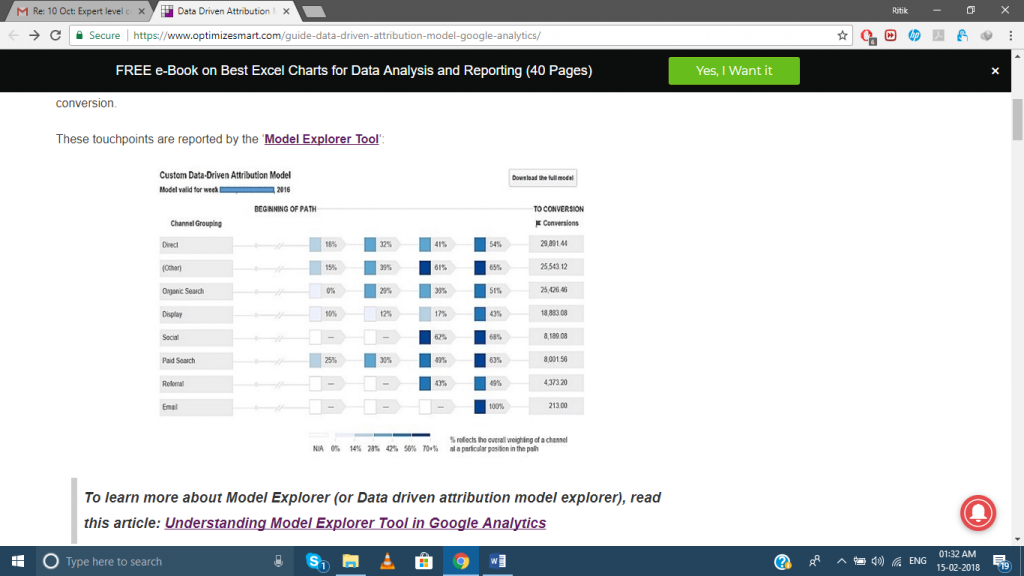
The standout feature of data-driven attribution is how it considers the touch points of the users before the start of the conversion process. The Model Explorer Tool reports these touch points. The data is then reviewed.

custom data driven attribution model

The data-driven attribution model serves as a baseline model in Google Analytics, enabling you to create new personalized attribution model. Create the new data-driven attribution model to share conversion credit with multiple touch points along the path of conversion before the implementation of personalized credit rules.

Use the data-driven attribution model to analyze both, the non-conversion and conversion path information. The latter is data gathered from visitors who were not converted by your site while the former is collected from the ones who did convert. A unique aspect of the data-driven attribution model is how it changes weekly.

Why does the data-driven attribution model work?

Understand that this model offers credit to the conversions of various touch points or marketing channels according to what they contributed in the conversion process. The touch point or marketing channel that offers the most assistance receives the most amount of credit for conversions, irrespective of whether it’s the initial touch, the middle touch, or the last touch. The rest of the touches or channels receive credit as per what they contributed during the conversion process.

As the task of assigning conversion credits depends on the latest conversion information rather than the touch point positions, the attribution becomes data-driven. This not only eliminates the need to assign random conversion credit to numerous touch points or channels but also explains why the entire model is called the data-driven attribution model.

Make it a point to remember that the validity of data-driven attribution lasts for a certain period of time since the model changes along with the conversion information.

What your business needs to implement the DDA (Data-Driven Attribution) model?

Never think for a second that an algorithm-based attribution model such as this one can be implemented by every business. First, meet and maintain various strict requirements, and only then can your business handle the data-driven attribution model.

  1. Access to a Google Analytics 360 account

Unless you have a Google Premium or Google Analytics 360 account, you cannot use the data-driven attribution model.

  1. High-quality data and its availability

Always remember that your DDA model’s strength rests on the information you submit. So a poor entry will beget poor results.

Now, the problem is, most organizations might be able to download and install Google Analytics 360, but they stumble hard when it comes to figuring out how to benefit from the service.

What’s more? Even though they have the resources to hire experienced analysts, they cannot always create and maintain large volumes of quality data gathered from different data sources.

Thus, the insights received from the DDA model are likely misleading, flawed, and unusable.

  1. Compatibility of KPIs and goals

The KPIs and goals you select for your business need to align across organizations and marketing channels. Otherwise, the data-driven attribution model does not work. So, if the primary Twitter campaign target is to improve site sales, then your Facebook campaign goal should also be the same.

  1. Conversion tracking

Set goals in Google Analytics Premium to monitor conversions as well as ecommerce. Using this conversion information, Google Analytics generates the data-driven attribution for your business, irrespective of whether you are permitted to use it or not.

  1. Importance of meeting and maintaining the minimum conversion threshold

Be certain that the Google Analytics Premium view to be generated meets the minimum conversion threshold. Also, know that it doesn’t matter if your Google Analytics’ view meets the minimum conversion threshold once; it does not allow for continued DDA analysis in Google Analytics. Make sure the minimum conversion threshold is maintained.

  1. Minimum conversion threshold for every type of conversion

The Google Analytics view you’ve selected must not only meet the minimum conversion threshold for every type of conversion; it needs to be maintained as well. Each kind of conversion generates its own DDA model, and it’s always possible that the generated DDA model works for certain conversions but not all.

If you’ve implemented data-driven attribution and the generated model does not work for that conversion, then GA is going to flash a warning sign right above the attribution model reports.

image of model explorer

Valuate your organic search channel with the DDA model

Open the ‘Model Comparison Tool’. Begin a comparison between the ‘last non-direct click’ and ‘data-driven’ model and the ‘last interaction model’.

model comparison tool

It is best to select the ‘last interaction’ model as it is the basic model for Google Analytics’ multi-channel funnel reports. The ‘Last non-direct click’ works since it is the basic model for non-multi-channel funnel reports. Finally, choose the ‘data-driven’ model rather than ‘time decay’ because:

  • The former not only analyzes the details from the Google Analytics account but other linked accounts as well, such as Google Ads, Doubleclick Campaign Manager, etc.
  • The DDA model uses an algorithm to assign credit to conversions, which is more reliable than credits given through the ‘Time Decay’ attribution and/or manual conversion.

Check the column labeled ‘% change in conversions (from ‘Last Interaction’) to find ‘organic search’

report on change in conversions

Use this report to measure the percentage by which organic search conversion changed from the previous interaction model to the data-driven model. In this case, you can see that it is 22.66 percent. This means if the DDA model is used to offer organic search conversion credits, the process will yield 22.66 percent more credits. So, the last click model undervalues organic search by 22.66 percent.

Once you’re done, download the DDA model into an excel sheet by simply clicking the button marked ‘Download the full model’ to the above right side of the ‘Model explorer tool’.

Concluding remarks

Choose the data-driven attribution model in Google Analytics to implement it for your business and experience the benefits. There are lots of other attribution models available but this model is in a league of its own.

Related reading

SEO tips tools guides 2018
guide to google analytics terms

This marketing news is not the copyright of Scott.Services – please click here to see the original source of this article. Author: Guy Sheetrit

For more SEO, PPC, internet marketing news please check out https://news.scott.services

Why not check out our SEO, PPC marketing services at https://www.scott.services

We’re also on:
https://www.facebook.com/scottdotservices/
https://twitter.com/scottdsmith
https://plus.google.com/112865305341039147737

The post How to get started with data-driven attribution in Google Analytics appeared first on Scott.Services Online Marketing News.


source https://news.scott.services/how-to-get-started-with-data-driven-attribution-in-google-analytics/