Friday, 27 April 2018

Sprinklr adds AI to its customer experience platform

Over the last year, Sprinklr has repositioned itself as a customer experience cloud, centered around its former role as a social media listening and management platform.

In another move to boost its capabilities, the company is this week adding the first installment of an artificial intelligence layer to its platform, called Intuition.

It initially tackles the customer care flow in the platform, where brands are often overwhelmed by the volume of social posts requesting help, asking questions or making complaints.

[Read the full article on MarTech Today.]


About The Author

Barry Levine covers marketing technology for Third Door Media. Previously, he covered this space as a Senior Writer for VentureBeat, and he has written about these and other tech subjects for such publications as CMSWire and NewsFactor. He founded and led the web site/unit at PBS station Thirteen/WNET; worked as an online Senior Producer/writer for Viacom; created a successful interactive game, PLAY IT BY EAR: The First CD Game; founded and led an independent film showcase, CENTER SCREEN, based at Harvard and M.I.T.; and served over five years as a consultant to the M.I.T. Media Lab. You can find him at LinkedIn, and on Twitter at xBarryLevine.

This marketing news is not the copyright of Scott.Services – please click here to see the original source of this article. Author: Barry Levine

For more SEO, PPC, internet marketing news please check out https://news.scott.services

Why not check out our SEO, PPC marketing services at https://www.scott.services

We’re also on:
https://www.facebook.com/scottdotservices/
https://twitter.com/scottdsmith
https://plus.google.com/112865305341039147737

The post Sprinklr adds AI to its customer experience platform appeared first on Scott.Services Online Marketing News.


source https://news.scott.services/sprinklr-adds-ai-to-its-customer-experience-platform/

Google’s mobile-first index: six actions to identify risks and maximize ranking opportunities

Google’s mobile-first index is here, causing fresh uncertainty about potential SEO impacts – but there are a number of proactive steps to take to manage risk and maximize ranking opportunities.

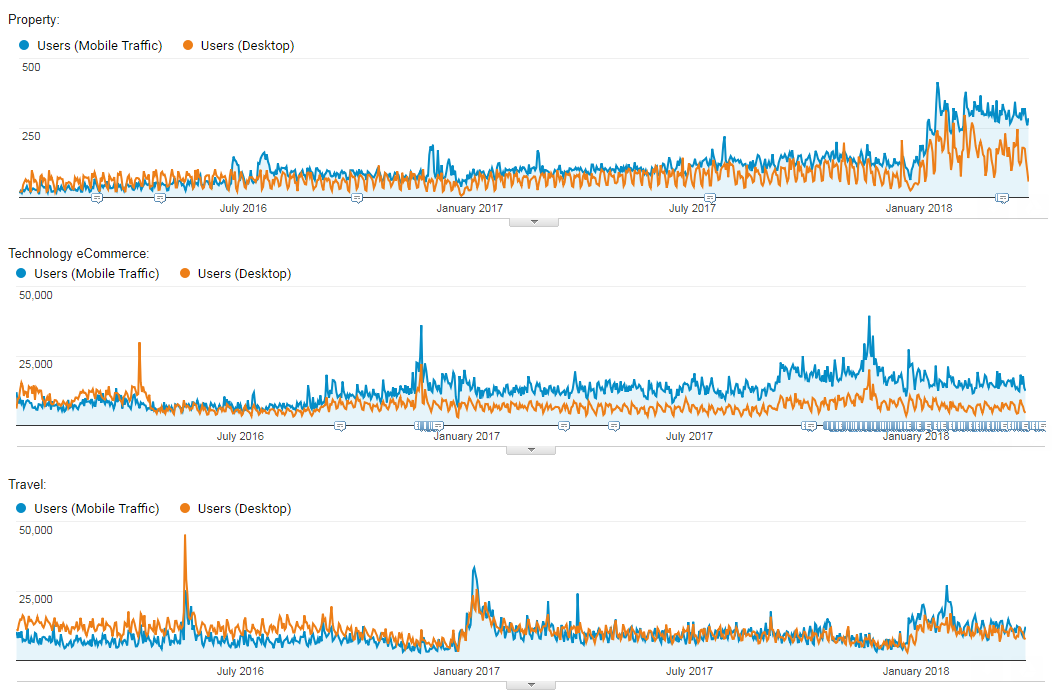
Rather than passively wait to feel the impact of the shift to mobile-first indexation, we advise companies to take six specific actions to prepare for opportunities and protect site performance as the mobile-first index is rolled out throughout 2018.

Brands that have been prioritizing mobile performance shouldn’t experience a negative impact from the mobile-first index, but an honest and systematic re-evaluation is required. Companies who have allowed the mobile and desktop experience to diverge over the years will likely experience change – rankings could be lost (or gained) as a result of the switch.

Before diving in and making changes to prepare for the mobile-first index, we recommend running a full audit of current desktop and mobile rankings in all the regions your company does business in, along with top performing pages.

Tracking this performance over time, any losses or gains in keyword visibility should be clear to see – along with potential causes. Across the six actions below the common thread is Google’s determination to provide accurate answers to users, in the channel that is used most frequently – mobile.

Keeping that at the heart of your SEO strategy and things should be fine – but having a plan certainly helps.

Identify risks

  • Action one – go mobile-responsive

Even today, too few marketers and SEO professionals meaningfully differentiate between responsive, mobile-friendly and standalone mobile sites – but that difference will become especially important in 2018.
A responsive website adjusts (or responds) based on user activity and the device used. Typical features of a responsive site include minimal navigation, images optimized for mobile and content that shifts seamlessly according to the size of the display.

In comparison, a mobile-friendly design is often anything-but mobile-friendly, attempting to show content on a mobile device as they do on a desktop, and so give users the frustrating experience of having to manually zoom in, or squint at small fonts.

Finally, some brands still operate standalone mobile sites, completely separate from the desktop experience. With responsive and mobile-friendly sites, there shouldn’t be any difference in content from a desktop version of a site.

However, a mobile-friendly site may be disproportionately skewed towards the desktop experience with an impact on factors like mobile site speed, navigation and general usability – and these are all areas of concern when considering how Google evaluates quality in 2018.

With a separate mobile site, marketers need to make sure that the mobile version contains everything (useful) that your desktop site does which could be a lot of work depending on your mobile strategy so far.

For some brands still lingering with standalone mobile sites, the shift to the mobile-first index may be the nudge needed to move to a fully responsive approach to the site.

Whether you operate responsive, mobile-friendly or a standalone mobile site, the first action we recommend is to identify any differences and either add to or completely overhaul the mobile sites you manage.

While desktop site continue will factor into rankings as a secondary consideration (and it is vanishingly unlikely that longstanding sites with many well-earned rankings will be wiped off the SERPS) making sure the mobile experience contains all the relevant content of the desktop experience – including all structured data/meta description/alt text/schema –  is an important protective step.

  • Action two – optimize site speed versus competitors

The mobile-first index flips previous logic – when 80% of evaluations about rankings were based on desktop crawling and indexing, site speed considerations were less of a concern.

However, as Google crawls mobile sites while mimicking (a not-very-good) mobile connection, slow performance, elements that struggle to load and broken links will quickly use up crawl equity and indicate that your site is less efficient at delivering the answers that users want relative to your competitors.

In addition to Google tools, we regularly use platforms like GTMetrix, Pingdom, DareBoost and WebPageTest.org to get a complete view of speed issues.

Particularly for international sites, testing mobile speed from different locations and comparing these measurements to those of your key competitors will help establish practical targets to aim for. Although Google frequently mentions a target page speed of under three seconds as being ideal, in practical reality and SEO terms, aiming to be better than your competitors should be enough.

Like with SEO in general, speed optimization is similar to an old joke –  ‘you don’t have to run faster than the bear to get away. You just have to run faster than the guy next to you.’

As ever, the quickest wins in terms of speed are usually to be found in reducing image and video size, managing JavaScript and other moving elements, minimizing tracking codes and scripts and doing what you can to reduce any slowdown caused by bolt-ons like booking and payment platforms.

The challenge for SEO professionals is to identify elements like these that can be improved without too much damage to the brand experience or taking away content useful for users.

  • Action three – optimize the customer journey

Understanding the intent of site visitors and reducing barriers from their first click in the SERPS to the information they are looking for should result in positive user experiences – and minimize the risk that comes from a site experience that causes confusion, fruitless clicking around and pushes customers away.

Although there’s some fuzziness about quite how Google interprets the quality of a user’s visit – and how it rewards that quality in terms of rankings – we advise researching the different types of mobile journeys your customers take in a systematic way and making them more efficient.

Though much ‘best practice’ SEO advice has in the past been based around engagement and keeping visitors on the site, we all know that site visitors often stick around because they’re being frustrated by unclear navigation and a poor approach to customer journey planning.

Users are more impatient of poor customer journeys on mobile – and we must anticipate that Google will feel the same too. Though helping visitors to get the answers they seek more quickly may actually decrease dwell time, we’re confident that Google and other search engines will differentiate between a short visit and a swift return to the SERPS, and a short visit that successfully ends the user’s search.

Evaluating bounce rates and the success of the mobile user journey using heat-mapping tools like Hotjar or user research panels like Peek User Testing will bring in objective data to answer whether your visitors are engaged and loving your content, or hitting barriers and getting increasingly annoyed.

In the mobile-index era, we predict that this annoyance will have a greater impact on rankings – and so is a risk to be managed carefully.

Maximising opportunities

While taking steps to understand your assets and protect your rankings is important, the shift to the mobile-first index is also a big opportunity to get ahead of competitors who are less prepared. Knowing that others will be slow to react really gives an extra incentive to put real effort into SEO strategies that will positively differentiate your brand from competitors.

  • Action four – prioritize content formatting that excels on mobile.

A lot of content marketing (such as infographics, interactive microsites, mega pages and even video, depending on the platform) produced by brands still display poorly on mobile devices.

Taking a mobile-first mindset and prioritizing everyday content and content marketing assets that work particularly well on mobile devices will resonate best with both customers and search engines. Fortunately, there are a lot of methodologies that can be used to provide depth of content that is engaging and easily navigable on mobile.

One of the biggest changes is the resurgence of expandable content areas like tabs, accordions and other filters. Use filters to hide content not relevant to a visitor’s specific query, tabs that reveal further information when clicked and accordions that expand the page are all familiar to site visitors – and allow for a single web page to be seamlessly used in multiple ways by multiple audiences.

While these have been seen by Google and other search engines as a potentially sneaky way to cram in content to a page, Google is on record as stating that content that is hidden to make a mobile site more efficient and speedier to explore will be taken into full consideration.

While competitors may have a responsive or mobile-friendly site and feel that this is enough preparation, many will likely still take a desktop-first mindset, creating overloaded pages that are tedious to wade through on mobile devices.

Thinking with a customer and mobile-first mindset to arrange content that can be skimmed easily through logical headings, bolding of main points and pull-out quotes, numbered lists, bullet-points and more will support mobile visitors and and differentiate from competitors while allowing search engine bots to crawl effectively.

  • Action five – evaluate AMP and progressive web apps

Again capitalizing on the slowness of competitors, the move to the mobile-first index means a re-evaluation of progressive web apps and accelerated mobile pages could bring up big opportunities.

As a recap, Accelerated Mobile Pages allow web pages to load especially quickly by loading page elements asynchronously and removing out elements of JavaScript that cause delays.

AMP templates are easily applied in the code with well-established procedures to provide the speedy AMP version to search engines, with the slower (but perhaps more visual) non-AMP still being recognized for ranking purposes with a canonical tag.

Progressive Web Apps use browser feature detection to give a fast, app-like experience that can be loaded from a mobile home screen or simply visited with a direct link. Websites that have a lot of moving parts and a lot of returning traffic, for example in e-commerce or other transactional sites, are the most well suited for Progressive Web Apps as they can massively streamline the user experience.

In both cases, although implementation is comparatively straightforward, you can bet that a minority of companies in your industry will have a systematic approach to using these technologies.

Being fast, being relevant and being right are key watchwords for future mobile-first SEO and using technologies that help speed, indexation and the user experience is a positive and proactive step.

Action six –  identify competitors to beat

As discussed, not every competitor will be thinking systematically about the mobile-first index, or the changing nature of SEO in general. That opens up the possibility that by being faster and more focused, some previously difficult to rank for keywords will become more obtainable.

Using your business and industry knowledge, we advise clients to identify competitors who have rankings ahead of your own that may be less responsive to change, and underprepared for the mobile-first index.

Building these target keywords into your mobile strategy and wider SEO strategy – including off-site SEO and link earning – should result in some strong opportunities.

Conclusion – manage risk, capitalize on opportunities

For some, the mobile-first index won’t result in anything transformational – if you’ve been following best practice for years and your main competitors have been doing likewise there probably won’t be any game-changing shifts.

However, in any period of uncertainty there are opportunities to take advantage of and risks to manage – and in competitive SEO niches, taking every chance to get ahead is important.

Whatever your starting point – the mobile-first index is the new normal in SEO, and now is the time to get to grips with the challenge – and potential.


Related reading

This marketing news is not the copyright of Scott.Services – please click here to see the original source of this article. Author: Martin Calvert

For more SEO, PPC, internet marketing news please check out https://news.scott.services

Why not check out our SEO, PPC marketing services at https://www.scott.services

We’re also on:
https://www.facebook.com/scottdotservices/
https://twitter.com/scottdsmith
https://plus.google.com/112865305341039147737

The post Google’s mobile-first index: six actions to identify risks and maximize ranking opportunities appeared first on Scott.Services Online Marketing News.


source https://news.scott.services/googles-mobile-first-index-six-actions-to-identify-risks-and-maximize-ranking-opportunities/

Customer acquisition on social media — with your own data

In the battle for customer acquisition, data plays an important role in marketing strategy, along with a desired product and excellent creative. There’s also the challenge of reaching a target audience where they spend most of their time, which today is within mobile apps and browsing social media.

When we look at Google, Facebook and Amazon from the perspective of an advertiser, we see that they utilize much more data for their own benefit than they make available for audience segmentation.

Amazon’s data has always been a walled garden. Their incredibly deep historical data on buying behaviors and patterns gives them a sizable advantage, leading to what many argue are cutthroat product decisions and incredibly targeted product recommendations.

I expect Facebook will increasingly become a walled garden after overexposing and ineffectively monitoring third-party data use. By shutting down their Partner Categories program, they’re reinforcing to their advertisers that Facebook audience data is the primary source for campaign segmentation.

How to cope in such an environment?

While numerous data sources are available for targeting across most digital properties, one of the most effective ways brands can target is by bringing their existing opted-in datasets to social media. This frequently provides a competitive advantage over the “walled gardens” of the major technology players, as your own data is typically much more relevant to your marketing efforts.

The four major sites — Facebook, Instagram, Twitter and Snapchat — all provide advertisers the ability to create custom audiences using their own data, and in some cases to use third-party data sets.

The workflow is similar across all sites:

  1. Prepare your data.
  2. Upload it.
  3. The social media sites hash and de-identify the data.
  4. Your data is then matched to the social media site’s user base.
  5. Your custom audience is created.
  6. And your original data file is deleted.

Typically, the most utilized datasets to match against are email addresses, identifiers/tags provided by the social media sites themselves and mobile advertising IDs. Most sites require a minimum of 1,000 records in order to create a custom audience. This is for privacy reasons (to ensure data is aggregated and no individual could be identified), and to ensure that the segment is large enough to deliver appropriately.

The perks of using your own data

The ability to create custom audiences on social media allows advertisers to reframe many of their existing marketing tactics. They can encourage repeat visits, whether in-store or online, from existing customers, or try to win shoppers from competitive locations.

Brands without physical locations that seek to go directly to the consumer can use custom audiences to reach their market on social media as well. Most sites also allow advertisers to create “lookalike” audiences to help increase the scale of the campaign. They look for common characteristics from the audience you’ve uploaded and find similar consumers for your campaign to reach.

One final example of how you can use your own data is to drive mobile app acquisition. Building a custom audience from existing customers creates a segment with a much higher propensity to download and use a mobile app, especially when paired with appropriate incentives.

A key component of such strategies has always been, and will continue to be, ensuring that the datasets you’re using have opted in to marketing communication and advertising. Expect to see more transparency required on behalf of the end user, especially as the General Data Protection Regulation (GDPR) goes into effect next month.

Aside from being able to reach a relevant audience, bringing your own data to a social media site can also result in performance improvements and cost savings. The cost savings stem from being more relevant — in Facebook parlance, this is having a higher relevance score — which can result in lower cost-per-click fees because you can potentially win the auction for a given impression at a lower price.

Brands, advertisers and the agencies they work with have been hungry for the right data to help them reach the holy trinity of right time, right place, right person. Using their own opted-in data sets will become an increasingly important tactic for the marketer’s overall customer acquisition strategy to achieve that goal.


Opinions expressed in this article are those of the guest author and not necessarily Marketing Land. Staff authors are listed here.


About The Author

Brian Handly, CEO of Reveal Mobile, possesses more than 20 years of technical, operational and executive management experience, with 18 years of that in advertising technology. Brian was co-founder and CEO of Accipiter, which was acquired by Atlas in December of 2006 followed by the $6.1 billion acquisition of Atlas by Microsoft in 2007. Before their recent acquisition, Handly served on the Board of Directors for WebAssign, and currently serves as an Operating Partner for Frontier Capital. Brian also has extensive experience as an angel investor and is an active advisor for several North Carolina technology companies.

This marketing news is not the copyright of Scott.Services – please click here to see the original source of this article. Author: Brian Handly

For more SEO, PPC, internet marketing news please check out https://news.scott.services

Why not check out our SEO, PPC marketing services at https://www.scott.services

We’re also on:
https://www.facebook.com/scottdotservices/
https://twitter.com/scottdsmith
https://plus.google.com/112865305341039147737

The post Customer acquisition on social media — with your own data appeared first on Scott.Services Online Marketing News.


source https://news.scott.services/customer-acquisition-on-social-media-with-your-own-data/

Search Buzz Video Recap: Google Core Algorithm Update, Autocomplete Changes, Negative SEO, Hijacks & One Line AdWords

This week in search, we got confirmation about the large Google update from Google as being a broad core update. It started a week ago Monday and seems to have gone on for ten or more days. Google also made changes to autocomplete search predictions, adding that they will remove more predictions if they are hateful. Google said negative SEO via canonical attributes is not a thing. Google was awarded a new patent that is like the PageRank patent, should SEOs care about it? Google seemed to have hijacked the speedtest.net search results page. Google study shows that Google often does not use your meta descriptions. Google says having duplicate meta descriptions is not so bad. Google doesn’t use rel=me microformats. Google is able to figure out page language without hreflang, but is it better to use wrong hreflang than not use it at all? Google says linking to noindexed pages is perfectly okay. Google is testing one line AdWords ads on mobile. Google is showing a photos tab for Android local panels. The search community honored Jason Dodge, Thomas Craver, Rohan Ayyar, Craig Campbell and Kelvin Newman. That was this past week in search at the Search Engine Roundtable.

Make sure to subscribe to our video feed or subscribe directly on iTunes to be notified of these updates and download the video in the background. Here is the YouTube version of the feed:

For the original iTunes version, click here.

Search Topics of Discussion:

Please do subscribe via iTunes or on your favorite RSS reader. Don’t forget to comment below with the right answer and good luck!

This marketing news is not the copyright of Scott.Services – please click here to see the original source of this article. Author: barry@rustybrick.com (Barry Schwartz)

For more SEO, PPC, internet marketing news please check out https://news.scott.services

Why not check out our SEO, PPC marketing services at https://www.scott.services

We’re also on:
https://www.facebook.com/scottdotservices/
https://twitter.com/scottdsmith
https://plus.google.com/112865305341039147737

The post Search Buzz Video Recap: Google Core Algorithm Update, Autocomplete Changes, Negative SEO, Hijacks & One Line AdWords appeared first on Scott.Services Online Marketing News.


source https://news.scott.services/search-buzz-video-recap-google-core-algorithm-update-autocomplete-changes-negative-seo-hijacks-one-line-adwords/

Google Adds Photos Tab To Local Panel On Android Devices

Sergey Alakov spotted Google adding a new tab to the local panel specifically for Photos. Well, it seems to just be showing on mobile for Android devices, not on iOS devices. If you search on Android, you will get the photos tab, if you search using an iPhone, you won’t.

Here is a screen shot of this on Android, notice the tab for photos:

Here is the same result on an iPhone, notice the photos tab is not there:

Maybe Google is going to be rolling this out more widely soon but for now, it seems to be just live for Android users.

Forum discussion at Twitter.

This marketing news is not the copyright of Scott.Services – please click here to see the original source of this article. Author: barry@rustybrick.com (Barry Schwartz)

For more SEO, PPC, internet marketing news please check out https://news.scott.services

Why not check out our SEO, PPC marketing services at https://www.scott.services

We’re also on:
https://www.facebook.com/scottdotservices/
https://twitter.com/scottdsmith
https://plus.google.com/112865305341039147737

The post Google Adds Photos Tab To Local Panel On Android Devices appeared first on Scott.Services Online Marketing News.


source https://news.scott.services/google-adds-photos-tab-to-local-panel-on-android-devices/

What Is Better Google: Wrong Hreflang Or No Hreflang?

We know hreflang is pretty complex and in many cases, you don’t necessarily need it but if you do it right, it can be great for Google in understanding your multilingual and multiregional web site.

But what is better to do? Is it better to try to do hreflang correctly and then get it wrong (by accident) or do no hreflang at all, so you don’t have a shot of getting it wrong?

John Mueller of Google responded to that question on Reddit and he said it depends on how you do it wrong.

If you just mess up the syntax, then it is like Google doesn’t see the hreflang at all and it is the same thing as not doing hreflang. So if some of the pages do it correctly and some don’t, in that fashion, then it is probably best to do it wrong some of the time.

But if the hreflang is between the wrong pages then it is probably best not to implement it at all. Like you tell Google the English page A page is really a Spanish page A page but it is not.

Here is how John answered it:

If hreflang isn’t valid (non-indexed pages linked, invalid language codes) then it’s ignored & the same as not having it at all (this is on a per-hreflang-link basis, so if some are ok, they’ll work). If the hreflang is between the wrong pages (eg the English “Fish” page is connected to the Spanish “Chicken” page), then that would probably be worse than not having hreflang set up at all.

Forum discussion at Reddit.

This marketing news is not the copyright of Scott.Services – please click here to see the original source of this article. Author: barry@rustybrick.com (Barry Schwartz)

For more SEO, PPC, internet marketing news please check out https://news.scott.services

Why not check out our SEO, PPC marketing services at https://www.scott.services

We’re also on:
https://www.facebook.com/scottdotservices/
https://twitter.com/scottdsmith
https://plus.google.com/112865305341039147737

The post What Is Better Google: Wrong Hreflang Or No Hreflang? appeared first on Scott.Services Online Marketing News.


source https://news.scott.services/what-is-better-google-wrong-hreflang-or-no-hreflang/

Google Hijacks Speedtest.net With Their Own Speed Test Widget

google pagespeed

You know the lovely folks at speedtest.net – they tell you how fast or slow your internet connection is? You also know that Google has a subpar version when you Google [speed test] right in the search results. They launched that feature about two years ago.

Well, now, if you search for the brand [speedtest.net], the domain name, in Google, Google will show you their speed test widget above the domain speedtest.net.

click for full size

Mike Pantoliano posted about this on Twitter and Danny Sullivan responded:

He is basically thinking it might be a bug and Google will fix it.

I am not sure if or when it will be “fixed” but this can be hugely upsetting to some folks if Google did this for their domain name.

Forum discussion at Twitter.

This marketing news is not the copyright of Scott.Services – please click here to see the original source of this article. Author: barry@rustybrick.com (Barry Schwartz)

For more SEO, PPC, internet marketing news please check out https://news.scott.services

Why not check out our SEO, PPC marketing services at https://www.scott.services

We’re also on:
https://www.facebook.com/scottdotservices/
https://twitter.com/scottdsmith
https://plus.google.com/112865305341039147737

The post Google Hijacks Speedtest.net With Their Own Speed Test Widget appeared first on Scott.Services Online Marketing News.


source https://news.scott.services/google-hijacks-speedtest-net-with-their-own-speed-test-widget/