We had an in-depth conversation in last week’s SEMrushchat, and the information shared could help small business owners, marketers, and agencies. Our guest, Tim Capper, and our community shared recommendations on tools to find marketing gaps, marketing advantages small businesses have, local search strategies, schema, and keywords that small brands can target that big brands can’t.
There were so many useful tips and strategies shared. We tried to choose the tweets that offered a variety of insights for our readers, and you read them below.
You can retweet any of the tips below by clicking on the Twitter logo next to the quote.
Tim Capper
In touch with actual customers – Personal connection. Flexibility to make quick changes – both online and offline. Highly focused on product and service. Location baked into their marketing – sponsorships, local news. Local customer word of mouth.
Diana Richardson
Local relevancy. Small, local businesses are more likely to show up for the ‘near me’ or ‘city’ type searches. And those are high-intent customers a business would want more so than someone doing a broader search.
Location – if you get the GMB set up correct you can power into the Map pack and steal all the big companies customers locally!
Patrick Delehanty
Direct engagement with prospects and customers, humanizing their brand. They also have the luxury of testing ideas and see what works / doesn’t. Enterprise brands have hierarchies and red tape. Small businesses often have less obstacles. Try things!
Ben Austin
Generally speaking, larger businesses have to work harder to relate to customers on a local level, but small businesses can take advantage of their existing connections within the community to build their business online.
Jake Symons
They’re small. Which means intimate. You can actually get to know every one of your customers and build a relationship with them that extends beyond your business.
We have been actively managing Questions & Answers on Google My Business by submitting our own ‘on brand’ questions and ensuring the business owner submits the answer so we get a verified checkmark. Thanks to @GregGifford for this knowledge!
Itamar Blauer
Reviews! It’s super important to signal to Google that your business is up-to-par with the big dogs! Got happy customers? Ask them to leave a review. It takes them a couple of minutes but can massively impact your local relevance and drive more business!
David Cohen
Small businesses, especially with physical locations, should promote and compel their customers to add pics and video for their business into Google. I do this and my content for other businesses has 2.3M views. Biz owners tell me it helps – $$$.
Diana Richardson
Location-centric landing pages. Local directory site listings (sometimes radio stations, news channels, etc. have business directories). Stronger ad copy that appeals to a locale. Colloquial keywords commonly used for names of the area (ex: The Triangle, NC)
Tim Capper
On-Page optimisation of location. Locally focused events, sales, and promotions. Google My Business. Local reviews. Produce local content – Q&A. Local structured data markup.
Move your shop to a street with a keyword in the street name. If I open a bakery it will be in Bakers Lane. Think ahead!
One additional tip by Tim that we thought any business or marketer could use, “Dont be afraid of in-depth guides and tech specs (depending on business). Big Brands overlook this all the time.”
Fistbump Media
I think it’s important to target things like neighborhoods and/or parts of town that are part of the local language, and not common or important or known to outsiders.
Tim Capper
Big brands often neglect long-tail, customer-specific search queries — Where to buy, How, What, Near Me, Product, Service in Location.
Ryan Jones
Sidecar: What’s with people literally putting the words ‘near me in their title tags? That’s not how those searches work.
Alexis Katherine
Don’t be afraid to go after some of the ‘bigger’ topics in organic search either. SMB are at some disadvantage, but Google is ultimately looking for the best content. Invest some resources in creating it, and it will pay dividends over the long-haul.
Carlos Castro
Long tail keywords based on customer problems, big brands often fail to address their audience needs and focus only on sales, small businesses can take advantage of that to be recognized by users as experts in their niche.
Patrick Delehanty
Relevant longtail keywords that you know prospects and customers search for through your conversations had with them (or by using @semrush) – develop informational, solution based content / pages around those keywords and have logical CTAs on those pages.
Need to know more about schema markup and all the options? Check out Schema.org.
Malte Landwehr
QA: Google is picking it up SUPER quick. Bonus if you include internal links in there. They will show up in the SERPs.
Tim Capper
Local Business. Events, Sales. Questions & Answers. priceRange. aggregateRating. geoMidpoint – for SAB. hasMap.
Brian Kato
Event schema is HUGE! Also, leverage the power of your sameas markup.
Ben Austin
Reviews Schema – Reputation is very important for small businesses! Local Business Schema (organization) – Boost the amount of information readily available on the SERPs! Events Schema – Allow your events to stand out.
Herd Digital
Job Posting! Great way to advertise your vacancies to people in your area!
Bentley University
Reviews, Product, Sales, Events, Q&A, Price, Aggregate Rating, Hours, Image/logo, hasMap, Geo, Contact point, SameAs, Address, and #
You could check out the local competition (with a tool like, I don’t know, @semrush). Do simple keyword searches in any number of tools or use Google auto-suggest to find how locals are searching. Check your analytics/GSC to see KWs for which you can optimize.
Fistbump Media
There is definitely some good competitive analysis stuff in @SEMrush, but I do quite a bit of observing and listening on social media to see what competitors are doing (and NOT doing) when it comes to content and conversations.
Netvantage Marketing
Google Search Console queries, @semrush’s topic research tool for common questions. Not a tool, but listening to your customer’s questions can help a ton!
Kieran Ledger
I always use @hootsuite to keep an eye on what’s going on locally, tailoring it all the time looking for opportunities. I also use #semrush social media competior tracker to see where other businesses are focusing their efforts in case I’ve missed something.
Webeo Global
@semrush Keyword magic tool OR Gap Analysis! Google search.
If so, please share them in the comments below. We also want to thank everyone that participated in the chat. We will be looking for your expert insights this week; SEMrushchat starts at 11 am ET/4 pm BST on Wednesday, August 14th.
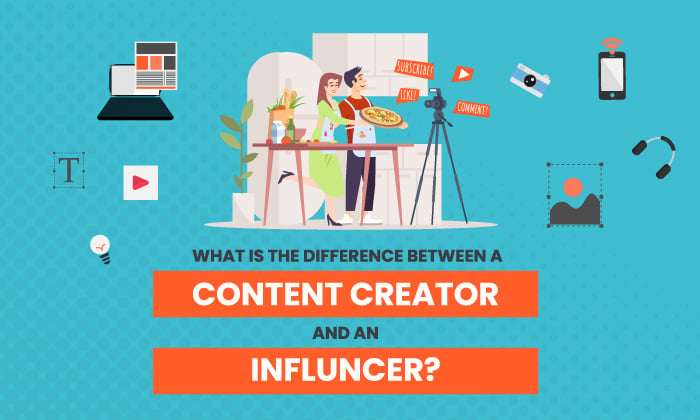
In today’s internet-focused age, words like “content creator” and “influencer” are thrown around on nearly every social media platform. Have you ever wondered: What do these terms really mean? Is it the same thing? How do the two roles differ from the perspective of a user or consumer?
In a nutshell, content creator is a broad term describing someone who produces some form of content, including but not limited to blog posts, videos, photography, and reels.
Influencers can also create such content, but they’re better known for their connection to their audience (i.e., the “influence” they have on their followers).
Still confused? Let’s dive deeper into the world of content creators and influencers to understand exactly what they do and what makes them different from each other.
What Do Content Creators Do?
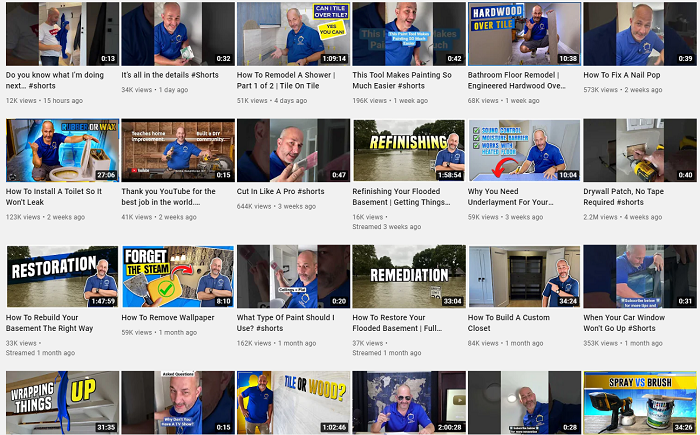
Content creators create content for blogs and social media platforms. This can include YouTube videos, TikTok reels, and text-based posts on social media sites like Facebook, Twitter, Instagram, LinkedIn, etc.
The content they produce is typically original and may be shared for money, audience building, brand awareness, or just as a way to share their talents online.
For example, “Insta poets,” bloggers, and newsletter writers are typically seen as content creators.
Here is an example of content on Instagram shared by the account @poets.
Content creators aren’t limited to texts, though. They can specialize in video, audio, and visual content, among other forms.
Influencers are popular individuals on social media and other content-sharing platforms who leverage their substantially large followings to promote certain brands and lifestyles.
This can be very beneficial for brands and small businesses looking to reach new users and build brand awareness.
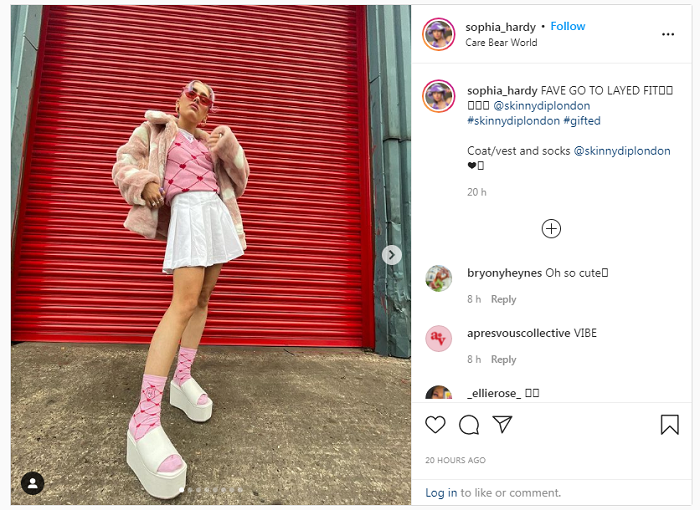
When you see someone with thousands of followers flaunting a beauty or wellness product with a “sponsored” tag, they’re probably an influencer.
Influencers promote products and lifestyles through photos, videos, blogs, reels, and other forms of “viral” media.
Influencers often create content; that’s where the confusion comes from.
However, the difference is influencers are more focused on audience engagement, promotions, and portraying a certain image about themselves and their lives to sustain and grow their influence.
Content creators and influencers have some overlapping skills. These typically include proficiency with technology, writing and communication skills, photography, and audience management.
While some individuals may be more proficient at one skill than others, most digital creators and influencers need these skills in some capacity to thrive in their field.
Common skills:
communicating ideas effectively
basic tech proficiency
managing client expectations
admin tasks like invoicing, managing emails, follow ups, etc.
Beyond the common overlapping skills, the two groups also need some specific skills to succeed. For instance, influencers need to have a strong understanding of how social media and audience engagement works. Their entire process depends on leveraging these talents.
Influencer skills:
photo editing
video editing
social media management
audience management
live streaming
promotion
knowledge of advertising
niche expertise in a particular industry
Content creators can benefit from these skills too, but writing, recording, editing, and publishing content may be a bigger priority for them. Content creators also need to be good storytellers to create engaging content.
Nowadays, many content creators also excel at SEO and digital marketing to help themselves and their clients achieve key business goals.
Content marketing skills:
above-average writing proficiency
SEO
digital marketing
storytelling
handling content management systems
content research
keyword research
audience research
broad knowledge of a particular industry
Content Creators Vs. Influencers: Strategy & Goals
The biggest difference between content creators and influencers lies in their goals and the strategies they use to achieve these objectives.
Content creators develop content marketing strategies. These include publishing schedules, topic research, keyword research, audience targeting, social media plans, and other digital marketing elements.
Content creators work with brands, agencies, business owners, and other clients to understand their current marketing needs and develop SMART plans to achieve their business goals.
Content creators earn money by developing content strategies and content items like blogs and videos for others, or by uploading media on their own accounts for ad revenue, affiliate sales, and paid subscriptions. This way, they either get paid directly by a client seeking their services or through their own efforts by building an audience that wants to pay to consume their content.
Influencers work differently. They work with a primary goal to “influence” the audience. They work to build strong relationships with their followers. They constantly strive to increase engagement on their posts and ensure they have an optimal web presence.
Influencers also accept sponsorships from brands to promote products and lifestyle ideas. In exchange for money or free products, these users upload reviews, product photos, and videos, or sponsored posts on their social media accounts.
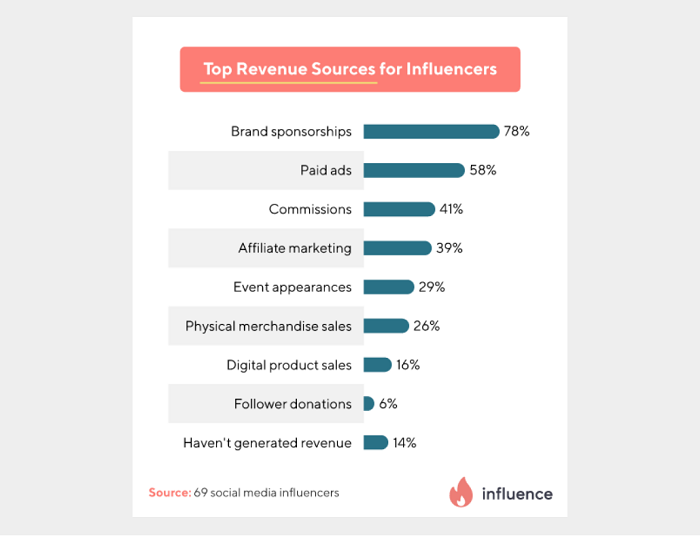
Many influencers make a huge share of their income through these sponsored posts, but not all influencers make enough money to make a living out of sponsorships. Some do it as a side hustle, while others do it for fame and status in society.
For instance, the following graphic by Influence.co shows the research findings highlighting the top ways popular influencers make money.
However, several influencers with millions of followers do reach a stage in their career where they’re regularly pulling in six figures from brand deals and sponsored posts.
Content Creators Vs. Influencers: Tools
Content creators and influencers use a variety of tools to meet their goals.
Content creators typically use the following tools:
Blogging platforms like WordPress (free and paid features) to create and publish content.
Google Trends (free) for keyword research and understanding current trends.
AnswerthePublic (free) to get blog and research ideas around a specific topic.
Grammarly (free and paid features) to catch typos and improve writing.
Hemingway App (free) to detect reading level, reduce passive voice, and polish writing.
Unsplash (free) to get free-of-cost, royalty-free images to use anywhere.
Audacity (free) to create and edit audio files for podcasts and other audio formats.
This is far from being an exhaustive list. Different content creators use different tools based on their needs and end goals, but I hope this list gives you a great place to start your search.
Influencers typically use the following tools:
Social media platforms (free and paid features) to post influential content and build an audience.
Canva (free and paid features) to create engaging graphics in a variety of formats.
Remove.bg (free and paid features) to remove background clutter from photographs.
Influence.co (free and paid features) as a social media style directory to find influencers and work with sponsoring brands.
TweetDeck (free) to organize tweets and feeds for easier access.
Intellifluence (free and paid features) to collaborate directly with brands and agencies for sponsorships.
Again, different influencers will use a combination of these tools (or something completely different) based on how they work, but this list can be a good place to start looking.
Content Creators Vs. Influencers: Which Is Right for My Business?
Now that you know more about what content creators and influencers do, how they work, and which tools they use, it’s time to think about which of the two would be right for your business.
Whether you’re planning to work with content creators, influencers, or both, each option has its pros and cons. Let’s discuss some of those below.
Working With Content Creators
Let’s start by highlighting the pros and cons of working with content creators. Know that there will always be some individual differences based on how each person works, but many content creators share the following traits.
Pros:
Content creators are well-versed with digital marketing and can add more value to your marketing campaigns.
Content creators can offer more than one skill. They can write about your product but also offer photographs and videos for a more comprehensive final product.
Content creators tend to be good storytellers. They can weave in narratives and strong research findings to strengthen your story and position your brand effectively.
Cons:
Content creators may or may not have huge followings. Many content creators don’t have a massive influence on their audience, so you won’t necessarily get millions of impressions on your post.
Content creators typically don’t take on sponsored posts, so your content may not be advertorial in nature.
Some content creators have specific processes of how they work, and they might not be able to tailor their content to match your marketing needs.
Working With Influencers
Now let’s look at the pros and cons you can experience when working with influencers across different industries.
Pros:
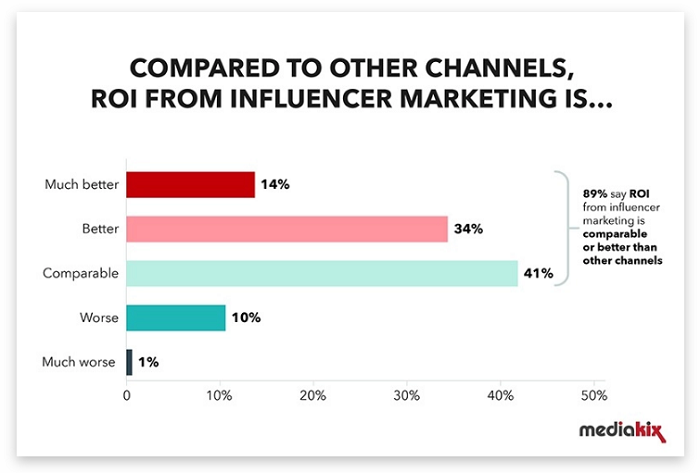
Influencer marketing offers a great return on your investment. Studies show nearly 90 percent of marketers feel influencers provide comparable or better ROI than other marketing channels.
Influencers have strong relationships with their audiences, so your posts can get a lot of engagement.
Working with influencers can help you target specific audiences. For instance, beauty influencers have a lot of followers interested in beauty and wellness products so you can market to them directly.
Cons:
Influencers may have huge followings but still be subpar content creators. Not every influencer can make the most engaging post so often there’s no guarantee of quality.
Influencers may have fake followers. Today many influencers buy followers or have fake accounts to boost their apparent credibility making it very difficult to vet them before partnership.
A lot of social media users dislike engaging with influencers, so you’re essentially cutting off a huge portion of your target audience by working only with influencers.
The bottom line here is that both influencers and content creators have something to offer, but you have to carefully consider your needs before choosing to work with any one of them.
Finally, remember that some content creators do double as influencers, offering you the best of both worlds.
Content Creators Vs. Influencers: Frequently Asked Questions
Here are some frequently asked questions about content creators and influencers.
Do content creators or influencers drive better ROI?
Statistically speaking, influencers tend to drive better ROI as they have a bigger audience, larger followings, and more consistent engagement on their posts.
What are the key differences between content creators and influencers?
Content creators are more focused on creating and publishing content, while influencers are more focused on building an audience, promoting brands, and maintaining the status quo. They also operate differently. Content creators create original content for sharing knowledge or building a brand, while influencers post sponsored content for money and popularity.
How do I find the right influencers for my brand?
You can find the right influencer for your brand by using free and paid research tools like Intellifluence, Influence.co, and popular social media apps. You can also look at who your competitors are working with and where they find relevant influencers.
Are YouTubers content creators?
YouTubers are typically called content creators as they upload videos and popular content on a fairly consistent schedule. Viral YouTubers can become influencers once they have a large following and start accepting sponsored deals.
Conclusion: Content Creators Vs. Influencers
Working with content creators and influencers can benefit your marketing efforts. Content creators can help build an effective content marketing strategy, while influencers can help you reach more targeted users through sponsored posts.
In 2019, high-authority links remain highly correlated with rankings. However, acquiring great links is becoming increasingly difficult. Those of you who operate publications of any variety, especially those who enjoy high domain authority, have likely received several link building requests or offers like this each day:
“Please link to my suspect site that provides little or no value.”
“Please engage in my shady link exchange.”
“I can acquire 5 links of DA 50+ for $250 each.”
Or maybe slightly more effectively:
“This link is broken, perhaps you would like to link here instead.”
“You link to X resource, but my Y resource is actually better.”
This glut of SEOs who build links through these techniques above have been consistently eroding the efficacy of this style of little-to-no-value ad outreach link building. In the past, perhaps it was possible to convert 2% of outreach emails of this style to real links. Now, that number is more like 0.2 percent.
Link building outreach has become glorified email spam—increasingly ignored and decreasingly effective. And yet, high-authority links remain one of the single most important ranking factors.
So where do we go from here?
Let’s start with a few axioms.
The conclusion: Leveraging data journalism to tell newsworthy stories re-enables effective promotion of content via outreach/pitching. Doing so successfully results in the acquisition of high domain authority links that enjoy the potential for viral syndication. Overall data journalism and outreach represents one of the only remaining scaleable high-authority link building strategies.
How can I leverage data journalism techniques to earn coverage?
To answer this question, I conducted my own data journalism project about the state of data journalism-driven link building! (Meta, I know.)
The primary goal was to understand how major publications (the places worth pitching content) talk about data journalism findings from external sources. By understanding how data journalism is covered, we lay the groundwork for understanding what types of data journalism, themes, and strategies for outreach can be most effective for link building.
We pulled 8,400 articles containing the text “study finds.” This keyword was used as a heuristic for finding data-driven news stories created by outside sources (not done internally by the news publication themselves). We then supplemented these articles with additional data, including links built, social shares, and Google’s Machine Learning topic categorization.
The categories derived by Google’s classifier can have multiple tiers based on the keywords in the article titles, giving us four ways to show the results within each category: The main topic area (containing all relevant subcategories), just the first subcategory, just the second subcategory, and just the third subcategory.
Which outlets most frequently cover data-driven stories from external pitches?
Let’s begin by taking a look at which top-tier news outlets cover “study finds” (AKA, any project pitched by an outside source that ran a survey or study that had “findings”).
For companies conducting studies, they hope to win press coverage for, these top sites are prime targets, with editorial guidelines that clearly see outside pitches of study findings as attractive.
It’s not surprising to see science-based sites ranking at the top, as they’re inherently more likely to talk about studies than other publications. But sites like The Independent, Daily Mail, The Guardian, CNN, Washington Post, and NBC News all ranked highly as well, providing great insight into which established, trusted news sources are willing to publish external research.
Which topic areas do these publishers write about most?
Diving a little deeper, we can explore which topics are covered in these publications that are associated with these external studies, providing us insight into which verticals might be the best targets for this strategy.
There are many unique insights to be gleaned from the following charts depending on your niche/topical focus. This data can easily be used as a pitching guide, showing you which publishers are the most likely to pick up and cover your pitches for the findings of your study or survey.
Here is a view of the overall category and subcategory distribution for the top publishers.
As you can see, it’s…a lot. To get more actionable breakdowns, we can look at different views of the topical categories. The categories derived by Google’s classifier can have multiple tiers based on the keywords in the article titles, giving us several ways to show the results within each category.
You can explore the Tableau sheets to get into the nitty-gritty, but even with these views, a few more specialized publications, like InsideHigherEd.com and blogs.edweek.org, emerge.
Which topic areas drive the most links?
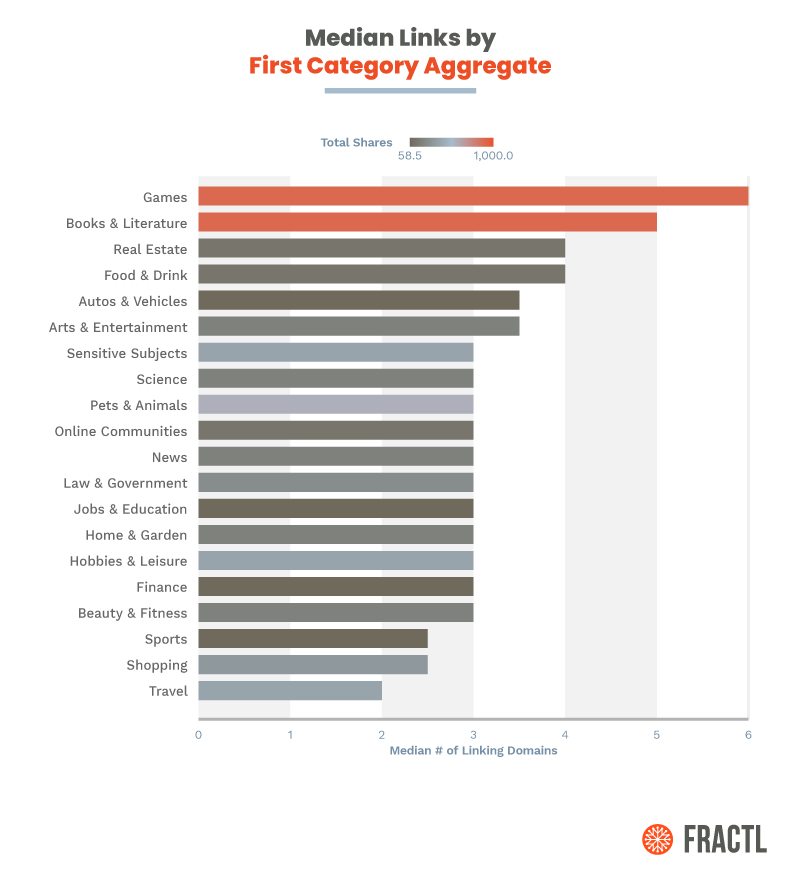
Press mentions are great, but syndication is where data journalism and content-based outreach strategy really shines. I also wanted to understand which topic areas drive link acquisition. As it turns out, some topics are significantly better at driving links than others.
Note that the color of the bar charts is associated with volume of sharing by topic—the darker the bar on the chart, the higher it was shared. With this additional sharing data, it’s plain to see that while links and social shares are highly correlated, there are some categories that are top link builders but do not perform as well on social and vice versa.
This next set of data visualizations again explore these topic areas in detail. In each batch, we see the median number of links built as an overall category aggregate and then by each category.
Which domains generate the most links when they pick up a data-driven story?
Another interesting question is which domains overall result in the largest number of links generated for “study finds” stories. Below is that ranking, colored by the median number of total shares for that domain.
Notice that while The Independent ranked supreme in the earlier graph about including the most “study finds” pieces, they don’t appear at all on this graph. Sites like The Guardian, CNN, The Washington Post, and NBC News, however, score highly on both, meaning they’re probably more likely to publish your research (relatively speaking, since all high-authority sites are tough to get coverage on), and if you’re successful, you’re probably more likely to get more syndicated links as a result.
Which topic areas are the most evergreen?
Now, let’s look at each category by BuzzSumo’s “evergreen score” to see what kind of content will get you the most bang for your buck.
The evergreen score was developed by BuzzSumo to measure the number of backlinks and social shares an article receives more than a month after it’s published.
When you’re considering doing a study and you want it to have lasting power, brainstorm whether any of these topics tie to your product or service offering, because it appears their impact lingers for longer than a month:
What this all means
Link building through data-driven content marketing and PR is a predictable and scalable way to massively impact domain authority, page authority, and organic visibility.
Always consider:
1. Which publishers make sense to pitch to?
Do they often cover external studies?
Do they cover topics that I write about?
Does their coverage lead to a high volume of syndicated links?
2. Does my topic have lasting power?
To really make the most of your content and outreach strategy, you’ll need to incorporate these tips and more into your content development and pitching.
In previous articles on Moz I’ve covered:
These ideas and methodologies are at the heart of the work we do at Fractl and have been instrumental in helping us develop best practices for ideation, content creation, and successful outreach to press. Pulling on each of these levers (and many others), testing, and accumulating data that can then be used to refine processes is what begins to make a real impact on success rates and allows you to break through the noise.
If you want to discuss the major takeaways for your industry, feel free to email me at kristin@frac.tl.
Did anything surprise you in the data? Share your thoughts below!
Google announced that it is not only showing more flavors of deal badges and showcases but also has added more reporting to the performance report in the Google Merchant Center to report on these deal badges.
Here is a recap of what happened in the search forums today, through the eyes of the Search Engine Roundtable and other search forums on the web.
Search Engine Roundtable Stories:
Google Ranking Update Fluctuations Continue (3/29-4/1)
These fluctuations won’t die down, it seems like we’ve been reporting these tremors and fluctuations a lot since the beginning of the year and even more so since the release of the March 12th core update. We are seeing more chatter around these fluctuations from around March 29th through today, April 1st – and no, this is no April Fools joke.
Google: Links Not Shown In Search Console Are Generally Irrelevant
Google’s John Mueller was answering questions around an old topic of Google showing only a sample of links in the link report in Google Search Console. He said that generally if the links are not shown in the tool then they are “pretty irrelevant overall.”
You Got Work To Do If Robotted Out Pages Is Out Ranking Your Content In Google
Google’s John Mueller said on Twitter that if your content on your site is being outranked by robotted out pages, then you got work to do. In short, if you have a page on your site that you used the robots.txt file to tell Google not to crawl and it still outranks other relevant content on your site for a query in Google – that is an issue.
Is Google Showing Knowledge Panel In Featured Snippet?
Dan Shure noticed Google showing a knowledge panel on the left side, where it looks like it is in the featured snippet box area. It almost seems like a bug or photoshopped but I can personally replicate this myself for the query – [radio history].
Google Webmaster Team Ends The Google+ Community
As you know, Google+ is closing down tomorrow, April 2nd – this is no April Fools joke. And one of the more active communities on Google+ for SEOs was the Google Webmasters community. The other day they posted a goodbye to Google+ and asked you follow them on Twitter instead.
Climbing The Ladder At Google
Here is a photo of someone climbing up the ladder at the Google NYC office. I showed you the view from the bottom of the ladder. Here is the view of someone climbing up it, despite it being only avail