So let’s say you are searching for pizza stores in Saint Moritz, Switzerland – does that mean you live there or you are about to travel there. Google’s John Mueller said while Google does try to understand where you are searching from, it does not differentiate between “living in X” from “traveling in X”.
What’s up, SEMrush, and welcome to this episode of Weekly Wisdom. My name is Mikhail Alfon. I am the president and co-founder of Blue Light Media, based in Costa Mesa, California. Today, we are going to be talking about how to use and find micro influencers.
Now, before we get into that, let’s talk about influencer marketing as a whole. It is one of the most popular ways for brands to really reach new audiences. Essentially what they are doing is using influential Instagram users or YouTubers, or whatever platform it might be, to help promote their product, service, or brand, whatever it might be, right. What they do is they find people who can encourage their audience to sell their products for them.
Macro Influencers vs. Micro Influencers
When you are starting your influencer marketing campaign, it is important to understand the difference between a macro influencer and a micro influencer. Macro influencers will typically have 100s of thousands of followers, if not millions of followers, and tend to be a little bit more expensive, and generally a little bit more difficult to solidify campaigns with. This video is for the small to medium size businesses, and we’re talking about micro influencers today. Micro influencers are going to have typically under 20,000 followers. You can push that up a little bit to 30,000 to 40,000, but let’s talk about under 20,000 followers.
There are a lot of benefits to using micro influencers. For example, they typically get higher engagement rates, which is really important.
Engagement rates are one of the key performance indicators when measuring an influencer marketing campaign is how well the content is performing for that influencer. They are also more likely to engage with their audience, which is going to drive more conversations about your brand or product, and you will typically get higher conversion rates as well. Obviously, the higher conversions, the better, and that is what we are all shooting for.
The Benefits of Working with Micro Influencers
One of the things that we love about using micro influencers is that they are typically more flexible with deliverables and how we are going to formulate the campaign. You can kind of work with them as opposed to just really being a slave to price or what a macro influencer might do. Being flexible is really important. One of the major things that we love about working with micro influencers is it helps fuel the content production process. For example, any of the content that they’re producing, we can use that on multiple campaigns.
When you are searching for a micro influencer, there are things that you should be looking for before attempting to solidify a partnership. One of them is the quality of their content. I am not just talking about photos, but also their captions. Let’s take a look at photos first.
Does the imagery that they are producing resonate with your brand? Does that look like something that you are going to share on your profiles? That is definitely something very important to look at. In addition to that, let’s talk about their captions.
You don’t want an influencer who is just putting up one line that doesn’t have any substance to it. When we are working with micro influencers, we really want to look for captions that have a lot of substance, a lot of heart and a lot of meat to it. The reason is that they typically will drive more conversations, and it shows that the influencer is intentional about the content that they are producing. Definitely look for those key things when it comes to content quality.
A Micro Influencer’s Engagement
Speaker 1: The other thing you want to look at is their engagement. How good is their engagement rate? What you can do is you can divide their engagement by their followers and multiply it by 100 to find what their engagement rate is. You want to look for at least 20% engagement rate for micro influencers with up to 10,000 followers. Now, once you cross 10,000 followers, there is something weird that happens where the engagement rate does drop significantly, so after 10,000 followers, look for at least a 5% engagement rate.
A Micro Influencer’s Authenticity
Another way to measure their engagement is whether or not it is authentic; this is going to take a little bit of research, but tap into their comments and look at what their audience is saying. Does it actually relate to their photo? Are they asking questions about their captions? Those types of things are very important to look at, because comment pods — and if you are unfamiliar with comment pods, they are ways for influencers to actually drive engagement inauthentically — comment pods are still something that happens on Instagram, so by looking into the type of engagement that they are getting, you will get a good feel of whether or not your campaign is going to be successful.
Now, one of the most important things, if not the most important thing to look at, is the influencer engaging with their audience back? When you are working with an influencer, you want them to be an advocate for your brand, and somebody who is going to help sell the product for you.
You want to see, are they going in?
Do they care about their audience?
Are they answering questions for them?
Are they continuing the conversation outside of just that post?
Micro Influencers and Branded Content
Now, another thing you want to be looking at when you are choosing a micro influencer is seeing how much branded content they have out there and how it is performing.
Branded content is any past collaborations that they might have had with a company or a brand or anything like that. Go into those posts. How does their audience engage with it? Are they asking questions about it? Does the influencer engage back and tell them how great the product is and why they are supporting it in the first place? Look at the type of content they are creating for the brand as well. Are they just taking a picture of themselves holding up the brand, or is it a video where they are actually using the products that they are helping promote?
These factors are really important to take into consideration because again, these influencers aren’t just a way to reach new audiences, they are a way to create new advocates for your product or your brand.
Managing Micro Influencer Campaigns
Next, we want to talk about how to manage the influencers once you find the ones that you want to work with. One of the best ways to manage your influencers, and the content they are providing for your company, is providing an influencer brief. An influencer brief can be a short deck or a hand out that includes the do’s and don’ts of creating content for your brand.
For example, you can say that your brand shouldn’t be pictured next to alcohol or shouldn’t be pictured in certain scenarios. You might want to tell them exactly how your product works as well, so that when they are using it, or they are wearing it, whatever it is, they are actually using it correctly.
Content Examples
In addition to that, you can also provide content examples; this is a great way to make sure that you are getting the high-quality content that you need and that you are paying for. Send them examples of either content that has been provided for you in the past or what you want to create based off of different aesthetics or different influencers that are creating content as well.
Hashtags
Be sure to include the required hashtags, and you also want to include any product information too, so that the influencer is super familiar with exactly what your product does, how it benefits them, and how they can communicate that to their audience.
Approval Process
When you are managing your micro influencer, make sure you have an approval process as well. This is how they are going to share the content with you before it goes live — because the last thing that you want is any mistakes in the content, any misclaims, whatever it might be. Be sure that the influencer is getting their context approved before it actually goes live.
Support
Now lastly, when you are managing your micro influencers, be sure to support them. Remember that this is a partnership and not just somebody working for you. Share their efforts on Instagram Stories, on Twitter, or whatever it might be, or even make announcements that you have new micro influencers working with you and your brand.
Measuring Your Influencer Campaign
Let’s talk about measuring your influencer campaign; this is obviously one of the most critical aspects of managing your influencer initiatives, so make sure that you do it right. One of the things that you can do is use tracked links. Bit.ly makes this really easy, and you can use a unique tracked link for every influencer that you are working with. In addition to that, you can also use a unique UTM code for every single one. You want to make sure that you know exactly where your traffic is coming from, so using these codes are definitely going to help you do that through Google Analytics or any other analytics tool that you are using.
Promotional Codes for Tracking
Lastly, you can also use a promotional code. If you are asking an influencer to sell the product for you, obviously you want to see what type of impact that is having on sales. These unique promotional codes can be used on Shopify, Squarespace, and Amazon to make sure that you know exactly where the sales are coming from.
Qualitative Things to Consider
Now, in addition to these hard metrics, you also want to look at some of the qualitative things as well, like what the engagement like with the content that you are putting out? You are not necessarily going to get a conversion overnight, but sometimes if you can tell that the content or the influencer is resonating well with that person’s audience, you can actually jump in there as the brand and help push that conversation along.
Check out what the engagement is like. See what the content is like. Are you getting enough content to maybe fuel campaigns in the future? These things are also some of the aspects that you want to take into consideration with your influencer campaign. It is not just about sales. There are so many other metrics that you want to look at.
Final Tips and Strategies
All right, so now you have all the tools that you need to start your micro influencer campaign, but before we leave you today, we want to talk about some final tips and strategies. Now, campaigns that take place over a long period of time, like 60 or 90 days, typically perform better. The reason being is because to that influencer’s audience, it doesn’t seem like they are just hawking a product; it seems like they are actual advocates of the brand or the product that they are helping promote. Make sure that when you are creating your briefs for the influencer, it spans over 60 to 90 days, multiple posts, Instagram Stories, etc. in addition to the other platforms that they are using as well for added benefit.
Branded Swag
The other thing that we suggest is to make sure is that you create unique packages for all of these influencers too. Create a branded box, add some swag in there. These types of things are going to get the influencer excited, and when they are excited, they are going to create better content for you and promote it even better.
Make sure that there is something unique for every influencer that you are working with because, at the end of the day, they are putting their brand on the line for yours.
Seasonal and Evergreen Creative Briefs
Lastly, you want to make sure to use a combination of seasonal and evergreen creative briefs. The reason we say this is because as content producers ourselves, we find it very difficult to continue creating new content week after week, day after day, etc. I am sure that as a brand, you are probably running into that challenge as well. Having a stack of evergreen content produced by your influencers will help fuel other campaigns in the future like paid or email campaigns, or even print if you have the right permissions. Be sure that you are using both seasonal and evergreen briefs in every campaign that you do so that you have more content to use in the future.
Thank you for checking out this episode of Weekly Wisdom, brought to you by SEMrush. My name is Mikhail, and I hope to see you again soon.
Google has made a small tweak to the “suggest an edit” feature in the local panel results. Yes, you can still suggest an edit but now if you click on the arrow to expand the hours of that business or store, Google will let you suggest an edit specific to the hours of the local business.
Have you ever outsourced link building? How did you like the experience?
To be honest, mine was terrible. Allow me to share my story.
When I had a typical 9-to-5 job as a marketing director at SEMrush, we made a decision to get more links from the top resources in our segment. We ended up hiring an agency to help us build these links. The agency was charging us an outrageous $13K a month, but, unfortunately, the high price didn’t equal quality. They weren’t capable of writing anything meaningful, not to mention publishing their content on trustworthy industry blogs. What made things worse was the fact that I brought them on board.
Needless to say, we stopped working with this agency. We decided to give another one a try, thinking that this time luck would be on our side.
Well, we were wrong. Although the second agency charged us nearly three times less and promised premium quality work with superb links and stellar results, the outcome was disappointing, to say the least. We ended up getting links from irrelevant content published on sites that wrote about everything, from the ten best sex positions to the ultimate guide on cleaning your toilet.
As ridiculous as it may sound right now, back then, I didn’t feel amused. These two failed attempts at outsourcing link building left me convinced in two things: getting high-quality links is a job to be done internally, and outsourcing is simply pouring money down the drain.
Fast forward to now, and I can honestly tell you that my opinion on outsourcing has changed. Since these two unfortunate scenarios with outsourcing, I went from working for SEMrush to being a freelancer, and, when the amount of work started to grow, I launched my own link building agency, Digital Olimpus. As I gained more experience in this field, I started to realize why our attempts at outsourcing failed so miserably.
At that time, I didn’t know the ropes of link acquisition. We weren’t thinking ahead to establish strict requirements to prevent us from getting links from low-quality sites. Thus, as I went through trial and error, I gathered some unique insights about the pros and cons of link building outsourcing. Today, I’d like to share these insights with you so you can better understand which option is the right one for you — to hire an agency or an in-house link builder.
When is outsourcing the right choice for you?
Here’s my perspective as the owner of a link building agency.
The majority of our clients come to us because they don’t have the time or resources to set up a decent link building process by themselves. Most of the time, their current focus is shifted towards some other business goals, but they still understand the value of links and have some pages that are trying to rank well on Google.
Usually, our ideal client knows what kinds of pages they want to boost via links, and they understand how SEO works. In most cases, they have an SEO team that has a lack of resources to step into link building, so they’re looking for someone who could help them get some juicy links.
So, at the end of the day, our clients pay for our knowledge and experience. But there are also other reasons why companies may choose to outsource link building to an agency as opposed to hiring an in-house specialist.
1. If hiring an experienced link builder is too expensive
The first reason to outsource link building is in the recruitment costs.
According to Glassdoor, the average salary of a junior-level link builder is about 30-40K, while those who are extremely experienced will be looking for an estimated yearly salary around 100K USD. As for the hourly rate, the lowest would be $13, while more experienced link building specialists expect you to pay them as high as $16 an hour.
Besides salaries, you also need to consider other points. For example, your in-house link building specialist would also need content developed specifically for link building purposes, which should have its own separate budget. Apart from that, to do the job properly, they need to have access to backlink analysis tools, like Ahrefs (costs $99/month), SEMrush (also $99/month), Moz (starting $99/month), and Pitchbox (starting from $300/month). All in all, you’ll have to pay for these tools, which alone will cost around 6K a year.
To put a long story short, hiring an in-house link builder will cost you a pretty penny. Moreover, it might take you quite a while to find the in-house link builder you’re looking for. So, while you’re searching for one, you could give an agency a try to get your link building strategy started.
2. If you need to get links straight away
The biggest difference between hiring an in-house link builder vs. an agency is the speed of acquiring links. Usually, an agency already has a tried-and-tested link building strategy, while an in-house link builder still has to develop one.
In my opinion, this is the biggest reason why our clients are choosing our fellow link building agencies and us. We have a well-established process of building links, but most importantly – we’ve already developed meaningful relationships across particular industries and niches. So, in some cases, it doesn’t take us longer than a few minutes to secure a link.
However, if you decide to do link building by yourself, you shouldn’t expect instant results. On average, it takes 3-4 months to start getting at least 10-20 links every month. Besides, it might take you a while to find the right and meaningful way to connect with other sites, and to learn how to pitch your ideas properly.
I should say that, even for my agency, it’s always a big issue to open a new niche and start building a decent number of links per month. The first few months are resulting in 2-4 links, and that for sure can’t be described as a decent flow of links.
3. If you need help educating your team on how to build links the right way
The exchange of knowledge and experience is another reason to outsource link building. It’s definitely why I outsource some tasks, and work closely with those who have substantial expertise in the areas where I don’t feel as confident.
Paying for knowledge is an excellent way to spend money, especially if you lack time. For example, I understand how long it would take me to learn before I could do technical SEO myself, so I’d rather hire someone to help me with that instead. And, while we’re working together, I’ll take this opportunity to enhance my knowledge as well.
For this exact reason, we have a few contractors on our team who are working on other projects, but gladly share their unique strategies and approaches with us. It’s like a breath of fresh air – their experience gives us new perspectives on building high-quality links.
By the way, if you decide to hire an in-house link builder, it might take them quite some time to learn how to work with such contractors, while a link building agency would already have well-established relationships with them.
So, with all that said, try to perceive outsourcing as a learning opportunity. If you already have some experience in link building, you don’t necessarily need to ask an agency to educate you. Instead, you can follow their strategy if you see that it’s working. We have a few clients who follow this logic, as they do link building in-house while still being under our guidance. Sure, one day, they might start building links independently, but it feels nice that we paved that path for them.
4. If you want links that would take you ages to acquire by yourself
Again, it’s all about the connections and how well you can build relationships with them. If you don’t have a tight circle of partners, you can’t expect quick results from your link building efforts.
Usually, the best link building agencies already have a great network of partners. However, it’s still very important to double-check that an agency operates within your niche and has some meaningful connections.
But even if the agency hasn’t worked in your niche before, don’t give up on it just yet. Most likely, the agency might still be able to network faster due to existing relationships with partners and word-of-mouth power.
Still, even for an experienced agency, developing the network of connections in a new and unexplored field will take some time. We’re always very transparent when it comes to telling a client that we haven’t yet worked within their industry, but some clients are ready to wait. However, your needs might be different, so always bring up this question to avoid misunderstandings.
5. If you need to scale your current link building efforts
Sometimes brands realize that link building can be a good strategy for them, but they might not fully understand how to approach it, considering the specifics of their industry and niche. If this is your case, the agency will help you select the right angle and review your current link building needs objectively.
Another pain point that makes our clients ask for our help is building links to problematic targets. Some pages — commercial ones, for example — are hard to build links to in an organic way. In my recent blog post, I talked more on the topic of building links to commercial pages and a few examples of how it can be done. But if you struggle with acquiring links to some pages, you can outsource this task to an agency, which will find the right way to address these difficulties and tackle them.
When outsourcing isn’t your best option
As someone who went through an unpleasant experience with outsourcing, I should say that you really have to know what you need when hiring an agency. This might be the first and most crucial reason not to outsource link building – you should know what to expect.
However, there are also other situations when outsourcing link building will be a waste of time and money. Let’s take a look.
1. You’re looking for digital PR and consider it link building
Over the years, I’ve met a lot of potential clients who ask for articles on leading sites in their industry just for the sake of having their brand mentioned by a popular resource. While getting links from such websites would be good for your brand image, this is a task for PR.
Here’s the thing: Links acquired from such resources are usually very weak from an SEO standpoint. Besides, there are cases when guest contributors sell links from these sites. In one of them, a well-known writer who worked for Forbes and Entrepreneur sold links under the radar, which is forbidden by Google’s guidelines.
As a result, links to such websites rarely bring any benefit, because they don’t carry the SEO value we are usually looking for.
From an SEO standpoint, the best links come from websites that are not involved in such suspicious activities. In addition, don’t be quick to trust influencers, since they often sell links on their websites as well.
Instead, try to find a website that doesn’t have guest posts. Google typically favors guest posting, while pushing the websites which are only used for link building to the bottom of search results.
2. You don’t have a solid SEO strategy and you just want to build some links
Many clients don’t understand that link building and SEO are interconnected. When it comes to link building, you need to remember that the results only come if you make links to the right pages from an SEO standpoint.
What does that mean? Such pages should target the right keywords relevant to your business, and that don’t have an insane level of competition. Also, content that is allocated on those pages should match user intent.
Just for context, it takes 10 times more time to get a page with commercial intent to the top of Google results, especially if the top 10 have informational intent.
Ideally, you should understand how many links you need in order to close the current link gap; otherwise, it might take ages for your page to rank well on Google. By analyzing what kind of links your rivals have already built, you can set up the right requirements for your link building agency.
3. You have very strict requirements and an agency can’t hit that mark
Sometimes, clients underestimate their link building needs. But other times, their expectations can be way too high, and it turns into a real problem. Let me give you some examples.
Once, we had a client that wanted us to implement a whole new link building approach just for his campaign. Everything should have gone great, except he forgot to tell us that he would need a unique approach, and what we were capable of providing at that time wasn’t what he was interested in.
Naturally, our partnership ended on that note. We decided to return the funds to this client and move forward. Now we do an in-depth interview with every client to give them a very detailed overview of our link building approach and our capabilities.
The same problem can occur in a few other cases:
You want links that will be allocated only in particular content. Ask the agency if it gets links through guest blogging. If not, this is not the best option for you.
You have a list of sites from which you want to get links. Contrary to what you might expect, link building isn’t an exact science, and it’s hard to predict or guarantee that a link will be secured on a particular site.
You want links only on pages that have already built a solid number of links and are already ranking well on Google. That’s a smart strategy, but it should only be done internally, since getting a link on such a page might take ages.
So, as I mentioned before, ask the agency about its capabilities before you outsource link building. It would be fair for both sides if you and the agency have clear expectations of the final result.
4. You expect to receive referral traffic from links that an agency will be building for you
Unfortunately, there’s minimal chance that referral traffic will come. Digital marketing experts confirm that there’s a very slim chance that even guest blogging on leading sites will bring you a solid flow of referral visitors.
Nowadays, steady referral traffic only comes through sources of organic traffic. A good example is this article with a list of SEO tools by Brian Dean that receives over 7K organic visitors per month:
Certainly, tools listed in Brian’s post are all getting some traffic, too, as those visitors are browsing through them and would love to learn more about them.
In general, we rarely see that our clients are getting referral traffic. Getting a good link is one scenario, but getting a good link that will send referral traffic is a whole other story.
In my opinion, building the links that will most likely send you a solid flow of referral visitors requires an analysis of current sources of referral traffic to your competitors and industry leaders. Then, you must try to understand the reason behind this traffic, whether it’s an active audience, being featured in a newsletter, etc. But the entire process differs from the link building strategy we usually follow.
5. You’re too busy to communicate your feedback to the agency
If you expect the link building agency to deliver the results you expect, communication is key. Outsourcing is not about delegating the task and forgetting about it. It’s about close collaboration.
With that said, be prepared to have to go on a number of calls with an agency just to figure out the link building strategy you will follow, not to mention other related meetings that will occur in the process. It is especially important if your link building needs are very specific.
So, let me reiterate – ongoing communication is crucial for building juicy, high-quality links. If you don’t have time to talk with the agency and articulate your needs and expectations properly, outsourcing link building is not the right option for you.
6. You don’t have a sufficient budget
If you are planning to hire an agency to outsource link building, you should evaluate your financial situation first, because it will cost you a fair amount of money.
To give you some context, we only take long-term contracts starting from $10K because one-time partnerships don’t help bring permanent link building results. In general, the entire process of building links should be ongoing, and your website should continuously show a rising link growth graph:
So, no matter how hard you try, the lack of a systematic approach to link building means no tangible results, and the client won’t get any profit from these links. That’s what made me understand that single-time link building is a waste of time and money.
What’s the verdict?
All in all, I should say that hiring a link building agency is worth every penny, as long as it has the experience you’re looking for, of course. Just from the rational standpoint, it’s much harder and more cost-intensive to do link building by yourself, especially if you have little knowledge of it.
There are also other perks of outsourcing link building. First and foremost, when you’re hiring an agency to build links, you’re paying for the speed of acquiring links. An agency already has all the connections to get links faster, in addition to a well-established process of building links in general.
Nevertheless, evaluate your needs first. Outsourcing might not be the best option for you if you are more interested in PR, not link building. You might also want to check what the agency can offer, as your requirements might not fit its profile. And, of course, outsourcing is not an option if you don’t have time to communicate with an agency or you have insufficient funds for such partnership.
However, in general, if you ask me now if outsourcing is worth it, I would say yes, but only if you are committed. Remember, outsourcing link building to an agency shouldn’t be a one-time occasion. If you want ongoing results, you need to commit to a long-term, close cooperation.
Sign up for The Moz Top 10, a semimonthly mailer updating you on the top ten hottest pieces of SEO news, tips, and rad links uncovered by the Moz team. Think of it as your exclusive digest of stuff you don’t have time to hunt down but want to read!
“A good chef has to be a manager, a businessman and a great cook. To marry all three together is sometimes difficult.”
– Wolfgang Puck
I like this quote. It makes me hear phones ringing at your local search marketing agency, with aspiring chefs and restaurateurs on the other end of the line, ready to bring experts aboard in the “sometimes difficult” quest for online visibility.
Is your team ready for these clients? How comfortable do you feel talking restaurant Local SEO when such calls come in? When was the last time you took a broad survey of what’s really ranking in this specialized industry?
Allow me to be your prep cook today, and I’ll dice up “best restaurant” local packs for major cities in all 50 US states. We’ll julienne Google Posts usage, rough chop DA, make chiffonade of reviews, owner responses, categories, and a host of other ingredients to determine which characteristics are shared by establishments winning this most superlative of local search phrases.
The finished dish should make us conversant with what it takes these days to be deemed “best” by diners and by Google, empowering your agency to answer those phones with all the breezy confidence of Julia Child.
Methodology
I looked at the 3 businesses in the local pack for “best restaurants (city)” in a major city in each of the 50 states, examining 11 elements for each entry, yielding 4,950 data points. I set aside the food processor for this one and did everything manually. I wanted to avoid the influence of proximity, so I didn’t search for any city in which I was physically located. The results, then, are what a traveler would see when searching for top restaurants in destination cities.
Restaurant results
Now, let’s look at each of the 11 data points together and see what we learn. Take a seat at the table!
Categories prove no barrier to entry
Which restaurant categories make up the dominant percentage of local pack entries for our search?
You might think that a business trying to rank locally for “best restaurants” would want to choose just “restaurant” as their primary Google category as a close match. Or, you might think that since we’re looking at best restaurants, something like “fine dining restaurants” or the historically popular “French restaurants” might top the charts.
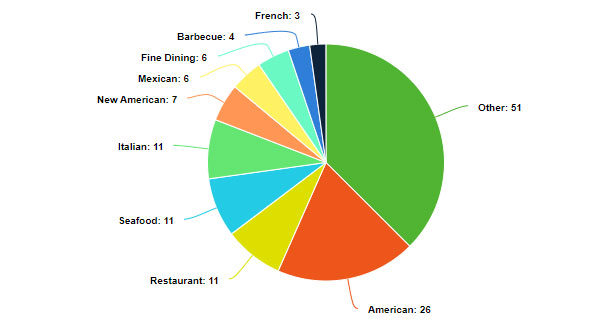
Instead, what we’ve discovered is that restaurants of every category can make it into the top 3. Fifty-one percent of the ranking restaurants hailed from highly diverse categories, including Pacific Northwest Restaurant, Pacific Rim Restaurant, Organic, Southern, Polish, Lebanese, Eclectic and just about every imaginable designation. American Restaurant is winning out in bulk with 26 percent of the take, and an additional 7 percent for New American Restaurant. I find this an interesting commentary on the nation’s present gustatory aesthetic as it may indicate a shift away from what might be deemed fancy fare to familiar, homier plates.
Overall, though, we see the celebrated American “melting pot” perfectly represented when searchers seek the best restaurant in any given city. Your client’s food niche, however specialized, should prove no barrier to entry in the local packs.
High prices don’t automatically equal “best”
Do Google’s picks for “best restaurants” share a pricing structure?
It will cost you more than $1000 per head to dine at Urasawa, the nation’s most expensive eatery, and one study estimates that the average cost of a restaurant meal in the US is $12.75. When we look at the price attribute on Google listings, we find that the designation “best” is most common for establishments with charges that fall somewhere in between the economical and the extravagant.
Fifty-eight percent of the top ranked restaurants for our search have the $$ designation and another 25 percent have the $$$. We don’t know Google’s exact monetary value behind these symbols, but for context, a Taco Bell with its $1–$2 entrees would typically be marked as $, while the fabled French Laundry gets $$$$ with its $400–$500 plates. In our study, the cheapest and the costliest restaurants make up only a small percentage of what gets deemed “best.”
There isn’t much information out there about Google’s pricing designations, but it’s generally believed that they stem at least in part from the attribute questions Google sends to searchers. So, this element of your clients’ listings is likely to be influenced by subjective public sentiment. For instance, Californians’ conceptions of priciness may be quite different from North Dakotans’. Nevertheless, on the national average, mid-priced restaurants are most likely to be deemed “best.”
Of anecdotal interest: The only locale in which all 3 top-ranked restaurants were designated at $$$$ was NYC, while in Trenton, NJ, the #1 spot in the local pack belongs to Rozmaryn, serving Polish cuisine at $ prices. It’s interesting to consider how regional economics may contribute to expectations, and your smartest restaurant clients will carefully study what their local market can bear. Meanwhile, 7 of the 150 restaurants we surveyed had no pricing information at all, indicating that Google’s lack of adequate information about this element doesn’t bar an establishment from ranking.
Less than 5 stars is no reason to despair
Is perfection a prerequisite for “best”?
Negative reviews are the stuff of indigestion for restaurateurs, and I’m sincerely hoping this study will provide some welcome relief. The average star rating of the 150 “best” restaurants we surveyed is 4.5. Read that again: 4.5. And the number of perfect 5-star joints in our study? Exactly zero. Time for your agency to spend a moment doing deep breathing with clients.
The highest rating for any restaurant in our data set is 4.8, and only three establishments rated so highly. The lowest is sitting at 4.1. Every other business falls somewhere in-between. These ratings stem from customer reviews, and the 4.5 average proves that perfection is simply not necessary to be “best.”
Breaking down a single dining spot with 73 reviews, a 4.6 star rating was achieved with fifty-six 5-star reviews, four 4-star reviews, three 3-star reviews, two 2-star reviews, and three 1-star reviews. 23 percent of diners in this small review set had a less-than-ideal experience, but the restaurant is still achieving top rankings. Practically speaking for your clients, the odd night when the pho was gummy and the paella was burnt can be tossed onto the compost heap of forgivable mistakes.
Review counts matter, but differ significantly
How many reviews do the best restaurants have?
It’s folk wisdom that any business looking to win local rankings needs to compete on native Google review counts. I agree with that, but was struck by the great variation in review counts across the nation and within given packs. Consider:
35 percent of “best”-ranked restaurants have between 100–499 reviews and another 31 percent have between 500–999 reviews. Taken together that’s 66 percent of contenders having yet to break 1,000 reviews.
A restaurant with less than 100 reviews has only a 1 percent chance of ranking for this type of search.
Anecdotally, I don’t know how much data you would have to analyze to be able to find a truly reliable pattern regarding winning review counts. Consider the city of Dallas, where the #1 spot has 3,365 review, but spots #2 and #3 each have just over 300. Compare that to Tallahassee, where a business with 590 reviews is coming in at #1 above a competitor with twice that many. Everybody ranking in Boise has well over 1,000 reviews, but nobody in Bangor is even breaking into the 200s.
The takeaways from this data point is that the national average review count is 893 for our “best” search, but that there is no average magic threshold you can tell a restaurant client they need to cross to get into the pack. Totals vary so much from city to city that your best plan of action is to study the client’s market and strongly urge full review management without making any promise that hitting 1,000 reviews will ensure them beating out that mysterious competitor who is sweeping up with just 400 pieces of consumer sentiment. Remember, no local ranking factor stands in isolation.
Best restaurants aren’t best at owner responses
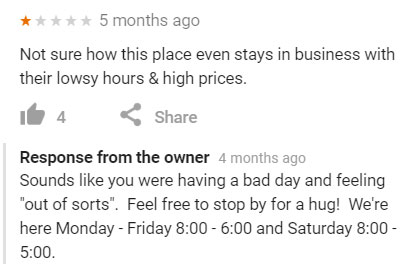
How many of America’s top chophouses have replied to reviews in the last 60 days?
With a hat tip to Jason Brown at the Local Search Forum for this example of a memorable owner response to a negative review, I’m sorry to say I have some disappointing news. Only 29 percent of the restaurants ranked best in all 50 states had responded to their reviews in the 60 days leading up to my study. There were tributes of lavish praise, cries for understanding, and seething remarks from diners, but less than one-third of owners appeared to be paying the slightest bit of attention.
On the one hand, this indicates that review responsiveness is not a prerequisite for ranking for our desirable search term, but let’s go a step further. In my view, whatever time restaurant owners may be gaining back via unresponsiveness is utterly offset by what they stand to lose if they make a habit of overlooking complaints. Review neglect has been cited as a possible cause of business closure. As my friends David Mihm and Mike Blumenthal always say:“Your brand is its reviews” and mastering the customer service ecosystem is your surest way to build a restaurant brand that lasts.
For your clients, I would look at any local pack with neglected reviews as representative of a weakness. Algorithmically, your client’s active management of the owner response function could become a strength others lack. But I’ll even go beyond that: Restaurants ignoring how large segments of customer service have moved onto the web are showing a deficit of commitment to the long haul. It’s true that some eateries are famous for thriving despite offhand treatment of patrons, but in the average city, a superior commitment to responsiveness could increase many restaurants’ repeat business, revenue and rankings.
Critic reviews nice but not essential
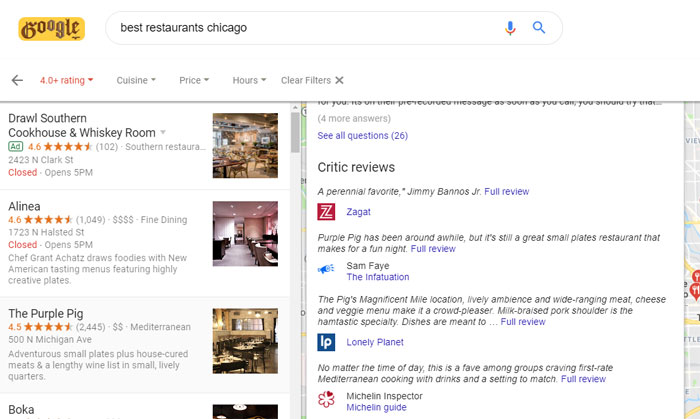
I’ve always wanted to investigate critic reviews for restaurants, as Google gives them a great deal of screen space in the listings:
How many times were critic reviews cited in the Google listings of America’s best restaurants and how does an establishment earn this type of publicity?
With 57 appearances, Lonely Planet is the leading source of professional reviews for our search term, with Zagat and 10Best making strong showings, too. It’s worth noting that 70/150 businesses I investigated surfaced no critic reviews at all. They’re clearly not a requirement for being considered “best”, but most restaurants will benefit from the press. Unfortunately, there are few options for prompting a professional review. To wit:
Lonely Planet — Founded in 1972, Lonely Planet is a travel guide publisher headquartered in Australia. Critic reviews like this one are written for their website and guidebooks simultaneously. You can submit a business for review consideration via this form, but the company makes no guarantees about inclusion.
Zagat — Founded in 1979, Zagat began as a vehicle for aggregating diner reviews. It was purchased by Google in 2011 and sold off to The Infatuation in 2018. Restaurants can’t request Zagat reviews. Instead, the company conducts its own surveys and selects businesses to be rated and reviewed, like this.
10Best — Owned by USA Today Travel Media Group, 10Best employs local writers/travelers to review restaurants and other destinations. Restaurants cannot request a review.
The Infatuation — Founded in 2009 and headquartered in NY, The Infatuation employs diner-writers to create reviews like this one based on multiple anonymous dining experiences that are then published via their app. The also have a SMS-based restaurant recommendation system. They do not accept request from restaurants hoping to be reviewed.
AFAR — Founded in 2009, AFAR is a travel publication with a website, magazine, and app which publishes reviews like this one. There is no form for requesting a review.
Michelin — Founded as a tire company in 1889 in France, Michelin’s subsidiary ViaMichelin is a digital mapping service that houses the reviews Google is pulling. In my study, Chicago, NYC and San Francisco were the only three cities that yielded Michelin reviews like this one and one article states that only 165 US restaurants have qualified for a coveted star rating. The company offers this guide to dining establishments.
As you can see, the surest way to earn a professional review is to become notable enough on the dining scene to gain the unsolicited notice of a critic.
Google Posts hardly get a seat at best restaurant tables
How many picks for best restaurants are using the Google Posts microblogging feature?
As it turns out, only a meager 16 percent of America’s “best” restaurants in my survey have made any use of Google Posts. In fact, most of the usage I saw wasn’t even current. I had to click the “view previous posts on Google” link to surface past efforts. This statistic is much worse than what Ben Fisher found when he took a broader look at Google Posts utilization and found that 42 percent of local businesses had at least experimented with the feature at some point.
For whatever reason, the eateries in my study are largely neglecting this influential feature, and this knowledge could encompass a competitive advantage for your restaurant clients.
Do you have a restaurateur who is trying to move up the ranks? There is some evidence that devoting a few minutes a week to this form of microblogging could help them get a leg up on lazier competitors.
Google Posts are a natural match for restaurants because they always have something to tout, some appetizing food shot to share, some new menu item to celebrate. As the local SEO on the job, you should be recommending an embrace of this element for its valuable screen real estate in the Google Business Profile, local finder, and maybe even in local packs.
Waiter, there’s some Q&A in my soup
What is the average number of questions top restaurants are receiving on their Google Business Profiles?
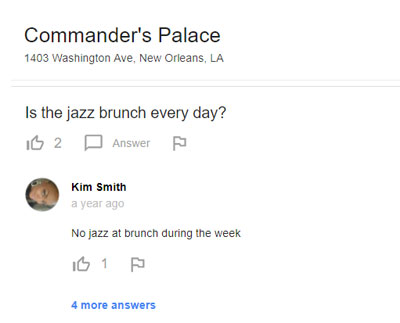
Commander’s Palace in New Orleans is absolutely stealing the show in my survey with 56 questions asked via the Q&A feature of the Google Business Profile. Only four restaurants had zero questions. The average number of questions across the board was eight.
As I began looking at the data, I decided not to re-do this earlier study of mine to find out how many questions were actually receiving responses from owners, because I was winding up with the same story. Time and again, answers were being left up to the public, resulting in consumer relations like these:
Takeaway: As I mentioned in a previous post, Greg Gifford found that 40 percent of his clients’ Google Questions were leads. To leave those leads up to the vagaries of the public, including a variety of wags and jokesters, is to leave money on the table. If a potential guest is asking about dietary restrictions, dress codes, gift cards, average prices, parking availability, or ADA compliance, can your restaurant clients really afford to allow a public “maybe” to be the only answer given?
I’d suggest that a dedication to answering questions promptly could increase bookings, cumulatively build the kind of reputation that builds rankings, and possibly even directly impact rankings as a result of being a signal of activity.
Looking at both the landing page that Google listings are pointing to and the overall authority of each restaurant’s domain, I found that:
The average PA is 36, with a high of 56 and a low of zero being represented by one restaurant with no website link and one restaurant appearing to have no website at all.
The average DA is 41, with a high of 88, one business lacking a website link while actually having a DA of 56 and another one having no apparent website at all. The lowest linked DA I saw was 6.
PA/DA do not = rankings. Within the 50 local packs I surveyed, 32 of them exhibited the #1 restaurant having a lower DA than the establishments sitting at #2 or #3. In one extreme case, a restaurant with a DA of 7 was outranking a website with a DA of 32, and there were the two businesses with the missing website link or missing website. But, for the most part, knowing the range of PA/DA in a pack you are targeting will help you create a baseline for competing.
While pack DA/PA differs significantly from city to city, the average numbers we’ve discovered shouldn’t be out-of-reach for established businesses. If your client’s restaurant is brand new, it’s going to take some serious work to get up market averages, of course.
Local Search Ranking Factors 2019 found that DA was the 9th most important local pack ranking signal, with PA sitting at factor #20. Once you’ve established a range of DA/PA for a local SERP you are trying to move a client up into, your best bet for making improvements will include improving content so that it earns links and powering up your outreach for local links and linktations.
Google’s Local Finder “web results” show where to focus management
Which websites does Google trust enough to cite as references for restaurants?
As it turns out, that trust is limited to a handful of sources:
As the above pie chart shows:
The restaurant’s website was listed as a reference for 99 percent of the candidates in our survey. More proof that you still need a website in 2019, for the very good reason that it feeds data to Google.
Yelp is highly trusted at 76 percent and TripAdvisor is going strong at 43 percent. Your client is likely already aware of the need to manage their reviews on these two platforms. Be sure you’re also checking them for basic data accuracy.
OpenTable and Facebook are each getting a small slice of Google trust, too.
Not shown in the above chart are 13 restaurants that had a web reference from a one-off source, like the Des Moines Register or Dallas Eater. A few very famous establishments, like Brennan’s in New Orleans, surfaced their Wikipedia page, although they didn’t do so consistently. I noticed Wikipedia pages appearing one day as a reference and then disappearing the next day. I was left wondering why.
For me, the core takeaway from this factor is that if Google is highlighting your client’s listing on a given platform as a trusted web result, your agency should go over those pages with a fine-toothed comb, checking for accuracy, activity, and completeness. These are citations Google is telling you are of vital importance.
A few other random ingredients
As I was undertaking this study, there were a few things I noted down but didn’t formally analyze, so consider this as mixed tapas:
Menu implementation is all over the place. While many restaurants are linking directly to their own website via Google’s offered menu link, some are using other services like Single Platform, and far too many have no menu link at all.
Reservation platforms like Open Table are making a strong showing, but many restaurants are drawing a blank on this Google listing field, too. Many, but far from all, of the restaurants designated “best” feature Google’s “reserve a table” function which stems from partnerships with platforms like Open Table and RESY.
Order links are pointing to multiple sources including DoorDash, Postmates, GrubHub, Seamless, and in some cases, the restaurant’s own website (smart!). But, in many cases, no use is being made of this function.
Photos were present for every single best-ranked restaurant. Their quality varied, but they are clearly a “given” in this industry.
Independently-owned restaurants are the clear winners for my search term. With the notable exception of an Olive Garden branch in Parkersburg, WV, and a Cracker Barrel in Bismarck, ND, the top competitors were either single-location or small multi-location brands. For the most part, neither Google nor the dining public associate large chains with “best”.
Honorable mentions go to Bida Manda Laotian Bar & Grill for what looks like a gorgeous and unusual restaurant ranking #1 in Raleigh, NC and to Kermit’s Outlaw Kitchen of Tupelo, MS for the most memorable name in my data set. You can get a lot of creative inspiration from just spending time with restaurant data.
A final garnish to our understanding of this data
I want to note two things as we near the end of our study:
Local rankings emerge from the dynamic scenario of Google’s opinionated algorithms + public opinion and behavior. Doing Local SEO for restaurants means managing a ton of different ingredients: website SEO, link building, review management, GBP signals, etc. We can’t offer clients a generic “formula” for winning across the board. This study has helped us understand national averages so that we can walk into the restaurant space feeling conversant with the industry. In practice, we’ll need to discover the true competitors in each market to shape our strategy for each unique client. And that brings us to some good news.
As I mentioned at the outset of this survey, I specifically avoided proximity as an influence by searching as a traveler to other destinations would. I investigated one local pack for each major city I “visited”. The glad tidings are that, for many of your restaurant clients, there is going to be more than one chance to rank for a search like “best restaurants (city)”. Unless the eatery is in a very small town, Google is going to whip up a variety of local packs based on the searcher’s location. So, that’s something hopeful to share.
What have we learned about restaurant local SEO?
A brief TL;DR you can share easily with your clients:
While the US shows a predictable leaning towards American restaurants, any category can be a contender. So, be bold!
Mid-priced restaurants are considered “best” to a greater degree than the cheapest or most expensive options. Price for your market.
While you’ll likely need at least 100 native Google reviews to break into these packs, well over half of competitors have yet to break the 1,000 mark.
An average 71 percent of competitors are revealing a glaring weakness by neglecting to respond to reviews – so get in there and start embracing customer service to distinguish your restaurant!
A little over half of your competitors have earned critic reviews. If you don’t yet have any, there’s little you can do to earn them beyond becoming well enough known for anonymous professional reviewers to visit you. In the meantime, don’t sweat it.
About three-quarters of your competitors are completely ignoring Google Posts; gain the advantage by getting active.
Potential guests are asking nearly every competitor questions, and so many restaurants are leaving leads on the table by allowing random people to answer. Embrace fast responses to Q&A to stand out from the crowd.
With few exceptions, devotion to authentic link earning efforts can build up your PA/DA to competitive levels.
Pay attention to any platform Google is citing as a resource to be sure the information published there is a complete and accurate.
The current management of other Google Business Profile features like Menus, Reservations and Ordering paints a veritable smorgasbord of providers and a picture of prevalent neglect. If you need to improve visibility, explore every profile field that Google is giving you.
A question for you: Do you market restaurants? Would you be willing to share a cool local SEO tactic with our community? We’d love to hear about your special sauce in the comments below.
Wishing you bon appétit for working in the restaurant local SEO space, with delicious wins ahead!