Monday, 2 December 2019

Snoopy On Google Bike

Snoopy On Google Bike In NYC

Here is a photo of the iconic Snoopy character on a rare Google bike in the Google NYC office. Yea, you don’t find many Google bikes in the New York office, most of them are in the Mountain View, California office.

The NY office has mostly scooters. Anyway, Snoopy found the bike and used it.

I found this on Instagram.

This post is part of our daily Search Photo of the Day column, where we find fun and interesting photos related to the search industry and share them with our readers.

This marketing news is not the copyright of Scott.Services – please click here to see the original source of this article. Author: barry@rustybrick.com (Barry Schwartz)

For more SEO, PPC, internet marketing news please check out https://news.scott.services

Why not check out our SEO, PPC marketing services at https://www.scott.services

We’re also on:
https://www.facebook.com/scottdotservices/
https://twitter.com/scottdsmith
https://plus.google.com/112865305341039147737

The post Snoopy On Google Bike appeared first on Scott.Services Online Marketing News.


source https://news.scott.services/snoopy-on-google-bike/

Sunday, 1 December 2019

Google’s Penguin Room – Giorgio’s Center

Google's Penguin Room - Giorgio's Center

Here is a photo of one of the rooms at the Google Zurich office – we know they have a Penguin Ave sign but here is a photo of a room that looks to be designed with Penguins. It is named Giorgio’s Center.

I found this photo on Instagram.

This post is part of our daily Search Photo of the Day column, where we find fun and interesting photos related to the search industry and share them with our readers.

This marketing news is not the copyright of Scott.Services – please click here to see the original source of this article. Author: barry@rustybrick.com (Barry Schwartz)

For more SEO, PPC, internet marketing news please check out https://news.scott.services

Why not check out our SEO, PPC marketing services at https://www.scott.services

We’re also on:
https://www.facebook.com/scottdotservices/
https://twitter.com/scottdsmith
https://plus.google.com/112865305341039147737

The post Google’s Penguin Room – Giorgio’s Center appeared first on Scott.Services Online Marketing News.


source https://news.scott.services/googles-penguin-room-giorgios-center/

Eight tools you need for backlink generation

Eight tools you need for backlink generation

So you’ve created your website, following all the recommended SEO best practices.

That means you’ve included valuable, relevant keywords on your pages, made it mobile friendly and even started a blog that you’re updating frequently with original, relevant content.

But despite your best efforts, you’re not seeing as much traffic as you’d like, and your site is still ranking too low on Google’s Search Engine Results Page (SERP). It could be that your site is missing just one thing: backlinks.

Backlinks are links from another website that point to your website. Getting backlinks from websites with high domain authority that are relevant to your niche will help you rank higher on Google searches and grab your audience’s attention.

Why is there such an emphasis on backlinks? Google’s Search Engine Results Page (SERP) uses them to discover new pages, confirm pages are legitimate and determine the popularity of these pages. After all, Google doesn’t want to risk its own reputation by ranking subpar sites high on the SERP. According to a study by Backlinko, the number of domains linking to a webpage “correlated with rankings more than any other factor”.

Backlink generation isn’t easy, especially for new businesses or businesses just starting to build their web presence. However, with time, effort and the right tools, you can make sure you’re ranking high and receiving the views you deserve.

If you’re a business owner and want to boost your backlinks, here are eight tools to get you started.

1. MozBarScreenshot of MozBar

MozBar is a free SEO toolbar you download onto your web browser. It shows you the domain authority (DA) of a certain website, which gives you an indication of whether or not you should reach out for a backlink. If you do earn a backlink from a website with a DA, this will positively affect your own site’s authority.

In terms of DA, it ranges from 1 to 100, and the higher, the better. There’s no ideal number to look for, but generally, try finding sites with excellent content that relate to your field. If the DA is, say, a 35, that won’t help you as much as a site with a 75, but it won’t hurt, either. Research sites thoroughly and makes sure they aren’t spammy before pursuing them.

2. SEMrushScreenshot of SEMrush

SEMrush, which helps with all types of marketing strategies, shows users a few key tools for backlink generation. When logged into the paid version, you can navigate to the mentions section and find which websites are mentioning you but not linking to you. Once you discover these mentions, you can reach out and ask for a link to your site (as long as the site is relevant and has a high DA), which will boost your rankings.

Another tactic is to go into the backlink audit and see who’s currently linking to your website. Check to see if the link appears underneath the proper SEO-rich keyword and if the site is legitimate and relevant. (If the site is not legitimate, you may want to reach out and ask them to take it down, since that backlink can potentially hurt your ranking.)

While on SEMrush, try the backlink gap tool, which shows you which backlink opportunities your competitors are not taking advantage of. Then, you can reach out and ask for those valuable backlinks instead.

3. PitchboxScreenshot of Pitchbox

Pitchbox is a platform to find websites that may want to spread the news about your business or backlink to your pages or content. You simply sign up for Pitchbox, log in, paste the link to the page/content you’re doing backlink generation for and add in some specific keywords you’re looking to target. Then, in a minute or two, Pitchbox will come up with (usually) hundreds of websites you can reach out to.

You can filter for or delete any websites with low domain authority, and go through the sites one by one to see which are valuable. You can reach out to these websites using a Pitchbox email template. Pitchbox will show you the contacts for that site (or allow you to manually input them), automatically place in the person’s name and their website name, and send as many follow-up emails as you’d like.

When using Pitchbox, double check the contacts to make sure they’re current. Another best practice is to email a maximum of two people at the website since you don’t want to spam numerous people within an organization. If you’re having trouble with backlink generation, consider offering a backlink exchange. Just make sure, again, that the site you’re promising to link to relevant to yours and not spammy.

4. AhrefsScreenshot of Ahrefs

Ahrefs is similar to SEMrush and allows you to use the platform’s backlinks checker to view your current backlinks. Since they’ve already linked to your content before, you can ask these sites to link back to your other pages as well. Ahrefs also allows you to disavow toxic backlinks that might hurt your ranking.

Another helpful backlink generation tool is the Ahrefs Site Explorer. By entering the name of your competitor, you can see all of their referring backlinks. Using that information, you can reach out to the same sites that are linking to your competitors and see if they want to link to a valuable piece of content from your site.

5. Google AlertsScreenshot of Google Alerts
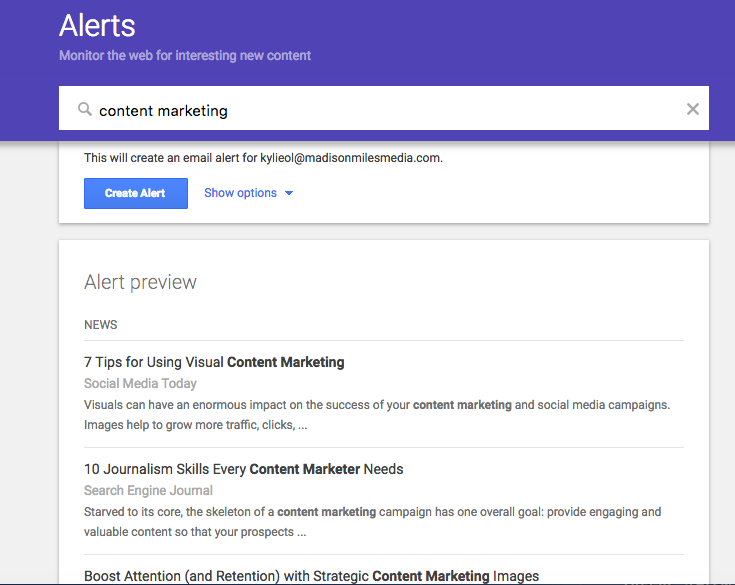
Let’s say you don’t have time to log onto SEMrush or Ahrefs every day and go through your mentions and backlinks. Instead, sign up for Google Alerts, which will email you when you’re mentioned somewhere. Visit the websites that mention you and try to find the contact information for someone you can reach out to there. If you can’t find them, log onto Hunter.io, which is a free tool for finding email addresses using only a domain name.

6. Broken Link Builder

Screenshot of Broken Link Builder

Somebody’s broken link can be your backlinking opportunity with Broken Link Builder. With this tool, you can find dead websites and their respective backlinks, and then offer up similar content to the website that was linking to the dead link. It’s a white-hat SEO tactic that benefits both webmasters and backlink seekers. Broken Link Builder only takes 30 to 60 minutes to generate a report for you to find valuable backlinking opportunities.

7. Majestic
Screenshot of Majestic

Majestic is a backlinking tool, like SEMrush and Ahrefs, that examines all the backlinks for your website, as well as your competitors, and allows you to perform very specific searches. You can search and filter backlinks however you choose, including by crawl or discovery dates, anchor text, link type, URL snippet or merchant ID. Majestic also claims to have the largest index out of any other service.

8. Linkody

Screenshot of Linkody

Linkody is another platform for tracking and performing research on backlinks. It tells you when you lose or gain links, and you can disavow bad links. You’re able to see your competitors’ backlinks and analyze your own link profile. You can choose to receive daily notifications in your inbox, view which links point to your landing pages and connect your Linkody and Google Analytics accounts for more backlink information. If you don’t want to pay for the service, you can use Linkody’s Free Backlink Checker to check two unique domains per week.

Tracking backlinks

With backlink generation, you need to track your efforts. A good place to do this is within a Google Sheet. Create a spreadsheet and share it with your team working on backlinks. They should input information like the date the backlink was pursued, the DA of the website, the URL of the website, the target URL of your content or page, the date the backlink was added, the contact’s email address and any notes about the process. Then, when you’re doing another round of backlink generation, you can refer to your Google sheet and reach out to the same people to see if they’d like to link to something else of yours.

Backlinks will always be part of Google’s ranking requirements. Understanding their importance and learning how to use these tools empowers you to do effective backlink generation that can increase your rankings and bring in more visitors to your site.

Mario Medina is a content strategist. He can be found on Twitter .

Related reading

Common technical SEO issues and fixes, for aggregators and finance brands
faceted navigation in ecommerce
marketing automation for SEOs, five time-saving strategies
A primer to forecasting the value of SEO

This marketing news is not the copyright of Scott.Services – please click here to see the original source of this article. Author: Mario Medina

For more SEO, PPC, internet marketing news please check out https://news.scott.services

Why not check out our SEO, PPC marketing services at https://www.scott.services

We’re also on:
https://www.facebook.com/scottdotservices/
https://twitter.com/scottdsmith
https://plus.google.com/112865305341039147737

The post Eight tools you need for backlink generation appeared first on Scott.Services Online Marketing News.


source https://news.scott.services/eight-tools-you-need-for-backlink-generation/

How I got 80% open rate in my email outreach campaign

achieving 80% email open rate

The suggestion that you could have 80% of your outreach read by recipients sounds like a pipedream — an astronomical figure designed to keep people plugging away on their outbox. 

With such a small canvas of visible information in a recipient’s inbox to work with, it can feel like enticing four out of every five targets to open your email is impossible.

But if you incorporate the right approaches, then it can very much become a reality. Just to give you the heads up, here’re some results we’ve managed to get in our recent outreach campaign:

In the following article, I’ve explored the ingredients needed to get 80% of your outreach messages viewed. So perhaps you’d like to pour yourself a coffee and brace yourself for an awful lot more audience interaction in the near future — the caffeine might come in handy.

Identify your targets

There are five key factors behind achieving a high open rate in your email outreach, and the first and most important is through identifying the right recipients.

A common mistake among many outreachers is their shotgun approach to distributing emails. While scattering mail across the internet into as many inboxes that can be sourced may seem like a good, time-saving and quantitative technique, it actually wastes more time that could be better invested in finding quality recipients.

Before a successful outreach campaign, you’ll need to dedicate some time to the preparation stage. Identify who your ideal responder would be, whether it’s a client, customer, consumer or collaborator, and work on devising a list of the perfect targets that fit the description.

Through the use of opt-ins and calls-to-action, you can have an interested recipient base come to you with minimal fuss and is a sure-fire approach to sending marketing emails to those most likely to view your content. By inviting your website’s visitors to subscribe to your mailing list via an effective call-to-action placed on your homepage, you get to save time on research and effortlessly come into possession of hundreds of emails – a great outreach method for websites that are in a position to offer a product or service to thousands of people.

For outreach emails with more link-building intentions sourcing becomes more difficult. If you’ve decided to target industry professionals and influencers, then tools like Email Hunter and Voila Norbert could be the answer — these services scour the internet for the relevant email addresses behind just about any active website and can help you hit the bulls-eye when it comes to finding the right people to get in contact with.

domain search for emails for search engine watch

Mastering the subject line

According to a poll conducted via Litmus, 34% of recipients believe that an email subject line is the most important factor in helping them to decide to open their mail. This means that over 1/3 of your targets for outreach will be waiting for a perfect heading before clicking on your message.

These stats illustrate how important it is to get your subject line right, and there are many schools of thought behind what’s most effective and what isn’t.

Of course, each subject line will vary depending on the type of outreach you conduct, but the best practice is to appeal to people’s curiosity, to make them believe they’ll be gaining something if they read your email – which of course they will if your campaign has been constructed well enough.

screenshot of how email outreach goes to

A winning subject line needs to be short, personal wherever possible, and relevant to the topics covered by your email. Sometimes being upfront can be effective, especially when it comes to outreaching savvy marketers and bloggers.

There are a few other factors that can make all the difference in making your email stand out too. Incorporating emojis into your heading may risk your content appearing puerile, but with the vast catalogue of emojis that are more serious than a winking yellow circle with a tongue sticking out, you can really add some standout imagery and colour to your title. For example, travel companies have been using holiday-themed emojis like aeroplanes and city skylines to great effect in capturing the imagination of recipients — if you can find something relevant that appeals to the aesthetics of your email, then it could be a key addition to make.

With so many individuals checking their inboxes via their smartphones, keeping your subject lines short and punchy has never been more important — make sure you get your message across in less than 50 characters.

By adding an element of urgency to your headline, recipients will feel more compelled to check its contents. You can exercise this by adding a sense of limited-time opportunity to your subject, or by inviting them to respond before a deadline — the chances are that they’ll be curious as to what’s caused the urgency and read on.

Don’t be afraid to ask questions in your subject line too — this can be seen as a way of cutting to the chase and getting your message across immediately.

Making use of your preview snippets

Many inboxes have menus that not only feature an unread email’s subject line but a snippet of text from the beginning of a message. It’s important not to neglect the opening lines of your email because this could be a key factor in whether or not it gets read or moved to the ‘junk’ folder.

Litmus has stated that 24% of recipients check the text previews of emails, so it’s worth dedicating time to.

The most important part of nailing your email opening is personalization. Make sure it begins with ‘Dear, [Name]’ or ‘Hi [Name],’ where possible – any less than this will give off the strong impression that you’re simply using templates to scatter across the web (which may well be the case, but we don’t want them to know that).

An effective use of the preview snippet is to treat it like a secondary subject line, or to summarize the email in the first line – doing so could be the deciding factor while your target’s hovering over your message in their inbox. If you’re using an email marketing software, make sure to use these two rules in every template.

Keeping your sender reputation in check

You could have compiled the best list of targeted recipients, the best subject line and opening text, all for it to be undone by a sender score that’s so low that your email drops straight into the junk folder never to be seen again.

Email providers are designed to give their users the best experience. And part of that is through whittling down any perceived junk automatically by filtering out any messages from users with a low sender score.

A sender score is calculated by prior interactions, and how many users generally open your emails. A great website to check if your current email address passes most servers’ junk filters is to consult Senderscore.org, which will let you know how your email is faring, and whether or not your messages will make it to the inboxes of your recipients.

sender score metrics for search engine watch

Effective follow-ups

Don’t be afraid to follow up on your emails. It can be easy to perceive the use of follow-ups as a nuisance or spammy, but in reality, a second email tends to work wonders in getting your content noticed.

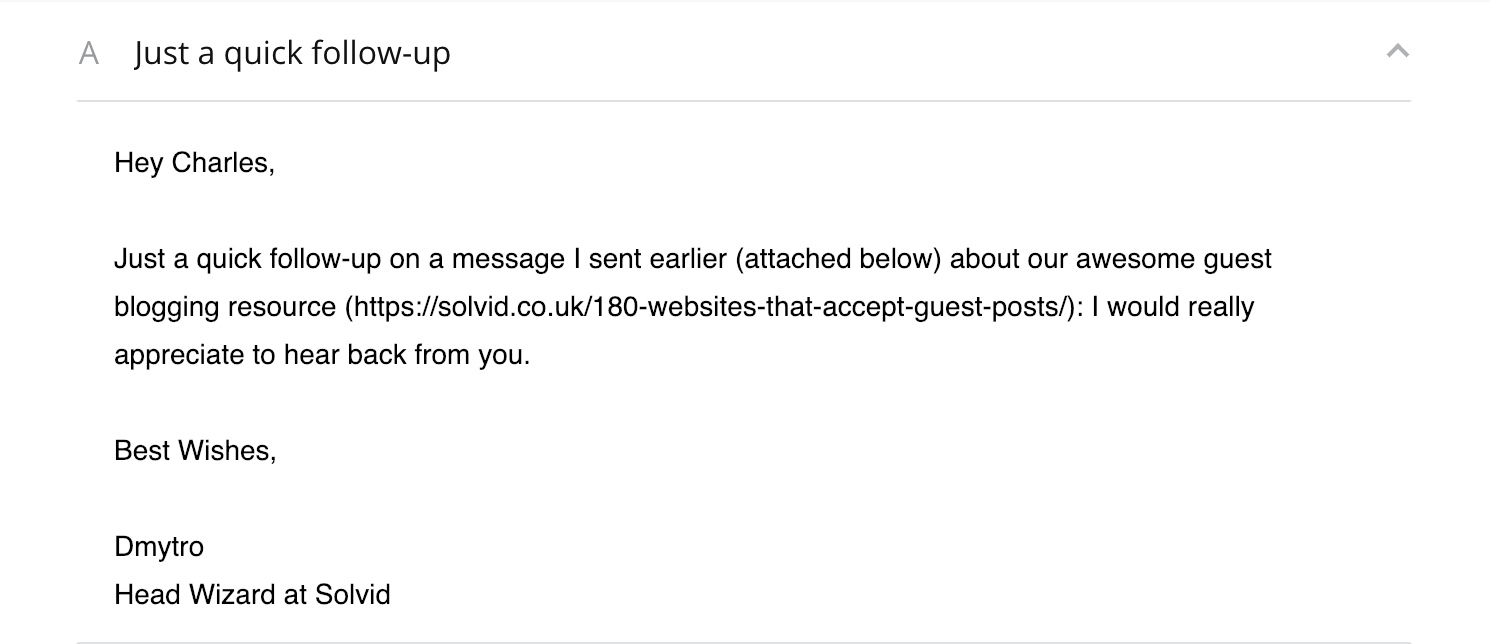
example of a follow up email for email outreach

There are many reasons why recipients don’t read emails the first time around; it could’ve been received at a busy time in their day, or deleted by accident, or simply missed. Here, a follow-up offers your target a second chance to see your content and acknowledge your outreach.

Be sure to specify that your email is a follow-up – this shows that you’ve been in touch prior and clearly value the recipient’s attention. Also be sure to note when you sent your initial email for ease of reference.

While it’s worth sending more than one follow-up email to maximize your recipient’s chances to respond, we advise against mailing more than two chasers in order to limit the risk of being considered spam, or worse, being blacklisted.

Dmytro Spilka is Head Wiz at Solvid Digital. He can be found on Twitter at @spilkadi.

Related reading

How to dominate Google News search in 2019
Conversation Mapping
lessons learned from launching 100+ campaigns
four tools to structure articles for SEO

This marketing news is not the copyright of Scott.Services – please click here to see the original source of this article. Author: Dmytro Spilka

For more SEO, PPC, internet marketing news please check out https://news.scott.services

Why not check out our SEO, PPC marketing services at https://www.scott.services

We’re also on:
https://www.facebook.com/scottdotservices/
https://twitter.com/scottdsmith
https://plus.google.com/112865305341039147737

The post How I got 80% open rate in my email outreach campaign appeared first on Scott.Services Online Marketing News.


source https://news.scott.services/how-i-got-80-open-rate-in-my-email-outreach-campaign/

Time to leave last touch attribution in the dust? Answer these 4 questions first

Retail marketers have debated the end of last touch attribution for over a decade now. In today’s omnichannel marketing world, where consumers shop across a variety of devices and channels, attributing a sale wholly to the last interaction before purchase is outdated and inefficient. That’s because you can overly emphasize low-funnel activities at the risk of neglecting efforts to fill the top of the funnel.

The customer journey has grown increasingly complex, so optimizing for a single action or channel ignores a much bigger picture of how consumers engage with a retailer’s brand messaging on the way to purchase.

A customer, for example, may discover a new product on Pinterest, rediscover that product through display ad retargeting, research the product via Amazon, and finally make the purchase after receiving a promotional email. This journey can occur across desktop, mobile and voice assistants. Valuing only the last touch, the email click ignores the very important role each marketing activity had in driving the sale and limits marketers’ ability to develop greater cross-channel cohesion.

While many marketers recognize the omnichannel nature of online retail and the limitations of last touch, few have made the switch to a more accurate, multi-touch attribution model. The reasons for this are varied. Changing marketing attribution can be time-consuming and requires lockstep collaboration across departments. Gaining buy-in from executives can also prove challenging because it is difficult to quantify the revenue and ROI payoff.

The end of last touch?

Despite these challenges and marketers’ inertia when it comes to last touch attribution, the time is now to audit your attribution model. You could gain an advantage over competitors who still use last touch by identifying new opportunities to grow your customer base and develop more impactful cross-channel marketing initiatives.

As competition grows on paid search, social and display marketing channels, and costs creep steadily higher, you will need to find a way to not simply spend more, but spend smarter. Multi-touch attribution provides a fresh perspective on performance and can point out which channels are contributing most to the sale but may be undervalued in terms of a marketing budget. A truly granular approach to attribution can even identify a specific ad creative that is outperforming other ads in your marketing mix.

Major advertising platforms like Google have also hinted that they will be moving away from a last touch attribution model. While last touch may not disappear entirely from Google Ads, Google will likely emphasize its multi-touch attribution reporting, and in particular Data-Driven Attribution (DDA), which uses algorithmic attribution to credit sales across Google’s ad properties.

All of these competitive and technological forces place retail marketers at a crossroads. Should you maintain the simplistic single touch approach or should you explore new attribution models?

Changing attribution models, particularly from something like last touch to one of the many multi-touch attribution models (U-shaped, W-Shaped, time-decay, algorithmic, etc.) is no easy task. That’s why it’s critical to evaluate whether this switch makes sense for your business. Before making an attribution change, ask yourself these four questions:

1. How many marketing channels do you advertise on?

Multi-touch attribution is most valuable for marketers who use a variety of channels to nurture consumers towards a sale. If you spend marketing dollars across email, Facebook, Google Shopping, paid search and Amazon, for instance, it may make sense to track attribution across all of these channels. That will help you identify the white space in your marketing efforts.

If, on the other hand, 90 percent of your marketing spend goes towards Facebook, for example, it may not make sense to invest in multi-touch attribution at this point. In the future, though, as marketing initiatives expand to new channels and grow in sophistication, you may want to consider evaluating various multi-touch models.

2. How many touches typically occur before the sale?

If you have a long buying cycle where every touch is important, an evenly weighted, linear attribution model or custom algorithmic-based model may make the most sense. A shorter sales cycle, on the other hand, may lead you towards an attribution model that weighs touches later in the sales cycle more heavily, such as a time decay model. If very few touches occur before the average sale, investing in a multi-touch attribution model may not make sense.

A simple way you can get a better view of your customer journey is by using the Multi-Channel Funnels reports in Google Analytics. In these reports, Google tracks how different referrals and searches contribute to a sale.

Google provides four different types of Multi-Channel Funnels reports. The Top Conversion Paths report shows how customers interacted with varying channels of marketing and searches before purchase. The Time Lag and Path Length reports show how long in days and interactions it took for users to become customers. And lastly, the Assisted Conversions report shows how many sales each channel initiated, assisted and completed, as well as the value of those conversions.

3. Can your business support a transition period to accurately report year-over-year metrics?

When you implement a new attribution model and use that new model as your source of truth, you lose the ability to make year-over-year comparisons with your data for the first year. Any sales data tracked with the last touch model, for example, cannot be compared to time decay attribution data.

If comparing year-over-year numbers is critical to your business, account for a year-long transition period. Plan to run your new attribution model alongside the legacy model for that first year. This allows for better data comparisons and doesn’t throw a wrench in year-over-year reporting.

4. Is competition making your performance marketing strategies less impactful?

Perhaps one of the biggest reasons to adopt a new attribution model is to discover the gaps in your marketing initiatives. If a certain channel or performance marketing campaign is no longer driving the same ROAS due to increased competition, it may be time to look at your data in a new way. A multi-touch attribution model can shine a light on a channel or campaign that seems to be underperforming in the last touch model but is contributing to sales when viewed in another way.

An easy way to view your campaigns through different attribution methods is by using the Google Analytics attribution model comparison tool, found under the “Conversions” tab in Google Analytics.

For example, in the below screenshot, you can see that performance for a paid search varies significantly when viewed through the lens of last touch, first touch, and position based (also known as U-Shaped) models. With the last touch model, it appears that paid search campaigns only contributed one conversion, at a costly CPA of $6,985.33. But first touch and positioned based models paint a completely different picture, with 69 and 34.69 conversions respectively.

In the last touch approach, paid search would be written off as a waste of time and ad spend, but in reality, the channel is helping fill the funnel by engaging shoppers early in their journey and nurturing them towards a purchase.

Attribution modeling provides a full-funnel advantage

Regardless of which attribution model you choose, it’s critical to start viewing performance marketing data in ways that more accurately reflect how your audience shops today. That means valuing the many channels and devices shoppers interact with and gaining a better grasp with how different marketing initiatives perform at different stages of the funnel. Investing in an attribution model that reflects these nuances will empower your organization to spend smarter than its competitors and identify previously overlooked initiatives that can grow the marketing funnel and your market share.

For retail marketers with a robust marketing strategy and an omnichannel sales approach, any attribution model is better than last touch.


Opinions expressed in this article are those of the guest author and not necessarily Marketing Land. Staff authors are listed here.


About The Author

Mike is a retail marketing strategist, fluent in paid search, shopping ads, affiliates, email, display, and comparison shopping engines. As Senior Director of Market & Customer Intelligence for Sidecar, Mike stays close to the shifting retail landscape and how it’s impacting marketing strategy. He has advised hundreds of marketers across retail verticals in the context of their business goals and the industry at large. Mike contributes to Marketing Land as well as Sidecar Discover.

This marketing news is not the copyright of Scott.Services – please click here to see the original source of this article. Author: Mike Farrell

For more SEO, PPC, internet marketing news please check out https://news.scott.services

Why not check out our SEO, PPC marketing services at https://www.scott.services

We’re also on:
https://www.facebook.com/scottdotservices/
https://twitter.com/scottdsmith
https://plus.google.com/112865305341039147737

The post Time to leave last touch attribution in the dust? Answer these 4 questions first appeared first on Scott.Services Online Marketing News.


source https://news.scott.services/time-to-leave-last-touch-attribution-in-the-dust-answer-these-4-questions-first/

GetResponse adds new webinar features, integrations with e-commerce, online payment and Facebook Ads

GetResponse, an inbound and outbound marketing platform, has announced expanded capabilities, including webinar support, e-commerce solutions, a new online payment gateway and Facebook advertising integrations.

The webinar capabilities include a new design that supports audio and video for HD streaming, live chat functionalities, Q&A management, recorder templates, Facebook and YouTube live streaming. Users can also customize calls-to-action.

GetResponse has deeper integrations with partners PrestaShop and WooCommerce for e-commerce solutions, Square for secure online payments and Facebook Ads. The features are directly accessible in GetResponse.

Why we should care

The company aims to make the platform a centralized place to manage and analyze integrated campaigns, including digital ads, emails, landing pages, social performance, webinars and e-commerce.

“Building on the success of our new Autofunnel offering, we’re delighted to continue to expand our platform’s features,” said GetResponse chief operating officer Daniel Brzezinski. “These new features provide marketers with an even more powerful turnkey solution for attracting, engaging and converting customers.”

Consolidation is a trending theme in martech these days — from mergers and acquisitions to new, deeper integrations. GetResponse anticipates that its customers will see stronger performance due to their integrated campaigns, as well as cost savings in eliminating the need to invest in additional platforms to support their efforts. By consolidating solutions into a single platform, marketers can also expect increased efficiencies.

More on the news

  • GetResponse has strengthened its integration with PrestaShop and WooCommerce for e-commerce, Square for online payments and Facebook for ad integration.
  • For Facebook ads, users simply upload their ad, select their audience and budget while GetResponse does the rest.
  • GetResponse currently supports over 350,000 customers in 182 countries

About The Author

Jennifer Videtta Cannon serves as Third Door Media’s Senior Editor, covering topics from email marketing and analytics to CRM and project management. With over a decade of organizational digital marketing experience, she has overseen digital marketing operations for NHL franchises and held roles at tech companies including Salesforce, advising enterprise marketers on maximizing their martech capabilities. Jennifer formerly organized the Inbound Marketing Summit and holds a certificate in Digital Marketing Analytics from MIT Sloan School of Management.

This marketing news is not the copyright of Scott.Services – please click here to see the original source of this article. Author:

For more SEO, PPC, internet marketing news please check out https://news.scott.services

Why not check out our SEO, PPC marketing services at https://www.scott.services

We’re also on:
https://www.facebook.com/scottdotservices/
https://twitter.com/scottdsmith
https://plus.google.com/112865305341039147737

The post GetResponse adds new webinar features, integrations with e-commerce, online payment and Facebook Ads appeared first on Scott.Services Online Marketing News.


source https://news.scott.services/getresponse-adds-new-webinar-features-integrations-with-e-commerce-online-payment-and-facebook-ads/

How marketers can take the lead with revenue optimization teams

Most marketers are equipped with copious amounts of data that help us understand our customers, create meaningful messaging that resonates with our audience and drives the business outcomes we need to achieve our goals. Marketers also have the ability to translate different trends across customers and prospects such as strong lead generation sources, common themes, objection trends and overall responses to different campaigns. But, many organizations operate in siloes, making it difficult to share these data points with the necessary people.

A solution? Establish a revenue optimization team to bring together the key internal players in your organization to improve alignment and ultimately, drive more revenue. 

Marketers and sales need to track the same goals

Thanks to the amount of valuable information accessible through our martech stacks, marketers can — and should — play a critical role in establishing a customer-centric revenue optimization team.

“Revenue optimization starts with the idea of putting the customer in the center of every interaction an enabling everyone to align around the customer to generate value in every interaction,” said Patrick Morrissey, chief marketing officer of customer revenue optimization platform, Altify. And according to Morrissey, marketers should play a critical role as part of the revenue team, and are best positioned to lead the charge. For many marketers, this requires a shift in thinking about our revenue contributions.

“From a marketing perspective, thinking about the fundamental outcomes, marketers have to start thinking of themselves as part of the revenue team,” said Morrissey. “This intersection presents an opportunity for marketers who are generally better communicators to become the translation mechanism for an entire team. Instead of tracking pipeline, marketers need to track revenue in closed/won business along with the sales team.”

The shift in mindset expands past the marketing team, however. According to Jenn DiMaria, senior manager of client services at marketing automation solution provider Digital Pi, the shift in mindset needs to be organizational. “Marketing is often viewed as a cost center, but in reality, other teams are lusting after the tools and data we have access to,” said DiMaria. “Aligning a revenue team creates opportunities for marketers to improve accessibility  to the data and help bridge gaps with other parts of the organization.” 

Marketers, get closer to the customer

Marketers tend to be far removed from any interactions with customers, but it is extremely valuable to engage face-to-face with customers. After all, marketers understand that relationship-building is key to retaining customers.  According to Morrissey, marketers need to put themselves in the shoes of the customer in order to understand their challenges.

“Marketers should focus on how we can get out of our own way and put ourselves in the shoes of the customers,” said Morrissey. “Going on the road to meet with salespeople and sit with customers will help marketers better understand the market, the broader changes in technology and fundamentally how to help customers succeed, personally and professionally.”

“Marketers need to have some real-world customer experience, explained Mary Ngai, founder of Connector42 and head of analytics and technology at RI. “Even if marketers are listening on sales calls, it can be incredibly insightful in grasping a better understanding of their needs.” Ngai also recommends that marketers attend customer site visits during ongoing projects or sales deals to increase visibility into accounts.

In addition to more face time with customers, Morrissey recommends that marketers lead internal account reviews and deal reviews with the sales and customer success teams. Regularly reviewing the accounts with members of different parts of the organization will expose different issues and areas that can be addressed by the necessary members of the revenue optimization team. Working with customer success can also bring to light what some of the daily challenges and successes the customer experiences — valuable insight for marketers as they developing retention campaigns to drive renewals. 

Leading the path to revenue optimization

Revenue optimization teams present an opportunity for marketers to leverage their communication, analytical and creative skills to improve holistic marketing efforts in coordination with other internal departments. 

“Marketers have proven that we can lead revenue optimization teams as we typically bear the brunt of the responsibility when it comes to acquiring new leads and we have to track our efforts,” said DiMaria. “Also, tools that have entered the market in the past ten years have made this possible.”

The concept of implementing a fundamental shift in thinking may seem overwhelming, but the long-term benefit is streamlined efforts across your organization and consistent communication around prospect and customer activities.

“If you think about the customer journey, we’re all trying to get a numeric view of the customer — BDRs are measured by the total number of call they make and are concerned with propensity-to-buy data,” said Morrissey. “Marketers are providing that data, creating segments and determining what funnel to put a prospect in. Then we talk about deal size or ACV, then finally we’re just an NPS score. Marketers are the ones who can best translate this into plain English, for everyone to understand.”


About The Author

Jennifer Videtta Cannon serves as Third Door Media’s Senior Editor, covering topics from email marketing and analytics to CRM and project management. With over a decade of organizational digital marketing experience, she has overseen digital marketing operations for NHL franchises and held roles at tech companies including Salesforce, advising enterprise marketers on maximizing their martech capabilities. Jennifer formerly organized the Inbound Marketing Summit and holds a certificate in Digital Marketing Analytics from MIT Sloan School of Management.

This marketing news is not the copyright of Scott.Services – please click here to see the original source of this article. Author:

For more SEO, PPC, internet marketing news please check out https://news.scott.services

Why not check out our SEO, PPC marketing services at https://www.scott.services

We’re also on:
https://www.facebook.com/scottdotservices/
https://twitter.com/scottdsmith
https://plus.google.com/112865305341039147737

The post How marketers can take the lead with revenue optimization teams appeared first on Scott.Services Online Marketing News.


source https://news.scott.services/how-marketers-can-take-the-lead-with-revenue-optimization-teams/