Monday, 30 April 2018

YouTube announces more moves to chip away at TV ad budgets

For years, digital platforms have courted TV advertising budgets, first via desktop campaigns, then with mobile-first efforts. Now, the pendulum is swinging back to the television screen. Consumers may be cutting their cable cords, but they’re still using their televisions or Smart TVs with OTT and streaming devices and gaming consoles.

YouTube says TV is now its fastest-growing screen in terms of watch time, with over 150 hours viewed per day. “We’re amidst the second major shift in how people watch video on YouTube. In the past few years, we witnessed mobile viewership exceed desktop, marking the first major shift in how people interacted with YouTube,” said Debbie Weinstein, managing director for YouTube/Video Global Solutions, in the announcement.

On Sunday, YouTube announced several initiatives to help advertisers reach TV screen viewers.

YouTube TV to sell ads through Google Preferred network

YouTube says its own paid streaming service that packages content from network and cable outlets, YouTube TV, is now available in more than 100 TV markets in the US. The company is now making YouTube TV programming part of Google Preferred, its premium video advertising program. YouTube will sell ads on content from some US cable networks participating in YouTube TV via the Preferred network.

Ads will be inserted dynamically, “giving advertisers the ability to show relevant ads to the right audiences, rather than just showing everyone the same ad as they might on traditional TV,” said Weinstein.

in AdWords and DoubleClick Bid Manager, advertisers will be able to target their YouTube campaigns specifically to TV screens — in addition to computers, mobile phones and tablets.

This will allow advertisers to adjust bids to TV screens or serve creative tailored to a TV viewing experience.

Light TV viewers audience

A Google-commissioned Nielsen study found more than half of 18- to 49-year-olds in the US are either light viewers of TV or do not subscribe to traditional TV services.

To reach the growing audience of consumers who aren’t tuning into TV traditionally, Google has created a new audience segment in AdWords called “light TV viewers.”

The audience can be targeted across screens.

These moves can be seen as a part of the screen-agnostic evolution and exponential growth in digital video ad spend. According to Zenith, global digital video ad spend overtook television advertising for the first time in 2017 and is expected to continue to gain. YouTube is positioning itself to capitalize on both consumer adoption of OTT and streaming trends and the growth in digital video ad spend to keep chipping away at traditional TV ad budgets.


About The Author

Ginny Marvin is Third Door Media’s Associate Editor, assisting with the day to day editorial operations across all publications and overseeing paid media coverage. Ginny Marvin writes about paid online marketing topics including paid search, paid social, display and retargeting for Search Engine Land and Marketing Land. With more than 15 years of marketing experience, Ginny has held both in-house and agency management positions. She can be found on Twitter as @ginnymarvin.

This marketing news is not the copyright of Scott.Services – please click here to see the original source of this article. Author: Ginny Marvin

For more SEO, PPC, internet marketing news please check out https://news.scott.services

Why not check out our SEO, PPC marketing services at https://www.scott.services

We’re also on:
https://www.facebook.com/scottdotservices/
https://twitter.com/scottdsmith
https://plus.google.com/112865305341039147737

The post YouTube announces more moves to chip away at TV ad budgets appeared first on Scott.Services Online Marketing News.


source https://news.scott.services/youtube-announces-more-moves-to-chip-away-at-tv-ad-budgets/

Drive Insane Traffic to Your Chatbot with PPC

Google Now Sending Mobile-First Indexing Enabled Notifications

Google is now starting to send out notifications about sites switching to the mobile-first indexing process. It is funny, because just an hour ago I reported that Google would begin expanding this rollout of the mobile first indexing but I have yet to see anyone claim they got a notification.

After I wrote it, two people I know said they just got a notification within the hour.

Ari Finkelstein shared a screen shot on Twitter and Jennifer Slegg posted one on her blog. So the notifications have begun.

Here is a screen shot from Ari:

Here is the text of the notification:

Mobile-first indexing enabled for domain name:

To owner of for domain name,

This means that you may see more traffic in your logs from Googlebot Smartphone. You may also see that snippets in Google Search results are now generated from the mobile version of your content.

Background: Mobile-first indexing means that Googlebot will now use the mobile version of your site for indexing and ranking, to better help our (primarily mobile) users find what they’re looking for. Google’s crawling, indexing, and ranking systems have historically used the desktop version of your site’s content, which can cause issues for mobile searchers when the desktop version differs from the mobile version. Our analysis indicates that the mobile and desktop versions of your site are comparable.

Forum discussion at Twitter.

This marketing news is not the copyright of Scott.Services – please click here to see the original source of this article. Author: barry@rustybrick.com (Barry Schwartz)

For more SEO, PPC, internet marketing news please check out https://news.scott.services

Why not check out our SEO, PPC marketing services at https://www.scott.services

We’re also on:
https://www.facebook.com/scottdotservices/
https://twitter.com/scottdsmith
https://plus.google.com/112865305341039147737

The post Google Now Sending Mobile-First Indexing Enabled Notifications appeared first on Scott.Services Online Marketing News.


source https://news.scott.services/google-now-sending-mobile-first-indexing-enabled-notifications/

Share A Story About How Matt Cutts Has Helped You

matt cutts

No one can argue that Matt Cutts has been one of the most significant personalities in our industry. Not just because of how he balanced the Google vs SEO line. Not just because of how he was able to provide more transparency about Google’s efforts over the years. Not just because he was one of the main people behind getting Search Console approved. Not just because of his efforts around the Google Dance. Not just because of the fact that he did deeply care about the SEO industry. But because there are thousnads of people who have stories, individual stories, of how Matt has helped them both professionally and personally over the years.

When we heard the terrible news about Matt unexpectedly losing his wife, the whole community mourned. Personally, I have been thinking about this on a daily (more than daily) basis, and how we can help Matt outside of contributing money to charities, sending flowers to the funeral or trying to improve ourselves with a 30-day challenge.

I’ve been collecting stories for the honor an SEM thing I’ve been running and there were many stories that have come in about Matt Cutts. So I decided to build a small web site where we can share and publish stories about how Matt Cutts has helped us personally or professionally. There are jut so many stories, I’ve already collected about 100 and I didn’t even announce it publicly until today.

I had my team put together a site that lets people submit stories, it goes into a moderation queue, which I can review and approve. When I approve them, it goes into an other queue that will automatically take one of the approved stories and post it on the site. It only posts one story per day, this way, Matt has something to look forward to that might make him smile, even for a fraction of a second, each and every day. We all want to help Matt heal and remove some of that gut wrenching feeling of losing someone so important to him. This might just help a little bit.

You can read some of the early stories at mattcutts.org and post a story over here.

Please spread the word, even outside of the SEO industry, because he has helped people across many many industries.

Matt, we love you, we are all thinking of you and we hope this helps you during your healing process (if that is even possible).

This marketing news is not the copyright of Scott.Services – please click here to see the original source of this article. Author: barry@rustybrick.com (Barry Schwartz)

For more SEO, PPC, internet marketing news please check out https://news.scott.services

Why not check out our SEO, PPC marketing services at https://www.scott.services

We’re also on:
https://www.facebook.com/scottdotservices/
https://twitter.com/scottdsmith
https://plus.google.com/112865305341039147737

The post Share A Story About How Matt Cutts Has Helped You appeared first on Scott.Services Online Marketing News.


source https://news.scott.services/share-a-story-about-how-matt-cutts-has-helped-you/

Consumers lose trust in businesses with inaccurate NAP

Over the years we’ve seen the importance of the humble business listing change. While citations were once considered key link sources and their accuracy a contributing ranking factor for local search, today their impact has waned somewhat.

However, as Moz’s most recent Local Search Ranking Factors survey found, NAP (Name, Address, Phone number) details in business listings and online directories are still considered fourth most important for ranking in the local pack and fifth most important in localized organic rankings.

But not everything is about rankings: accurate citations are still a foundation tactic for any business, as they increase online visibility by placing businesses in the listings and directories in which potential customers are looking for them.

That’s if they are accurate. What happens if they’re not?

Recent research by BrightLocal, in the Local Citations Trust Report 2018, sought to answer this question by polling 1000 US consumers on how they feel and behave when they come across inaccurate business information online.

Consumers lose trust in businesses with incorrect or inconsistent NAP information

Today, trust in business and institutions in the US is at an all-time low, and it’s the responsibility of every business owner to make a difference in any way they can – even if it’s something as seemingly small as ensuring business name, location, and contact number information are reliable and consistent online.

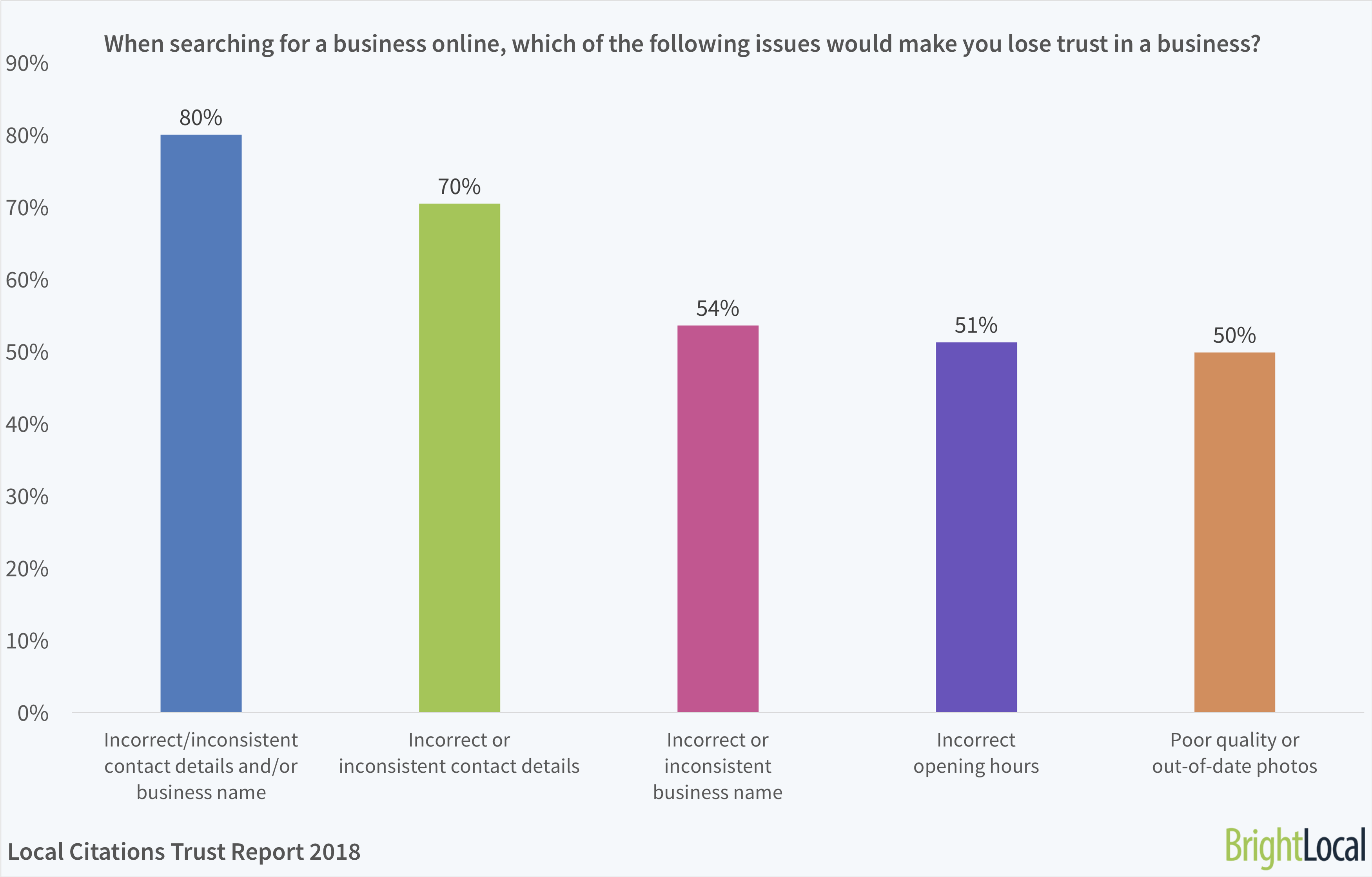
According to the BrightLocal research, 80% of respondents felt that seeing incorrect or inconsistent contact details and/or business names online would make them lose trust in a business. With consumer trust in business being such a critical part of the buyer’s journey, this is obviously of great concern.

Of course, this is only an issue if businesses are actually uploading inaccurate information to online directories.

Thirty percent found inaccurate business information online

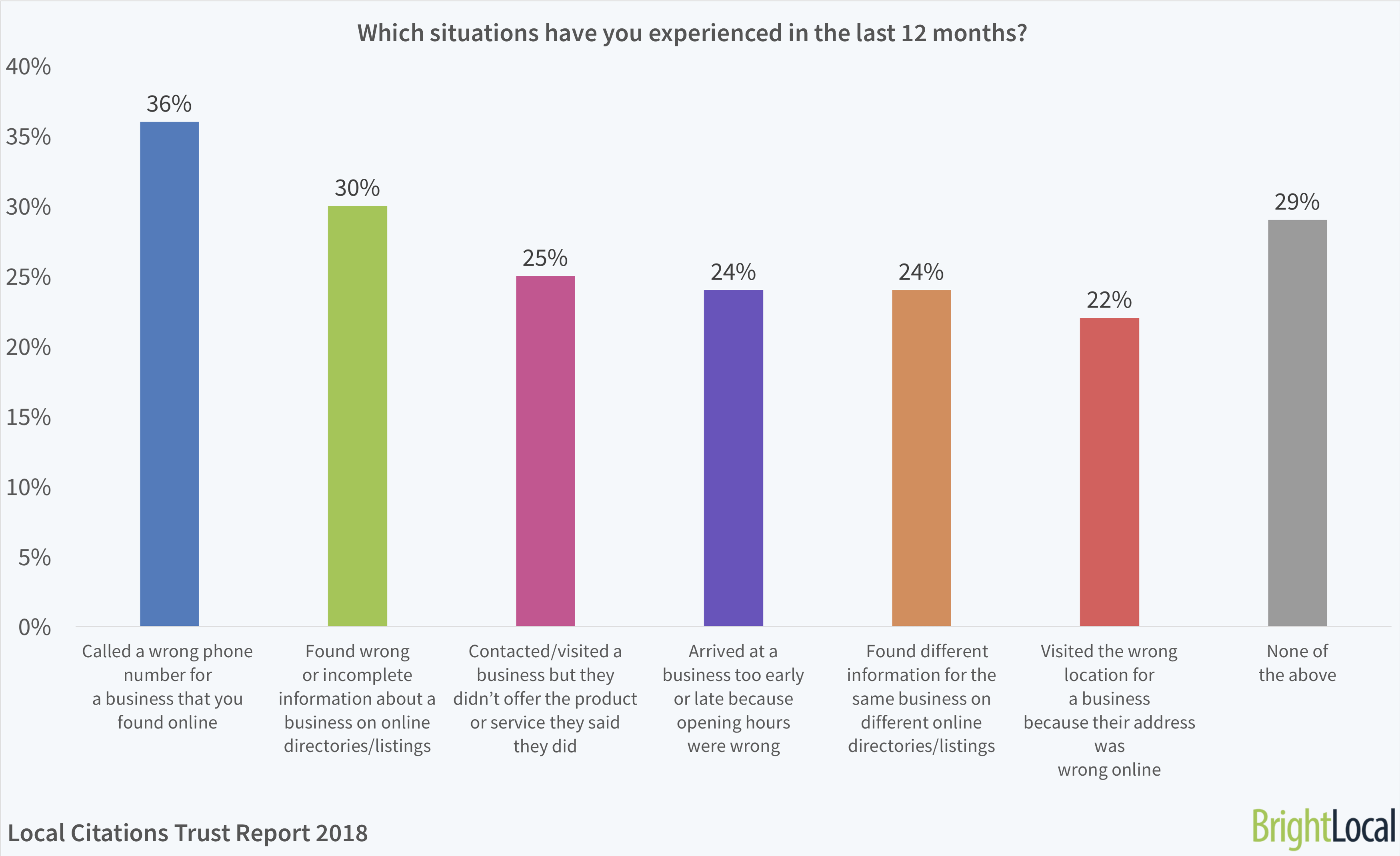
If you thought inaccurate citation data wasn’t a problem, think again. Not only have 30% of consumers found inaccurate business information online in the last 12 months, but a shocking 36% have also ended up calling incorrect phone numbers for businesses as a result of this inaccurate information. Add to this the fact that 22% of respondents went to the trouble of visiting a business only to find it was not located where online information suggested it was, and you start to see a troubling picture of lost business.

These experiences aren’t just confined to incorrect NAP, though. Nearly one quarter of consumers have visited a business too early or too late owing to incorrect opening times displayed online. Ultimately, this means that businesses with inaccurate citation data are likely to be missing out on a great deal of custom.

Let’s say a consumer has found a business’ address online and gone to that location, only to find the business is nowhere to be seen. What happens next?

Forty-one percent would not use a business if they couldn’t find it straight away

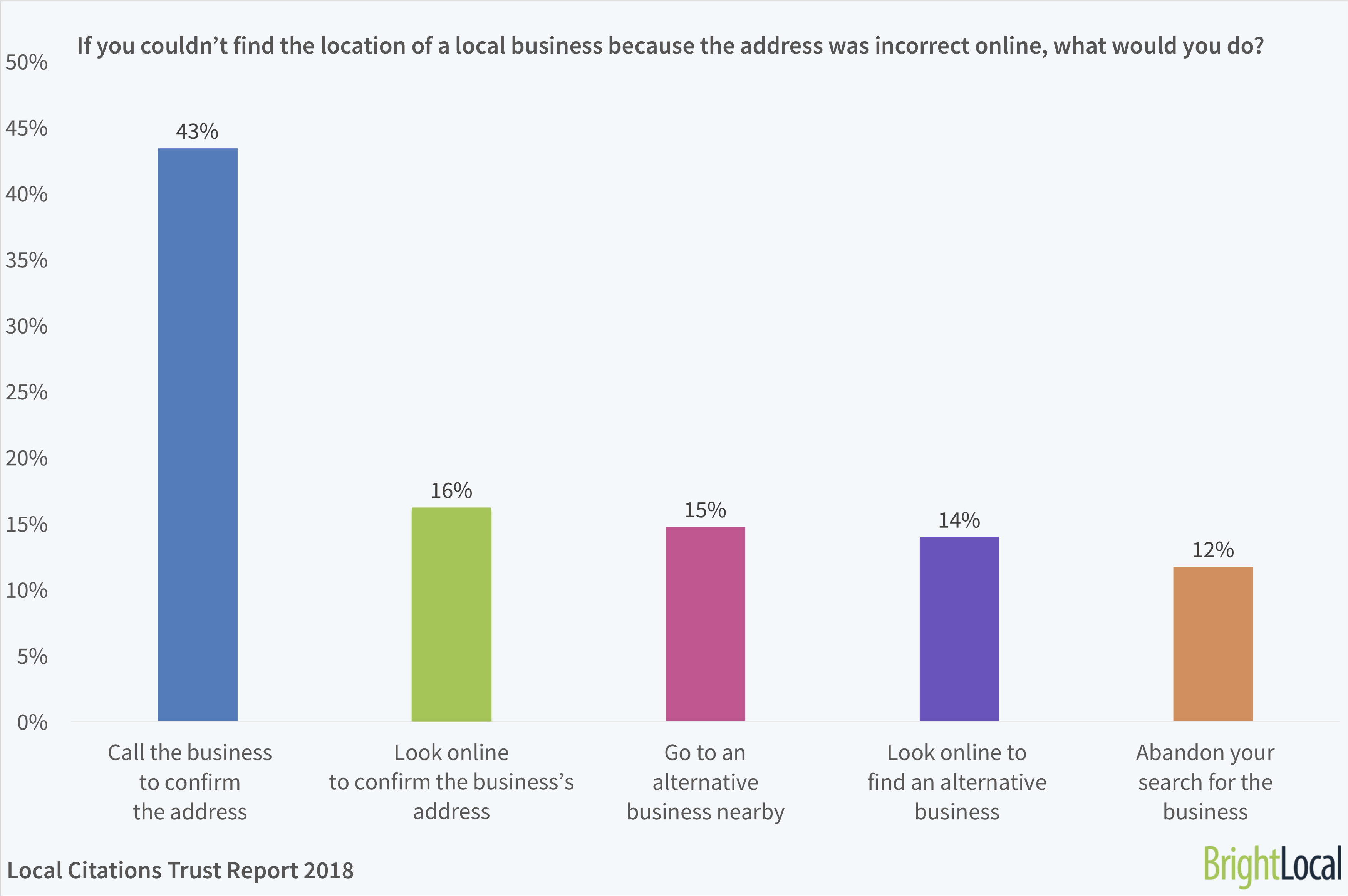
Although it’s encouraging to see that 59% of people would persist in their search for a business if they couldn’t find it – either by calling or looking elsewhere online for the address, many aren’t quite so patient.

Almost one third (29%) of consumers said they would try to find another business online or nearby, and 12% would give up completely. Obviously, the likelihood of the latter, more extreme reaction is down to how necessary the need for the business was, and also how far the consumer had to travel, but this data still suggests that businesses with inaccurate citations data online risk losing out.

As the research found, 22% have visited an incorrect address, and with only 29% of these people seeking out an alternative business, we can get an idea of how much business is being lost to competitors as a result of inaccurate location data.

Just imagine: you do all that great work and spend all your marketing budget encouraging someone to use your business, and you succeed, only to lose out to a local rival owing to something as simple as inaccurate citation data. Marketers tend to be very good at looking at the big picture, but it’s little details like this that result in lost business, even when marketing activity has otherwise succeeded.

It’s worth pointing out, too, that men answering this question seemed to be far more likely to give up their search for a business completely. Eighteen percent of those who identified as male in the survey said they would abandon their search. We live in a far more fast-paced world than ever before and immediate gratification is paramount, so I’d strongly recommend that businesses with a primarily male customer base get their citations in order, lest they face the lost custom of a frustrated customer.

Ninety-three percent of consumers are frustrated to find incorrect information in online directories

Frustration is an unpredictable emotion that can result in a range of reactions depending on the state and personality of the person experiencing it. As we’ve seen, once frustrated by incorrect business information, consumers could calmly persist with contacting the business (providing the contact number is accurate), look for another business, or quit their search entirely.

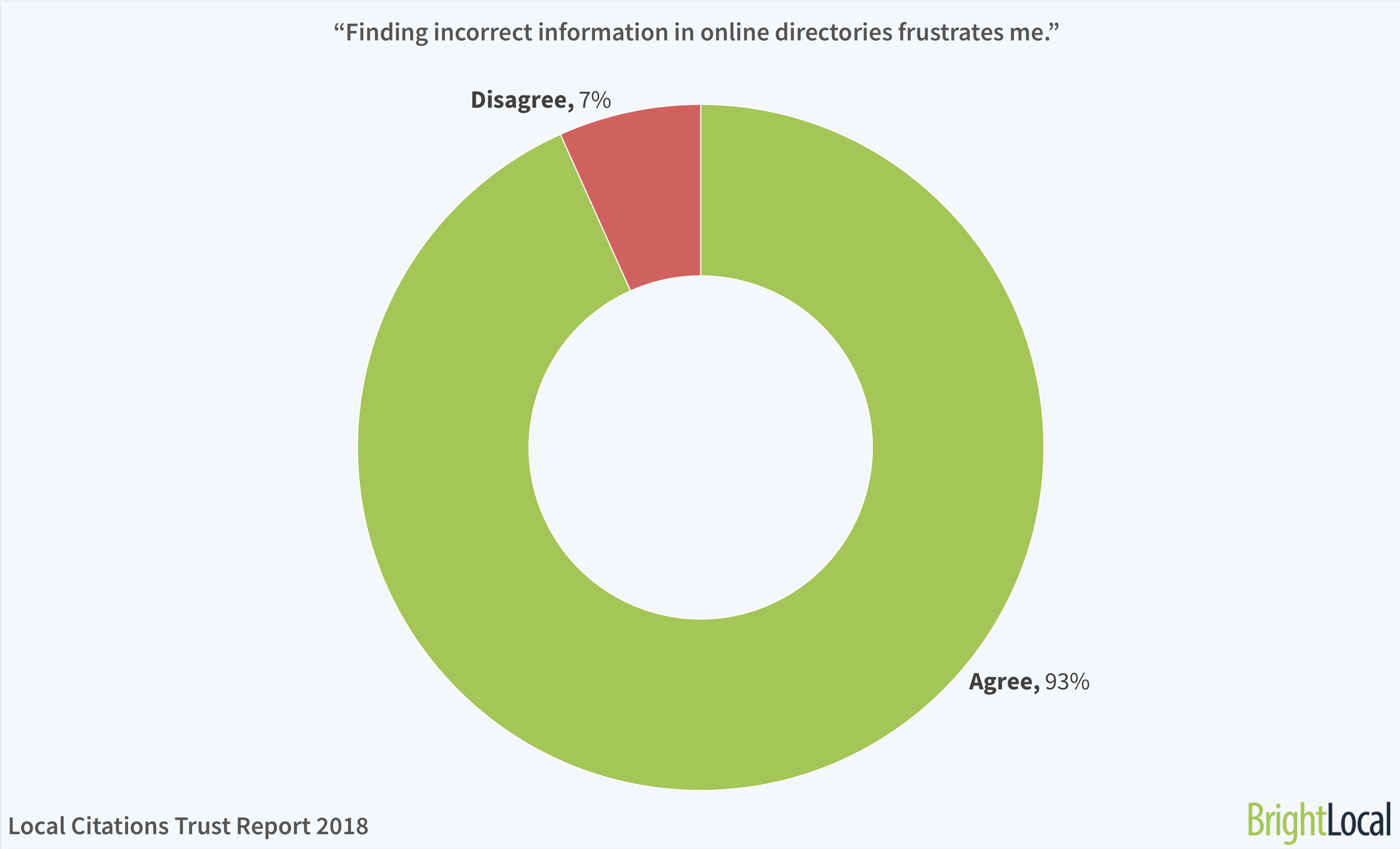
The BrightLocal research found that a huge 93% of consumers agree that finding incorrect information in online directories “frustrates” them. These are consumers with a strong intent to buy, as they’ve already searched for a business like yours and picked yours due to any number of factors. Even if they do choose to use your business after all, their first experience with it involves frustration. If you’re providing incorrect or inaccurate information online, you’re going to have to hope that your product or service is spectacular to avoid an overall negative experience.

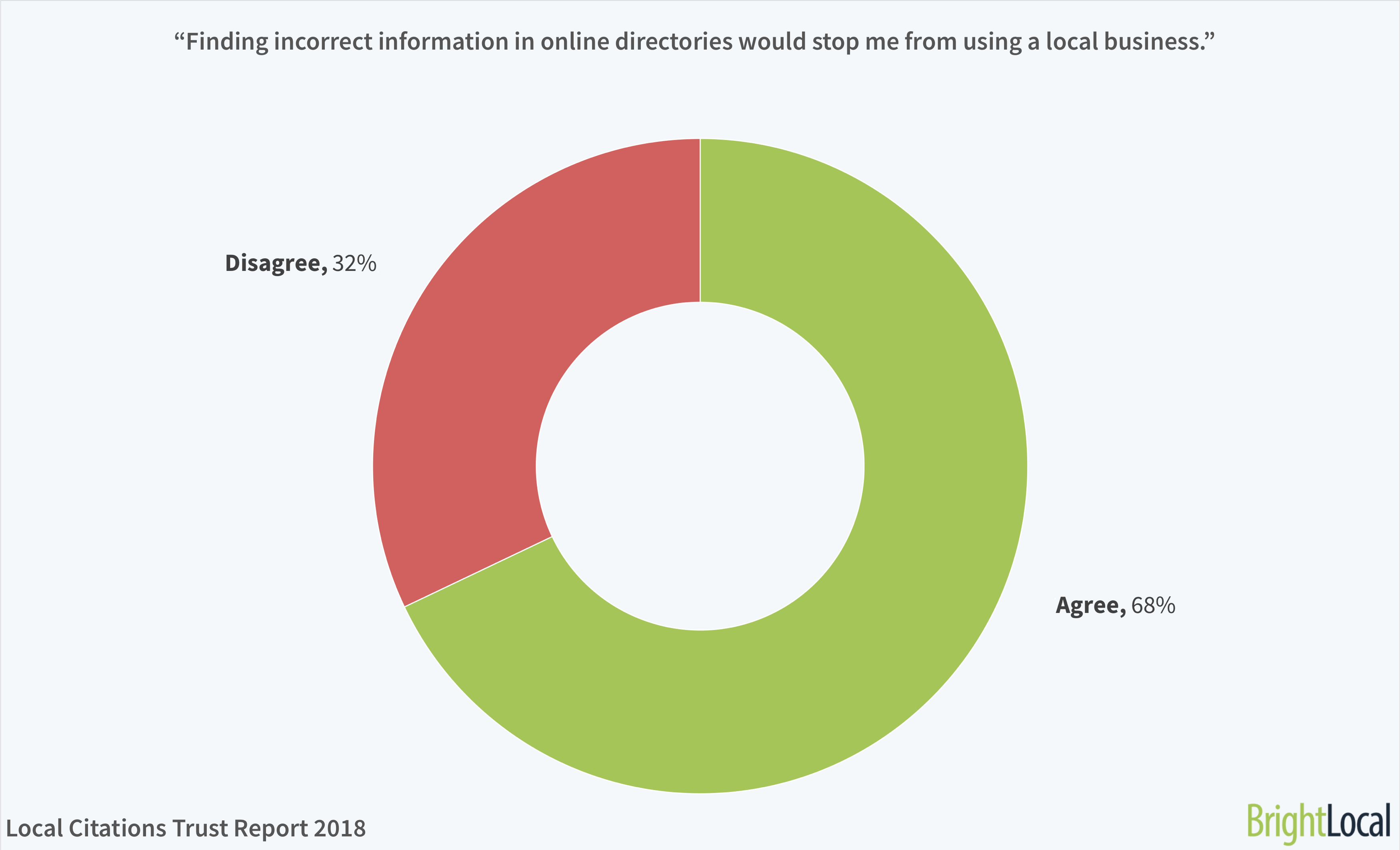
Sixty-eight percent of consumers would stop using a local business after finding incorrect information online

After ploughing through incorrect information and coming up empty-handed, almost 70% of consumers said they would stop using a business as a result. This includes the quite literal cessation of business use due to not being able to find or call them, as well as deciding not to use a business because of diminished trust caused by inaccurate online information.

Businesses must have accurate and consistent citations to avoid losing customers

If you run a business or manage a client with incorrect business listings information, you are at high risk of missing out on swathes of new customers.

All your marketing, visibility, and brand awareness efforts are for naught if potential customers can’t find your business. You risk frustrating them, and in some cases completely wasting their time. First impressions are paramount, and creating accurate citations is one of the most important ways to ensure you’re building consumer trust from the off. If not, then I’m sure your competitor in the next neighborhood would be happy to take the business.

Related reading

This marketing news is not the copyright of Scott.Services – please click here to see the original source of this article. Author: Jamie Pitman

For more SEO, PPC, internet marketing news please check out https://news.scott.services

Why not check out our SEO, PPC marketing services at https://www.scott.services

We’re also on:
https://www.facebook.com/scottdotservices/
https://twitter.com/scottdsmith
https://plus.google.com/112865305341039147737

The post Consumers lose trust in businesses with inaccurate NAP appeared first on Scott.Services Online Marketing News.


source https://news.scott.services/consumers-lose-trust-in-businesses-with-inaccurate-nap/

Google Featured Snippets Expand By Category/Topic

David Gray spotted and posted on Twitter a featured snippet that expands and has multiple drop down expansion menus. If you search for [garage conversion] on mobile, you probably will see it for yourself. It shows the featured snippet, with the images and text and then below it, it has categories that you can expand that show a section for cost, plans, building regulations and insulation.

Each section comes from a different site, for the most part. Here is a GIF of it in action:

Here is a static image of it all closed:

It seems like to be an extension from the multifaceted Google featured snippets.

Forum discussion at Twitter.

This marketing news is not the copyright of Scott.Services – please click here to see the original source of this article. Author: barry@rustybrick.com (Barry Schwartz)

For more SEO, PPC, internet marketing news please check out https://news.scott.services

Why not check out our SEO, PPC marketing services at https://www.scott.services

We’re also on:
https://www.facebook.com/scottdotservices/
https://twitter.com/scottdsmith
https://plus.google.com/112865305341039147737

The post Google Featured Snippets Expand By Category/Topic appeared first on Scott.Services Online Marketing News.


source https://news.scott.services/google-featured-snippets-expand-by-category-topic/

Google Image Search Bug: Only Some Images Are Loading?

There are a bunch of complaints in the Google Web Search Help forums about a bug with Google’s image search where the images are not fully loading. The first few rows of images might come up and then the rest do not, plus the rest of the interface somewhat freezes up.

The users are saying:

Google Images while using Chrome (on Firefox it works perfectly fine), only about 3 rows of images load, the others remaining colored squares, and I can’t click or open the images that do show. The “Safe Search” dropdown menu doesn’t work, and neither do the “more”, “settings” and “tools” buttons/links.

Here is a screen shot from a user impacted by this:

click for full size

I personally cannot replicate this but there is a number of people who are experiencing the same issue since over the weekend.

Google has not responded, so I don’t know if it is a browser security issue, ISP related, browser specific, OS or something else?

Forum discussion at Google Web Search Help.

This marketing news is not the copyright of Scott.Services – please click here to see the original source of this article. Author: barry@rustybrick.com (Barry Schwartz)

For more SEO, PPC, internet marketing news please check out https://news.scott.services

Why not check out our SEO, PPC marketing services at https://www.scott.services

We’re also on:
https://www.facebook.com/scottdotservices/
https://twitter.com/scottdsmith
https://plus.google.com/112865305341039147737

The post Google Image Search Bug: Only Some Images Are Loading? appeared first on Scott.Services Online Marketing News.


source https://news.scott.services/google-image-search-bug-only-some-images-are-loading/