Thursday, 1 February 2018

What the ROAS? A practical guide to improving return on ad spend

Do you want to improve your paid search campaigns? There are a lot of paid search metrics, but one of the most useful and most underused is return on ad spend (ROAS).

One of the main points behind online advertising is to drive sales for your business. This is particularly true when it comes to paid search. Most paid search campaigns are targeting potential customers who are fairly low in the funnel. A paid search click usually costs more than a display or paid social click, but it’s worth having if that click turns into a paying customer.

However, just because you are targeting bottom-of-the-funnel traffic, that doesn’t mean that every element of your paid search campaigns is a good investment.

This is where ROAS comes into play. One of the best things about paid search advertising is the ability to connect what you spend on a campaign, ad or keyword to how much new revenue is generated. With a little extra effort, you can connect all the dots and use ROAS to identify which aspect of your paid search advertising deserves more of your budget and which needs work.

Figuring out your ROAS

The key to using ROAS to improve the performance of your paid search campaigns is great conversion and sales tracking. After all, if you don’t know which campaigns, ad groups, ads and keywords are producing which conversions and sales, you can’t exactly calculate and use your ROAS.

Fortunately, most paid search platforms make it pretty easy to track conversions and sales. For example, if you’re running an e-commerce company, you can easily assign a conversion value to transactions and directly view the value a particular campaign element produces in AdWords:

However, ROAS isn’t just a metric for e-commerce businesses. For example, most conversion types can be directly tracked in AdWords, and with the right tracking set up (UTM parameters work great for this), you can follow data in a CRM like Salesforce.

As those conversions turn into sales, you can use this AdWords-Salesforce integration to pass your sales and revenue data back into AdWords for easy tracking and analysis.

Using your ROAS data

Sadly, most marketing decisions are not made using ROAS data. At my company, we’ve audited thousands of paid search accounts and found that only 29 percent of advertisers are tracking conversions effectively — let alone ROAS!

Using metrics like click or conversion data to guide your marketing isn’t a bad thing, but without ROAS data, you can end up making decisions that improve your metrics and hurt profitability.

The problem with clicks

Here’s an example of not using ROAS data in decision-making.

Let’s imagine that you sell hot tubs. Your average hot tub sells for $3,500 and has a 50 percent profit margin. In an effort to boost sales, you’ve been running five paid search campaigns that have yielded the following results:

If you had to pick a campaign to keep investing in, which would it be? The obvious choice here is campaign #3: it has the highest click-through rate and the cheapest cost per click.

However, while campaign #3 drives the most clicks at the lowest cost, we really don’t know much about the quality of those clicks. For example, if campaign #3 is driving a lot of traffic because you are bidding on the broad match keyword “hot tub,” you could be getting all sorts of irrelevant clicks.

The problem with conversions

To address our traffic quality issue, let’s take a look at how those clicks are converting:

As you can see, campaign #3 has a relatively poor conversion rate (CR). However, campaign #3 also drives so many cheap clicks that it still has the lowest cost per lead (CPL) of the group by a considerable margin.

Using this data, it still looks like campaign #3 is worth the investment. Sure, it could probably use a little optimization, but it clearly outperforms the rest of your campaigns.

Or does it?

Leads are nice, but a lead is not a sale. Conversion data only tells us how good a campaign is at getting people into our funnel; it doesn’t tell us anything about how well a campaign produces new revenue.

A ROAS reality check

To really answer the “is this campaign profitable?” question, we need to take a look at ROAS:

Now which campaign would you invest in?

Although Campaign 3 had the best click and conversion stats, it has a terrible sales rate (SR) and cost per sale (CPS). In fact, with your 50 percent profit margin, every sale from Campaign 3 actually costs you money. In contrast, Campaign 4 is incredibly profitable. Sure, it had lousy click and conversion stats, but when it comes to profit, it’s the obvious choice.

Obviously, this is a bit of a manufactured scenario, but it makes an important point. Click and conversion data can help you identify problem areas in your marketing, ad or keyword campaigns.  But if a campaign is not producing a good ROAS, something needs to change.

Using your ROAS

By now, I hope I’ve convinced you to use ROAS to evaluate and optimize your paid search campaigns. The question now is, how? To answer that, let’s work through another example.

In this scenario, let’s say you run a whale-watching business. It is a side business, and your boat is kind of small, so you can only take one person out at a time. But you charge $150 for each one-hour expedition and make around 20 trips a month at a 50 percent profit margin, so it’s not a bad gig.

However, after hearing countless passengers say you should do this full time, you decide to finally bite the bullet. You rent an office, hire a part-time assistant and discover your expenses are running $2,000 a month, which is more expensive than you initially thought.

All of sudden, you are losing $500 a month. You need to sell more tickets, fast!

To bring in more business, you start running paid search campaigns. But how do you know whether a campaign, ad group, ad or keyword is working? Let’s see how we can use ROAS to answer that question.

1x return on ad spend

Let’s say you charge $150 a ticket. If it costs $150 to bring in a new sale, you should at least be breaking even, right? Unfortunately, that’s not how it works. When every trip costs you $75 in gas plus wear and tear, a 1x ROAS leaves you deeper in the hole with every purchase.

Plus, you still have that $500 monthly expense hole to dig yourself out of, so any campaign element producing a 1x ROAS needs some work or to be eliminated entirely.

2x return on ad spend

If a 1x ROAS doesn’t cut it, what about a 2x ROAS? You make $75 on every sale, so if you spend $75 on marketing, you’ll be okay, right? Sadly, still not the case. If all you do is break even on every trip, you will never make any money. In fact, you’ll never even be able to pay off that $500 deficit.

Since the whole point of marketing your business is to overcome deficits and make money, any campaign element with a 2x ROAS could probably use some work. I’d put more of a priority on 1x elements, but once those are working better, your 2x elements could use some attention.

3x return on ad spend

At a 3x ROAS, things start to make a lot more sense. If you can drive over 20 extra sales with your marketing at a 3x ROAS, you’ll actually be making money!

You won’t be rolling in cash at a 3x ROAS, but at least you’re in the black. In general, I recommend that you shoot for a minimum of a 3x ROAS in your marketing campaigns.

4x return on ad spend

Once you hit a 4x ROAS, things usually start to add up. At this level of return, you only need 14 sales to cover all of your fixed and variable expenses and start making money.

Getting and keeping every element of your paid search marketing campaigns at this level is a worthy goal, although it’s probably a bit impractical. But if your campaign is on the whole at a 4x ROAS, you’re probably doing okay.

5x+ return on ad spend

At a 5x or higher ROAS, your paid search campaigns are running well enough that you can probably start growing your business.

After about 12 sales, you are turning a decent profit, which should enable you to get a bigger boat and book larger groups. Both of these things will increase your profitability.

If we lived in a perfect world,  every element of your campaigns would perform at this level, but if your campaign as a whole is a 5x or better ROAS, you’re probably okay.

Using ROAS

Obviously, this is another highly specific scenario, but it illustrates a fairly consistent rule of thumb: Shoot for a 4x ROAS with most paid search campaigns and campaign elements.

Any campaign element with a ROAS of less than 3x probably needs work. How important it is to work on any given element will depend on how much it’s costing you, but in most situations, you need at least a 3x ROAS to break even.

Of course, this rule doesn’t cleanly apply to “branding”-type campaigns, but most paid search campaigns don’t fall into this category. Paid search marketing is usually expensive, low-funnel marketing, so if your overall ROAS isn’t at least 4x, your marketing is probably on life support.

When it comes to specific elements of your campaigns, ROAS is also a handy triage tool. As you can probably imagine, you’ll want to look at a big enough data set to fairly evaluate a given campaign (at least 100 clicks, at a bare minimum), but with sufficient data, you can use this rule of thumb to quickly identify campaign elements that need to be improved, eliminated or grown.

Conclusion

ROAS is often seen as an e-commerce metric, but in reality, it’s one of the most valuable and yet least-used paid search metrics out there. Yes, it does take a little extra work to get tracking set up, but the information is worth it.

Once you have ROAS tracking set up, you actually have to use it to improve your campaigns. The trick here is knowing what ROAS data tells you about the end performance of your campaign elements and how to use that information to identify elements that need to be improved. Fortunately, after reading through this article, you should have a good sense of how to interpret and use your ROAS data.

Your specific goals may vary, but by using ROAS to guide your campaign decisions, you’ll be making decisions that affect what matters most — making money!

Opinions expressed in this article are those of the guest author and not necessarily Search Engine Land. Staff authors are listed here.

About The Author

Jacob is passionate entrepreneur on a mission to grow businesses using PPC & CRO. As the Founder & CEO of Disruptive Advertising, Jacob has developed an award-winning and world-class organization that has now helped over 2,000 businesses grow their online revenue. Connect with him on Twitter.

This marketing news is not the copyright of Scott.Services – please click here to see the original source of this article. Author: Jacob Baadsgaard

For more SEO, PPC, internet marketing news please check out https://news.scott.services

Why not check out our SEO, PPC marketing services at https://www.scott.services

We’re also on:
https://www.facebook.com/scottdotservices/
https://twitter.com/scottdsmith
https://plus.google.com/112865305341039147737

#seoservices #seoservice #seocompany #seocompanies #seoagency #seoagencies #seoconsultant #seoconsultantsuk #seoconsultant #seoconsultantuk #seoexpert #seoexperts #seocompanyuk #seomarketing #seospecialist #seospecialists #seoservicesuk #seofreelancer #seopackages #seostrategy #smallbusinessseo #affordableseoagency #localseoservices #seocost #seopackagesuk #searchengineoptimisationcompany #seoexpertuk #seomarketingcompanies #freelanceseoconsultant #professionalseoservices #seoservicescompany #affordableseoservices #searchengineoptimisationconsultant #seomarketingagency #seomarketingservices #smallbusinessseoservices #completeseoservices #seoadvice #seoconsultingservices #professionalseocompany #googleseoconsultant #affordableseocompany #freelanceseoexpert #professionalseoconsultant #marketingnews #seonews #ppcnews #seo #searchengineoptimisation #searchengineoptimization #scottseo

The post What the ROAS? A practical guide to improving return on ad spend appeared first on Scott.Services Online Marketing News.


source https://news.scott.services/what-the-roas-a-practical-guide-to-improving-return-on-ad-spend/

Adjust launches solution to battle new evolution of ‘SDK spoofing’ for app installs

Graphic from Adjust

Graphic from Adjust

Fraudulent reporting of app installs is one of the most common mobile-specific issues that confront marketers.

Ad campaigns promoting a new game app, for instance, are often set up on a pay-for-performance basis, so those responsible for convincing users to install receive payments for each app that is installed within the time window surrounding that campaign. But fake installs mean app publishers behind those campaigns end up paying for fakes.

Now, app measurement Adjust is out with a new solution that combats what it says is a very widespread — but rarely discussed — kind of app install fraud that started spreading last year. In fact, the company says, this kind of fraud can affect up to 80 percent of the reported installs for any given campaign.

It’s called SDK spoofing, or replay attacks. Adjust Fraud Specialist Andreas Naumann told me it’s the latest evolution in app install fraud.

[Read the full article on MarTech Today.]


About The Author

Barry Levine covers marketing technology for Third Door Media. Previously, he covered this space as a Senior Writer for VentureBeat, and he has written about these and other tech subjects for such publications as CMSWire and NewsFactor. He founded and led the web site/unit at PBS station Thirteen/WNET; worked as an online Senior Producer/writer for Viacom; created a successful interactive game, PLAY IT BY EAR: The First CD Game; founded and led an independent film showcase, CENTER SCREEN, based at Harvard and M.I.T.; and served over five years as a consultant to the M.I.T. Media Lab. You can find him at LinkedIn, and on Twitter at xBarryLevine.

This marketing news is not the copyright of Scott.Services – please click here to see the original source of this article. Author: Barry Levine

For more SEO, PPC, internet marketing news please check out https://news.scott.services

Why not check out our SEO, PPC marketing services at https://www.scott.services

We’re also on:
https://www.facebook.com/scottdotservices/
https://twitter.com/scottdsmith
https://plus.google.com/112865305341039147737

#seoservices #seoservice #seocompany #seocompanies #seoagency #seoagencies #seoconsultant #seoconsultantsuk #seoconsultant #seoconsultantuk #seoexpert #seoexperts #seocompanyuk #seomarketing #seospecialist #seospecialists #seoservicesuk #seofreelancer #seopackages #seostrategy #smallbusinessseo #affordableseoagency #localseoservices #seocost #seopackagesuk #searchengineoptimisationcompany #seoexpertuk #seomarketingcompanies #freelanceseoconsultant #professionalseoservices #seoservicescompany #affordableseoservices #searchengineoptimisationconsultant #seomarketingagency #seomarketingservices #smallbusinessseoservices #completeseoservices #seoadvice #seoconsultingservices #professionalseocompany #googleseoconsultant #affordableseocompany #freelanceseoexpert #professionalseoconsultant #marketingnews #seonews #ppcnews #seo #searchengineoptimisation #searchengineoptimization #scottseo

The post Adjust launches solution to battle new evolution of ‘SDK spoofing’ for app installs appeared first on Scott.Services Online Marketing News.


source https://news.scott.services/adjust-launches-solution-to-battle-new-evolution-of-sdk-spoofing-for-app-installs/

4 Advanced AdWords Audience Targeting Tactics by @iambenwood

The audience targeting options available to PPC advertisers across both search and social are constantly evolving.

In the past few years, advertisers have begun to be able to target custom audiences through search network campaigns, create similar audiences to mimic users who have completed a desired action on their website and target users via mailing list upload features such as customer match.

In this post, I will outline four advanced audience targeting tactics that will allow you to refine your PPC targeting to leverage budget and maximize return on ad spend (ROAS).

1. Smarter Use of Remarketing Lists for Search Ads (RLSAs)

Remarketing lists for search ads (RLSAs) allows you to customize your search ad campaigns based on the user behavior of previous website visitors, and tailor your bids/targeting options around these users when they’re searching on Google.

Example: Target People Who Spend over Your Average Order Value When Searching for Competitor Brands

This tactic will allow you to target and display ads to users that have generated a high conversion value for you historically whenever they are searching for one of your competitors on Google search, which could help you avoid losing customers to your paid competitors!

For example, an online grocery retailer could identify shoppers who spend over their average order value each week.

In this scenario, the advertiser could set up a separate campaign to target and bid on competitor terms but use RLSAs so that ads are only served whenever users within the list are searching.

This is a great way of ensuring your budget is only spent on retaining profitable customers.

If you’d like to apply this tactic to your account, you’ll first need to find the average order value being reported in your Google Analytics account by navigating to Conversions > E-commerce > Overview:

Avg Order Value

Once you’ve found the average order value figure you’ll be able to create an audience list using the audience builder via Admin > Audience Definitions > Audiences in Google Analytics:

This tactic is particularly effective in industries where consumers aren’t loyal and may often flick between different retailers for the best deal (e.g., in grocery retail).

By applying this list you could tailor your ad copy and advertise loyalty discounts to these customers to prevent them from deserting your brand for a competitor:

2. Combining Social Audiences with RLSAs

With more than 1.5 billion monthly active users, Facebook has no rival when it comes to the enormity of its audience.

The main benefit Facebook offers lies in the potential granularity with which you can target Facebook’s users.

Unlike AdWords, Facebook has information on what users actually “Like” or follow, and in-depth data from users’ personal profiles.

The benefits of using social ads alongside search campaigns can be huge.

For example, a 2014 study from Kenshoo showed that paid search audiences which were already exposed to Facebook advertising generated 30 percent more return on ad spend, and a 7 percent uplift in CTR.

Despite this, I still encounter tons of brands whose approach to advertising on both Facebook and Google is unaligned and therefore they fail to share insights gained from one platform to another to maximize success.

Example: Use Facebook to uncover new potential buyers and then target these people on search to increase the likelihood of them converting

Facebook is one of the best platforms for expanding your reach and identifying new users who aren’t actively looking for your products or services right now.

By tagging the ads you run on Facebook targeting these new audience segments you will later be able to target ads at these users when they search Google using top of the funnel keywords, increasing the likelihood of those Facebook clicks turning into new customers!

To do this, you would first need to create a new campaign on Facebook designed to target new potential customers you aren’t already targeting with your search ads (exclude existing website visitors and mailing list members):

targeting example

By tagging the resulting Facebook campaign with UTM tags, any clicks from this audience will be recorded in Google Analytics under the campaign name you have set.

You’ll then be able to create an audience list in Google Analytics which consists of traffic from this particular Facebook campaign:

facebook audiences in ga

Remember, like any audience list you create, the list must contain at least 1,000 members before being eligible for use on Google search.

Once you’ve populated your audience list with enough traffic from Facebook, create a search campaign on AdWords which includes only top of the funnel keywords such as informational queries related to the product/service you offer (they need to be top of the funnel because this audience isn’t specifically searching for your product/service).

Finally, apply the remarketing list to the ad groups created in your search campaign, choosing the target and bid setting, so that the search ads only show to users who are from your list of new potential customers uncovered on Facebook.

I strongly recommend this tactic if you feel like you have exhausted current demand on Google search in your industry, as it allows you to effectively create search demand by reaching new users and promoting consideration of your product or service.

3. Utilizing Custom Affinity Audiences

Google launched custom affinity audiences to give advertisers granular control over audience targeting options on the display network.

This tackles the issue with regular Google AdWords affinity audiences in that there isn’t a predefined affinity audience suitable for every business.

Custom affinity audience targeting can be set-up by navigating to a Display campaign in AdWords, clicking Targeting > Interests & Remarketing  > Custom Affinity Audiences > New Custom Affinity Audience.

Here you can create your own specific audience using free form interests entered as keywords and/or using URLs as a proxy for interest bundles:

custom affinity example

In this example, the custom affinity targeting has built an audience of “Garden Enthusiasts” using interests (keywords entered) and URL targeting:

custom affinity audiences

While custom affinity audience targeting allows for more control on the GDN, I think it’s best used for brand building.

You can take an even more granular approach to GDN targeting by layering custom affinity audiences with other forms of targeting to increase campaign efficiency.

4. Combining In-Market Segments with Remarketing

In-market audiences allow you to set up your campaigns to reach people who are further down the funnel and ready to make a purchase.

Google accurately categorizes users so you can target those most interested in their offerings.

Google says that you can distinguish interest from purchaser’s intent by leveraging real-time data and a powerful classification system based on demonstrated in-market behavior.

In-market audiences can help drive incremental conversions, helping you to connect with consumers as the last step before they make a purchase decision.

Google will be rolling out a few more in-market segments throughout 2018, increasing the availability of this feature to more advertisers.

To target an in-market audience segment you would need to navigate to Targeting > Interests and Remarketing > In-market Audiences.

Here you will see a list of almost 500 available in-market audiences (and Google is constantly expanding this list):

in-market audience

The real impact on conversions comes when using in-market segments in conjunction with website remarketing lists.

You can layer the in-market segments on top of your remarketing lists to increase reach while maintaining a high degree of relevancy with the aim of bolstering overall conversions.

You can read more about the set of in-market audiences available here.

Conclusion

Paid search is becoming increasingly expensive. There’s a ton of competition on almost every possible advertising SERP.

As a result, many advertisers are shifting huge chunks of budget over to Facebook and other paid social platforms, largely due to superior audience targeting options (not searcher intent) and reduced CPCs.

With this in mind, I’d expect the rollout of new targeting options such as more affinity audiences, expanded in-market segments and custom intent audiences to continue as Google attempt to retain and recapture a larger share of advertising spend.

The audience targeting options available to advertisers are only set to increase across both Google and Facebook, so make sure you keep on top of the latest features as well as testing some of the tips outlined above to see whether they can deliver improved paid media results for your business.

More PPC Audience Targeting Resources:


Image Credits
Featured Image: Pexels

Screenshots by Ben Wood. Taken January 2017

This marketing news is not the copyright of Scott.Services – please click here to see the original source of this article. Author: Ben Wood

For more SEO, PPC, internet marketing news please check out https://news.scott.services

Why not check out our SEO, PPC marketing services at https://www.scott.services

We’re also on:
https://www.facebook.com/scottdotservices/
https://twitter.com/scottdsmith
https://plus.google.com/112865305341039147737

#seoservices #seoservice #seocompany #seocompanies #seoagency #seoagencies #seoconsultant #seoconsultantsuk #seoconsultant #seoconsultantuk #seoexpert #seoexperts #seocompanyuk #seomarketing #seospecialist #seospecialists #seoservicesuk #seofreelancer #seopackages #seostrategy #smallbusinessseo #affordableseoagency #localseoservices #seocost #seopackagesuk #searchengineoptimisationcompany #seoexpertuk #seomarketingcompanies #freelanceseoconsultant #professionalseoservices #seoservicescompany #affordableseoservices #searchengineoptimisationconsultant #seomarketingagency #seomarketingservices #smallbusinessseoservices #completeseoservices #seoadvice #seoconsultingservices #professionalseocompany #googleseoconsultant #affordableseocompany #freelanceseoexpert #professionalseoconsultant #marketingnews #seonews #ppcnews #seo #searchengineoptimisation #searchengineoptimization #scottseo

The post 4 Advanced AdWords Audience Targeting Tactics by @iambenwood appeared first on Scott.Services Online Marketing News.


source https://news.scott.services/4-advanced-adwords-audience-targeting-tactics-by-iambenwood/

Carter G. Woodson Google doodle honors scholar who started Black History Month

To kick off Black History Month, today’s Google doodle pays homage to Dr. Carter G. Woodson —  the scholar who, in February 1926, first devised an African-American studies program.

Known as the Father of Black History, Dr. Woodson committed his life to African-American studies and the preservation of African-American history. It was his week-long event promoting African-American studies that eventually became Black History Month.

According to Google, Dr. Woodson chose February to focus on African-American studies because it is the birth month of both abolitionist Frederick Douglass and President Abraham Lincoln.

Born in New Canton, Virginia, in 1875, Dr. Woodson was the son of former slaves Anne Eliza and James Henry Woodson. He was able to enter high school in 1895 and eventually earned a master’s degree from the University of Chicago. He continued his studies and became the second African-American to receive his doctorate from Harvard University.

From Dr. Carter G. Woodson African American Museum website:

In 1915, he and friends established the Association for the Study of Negro Life and History. A year later, the Journal of Negro History began quarterly publication. Dr. Woodson was the founder of Associated Publishers, the founder and editor of the Negro History Bulletin, and the author of more than 30 books. His best known publication is “The Mis-Education of the Negro,” originally published in 1933 and still pertinent today.

The doodle was designed by Virginia-based illustrator Shannon Wright, whose work has appeared in numerous publications, including The New York Times, Mother Jones and TIME Magazine. It leads to a search for “Carter G. Woodson” and features the scholar in his library with images of African-American leaders at his side.

“Woodson’s commitment to achieve an education for himself and spread awareness and pride in Black history inspired me and continues to do so in so many ways,” writes Google’s director of brand marketing, Sherice Torres on the Google Doodle Blog, “When I voiced my ambition to go to Harvard, I was told by teachers, guidance counselors, and even some family members that people like me didn’t go to schools like that.”

An active member of the Black Googlers Network, Torres says it was American leaders like Dr. Woodson who gave her the confidence to follow her dreams and achieve more than she ever imagined.

About The Author

Amy Gesenhues is Third Door Media’s General Assignment Reporter, covering the latest news and updates for Search Engine Land and Marketing Land. From 2009 to 2012, she was an award-winning syndicated columnist for a number of daily newspapers from New York to Texas. With more than ten years of marketing management experience, she has contributed to a variety of traditional and online publications, including MarketingProfs.com, SoftwareCEO.com, and Sales and Marketing Management Magazine. Read more of Amy’s articles.

This marketing news is not the copyright of Scott.Services – please click here to see the original source of this article. Author: Amy Gesenhues

For more SEO, PPC, internet marketing news please check out https://news.scott.services

Why not check out our SEO, PPC marketing services at https://www.scott.services

We’re also on:
https://www.facebook.com/scottdotservices/
https://twitter.com/scottdsmith
https://plus.google.com/112865305341039147737

#seoservices #seoservice #seocompany #seocompanies #seoagency #seoagencies #seoconsultant #seoconsultantsuk #seoconsultant #seoconsultantuk #seoexpert #seoexperts #seocompanyuk #seomarketing #seospecialist #seospecialists #seoservicesuk #seofreelancer #seopackages #seostrategy #smallbusinessseo #affordableseoagency #localseoservices #seocost #seopackagesuk #searchengineoptimisationcompany #seoexpertuk #seomarketingcompanies #freelanceseoconsultant #professionalseoservices #seoservicescompany #affordableseoservices #searchengineoptimisationconsultant #seomarketingagency #seomarketingservices #smallbusinessseoservices #completeseoservices #seoadvice #seoconsultingservices #professionalseocompany #googleseoconsultant #affordableseocompany #freelanceseoexpert #professionalseoconsultant #marketingnews #seonews #ppcnews #seo #searchengineoptimisation #searchengineoptimization #scottseo

The post Carter G. Woodson Google doodle honors scholar who started Black History Month appeared first on Scott.Services Online Marketing News.


source https://news.scott.services/carter-g-woodson-google-doodle-honors-scholar-who-started-black-history-month/

Febreze aims to score another touchdown with this year’s #BleepDontStink Super Bowl LII ad

Last year, P&G air freshener brand Febreze made its debut appearance as a Super Bowl advertiser. The brand used its spot to promote its OdorClear Technology, creating a 30-second Super Bowl commercial titled, “America’s Halftime Bathroom Break.”

“Our objective to get our teasers out early was to urge consumers to get Febreze Air and Small Spaces in their shopping carts before the big game,” says Mandy Ciccarella, communications manager for P&G, referring to the brand’s 2017 Super Bowl campaign.

“Video assets were available on YouTube in the days leading up to the game, and content on our social channels, including Facebook and Twitter, served as a reminder for consumers to put Febreze cans in carts as they prepared for Super Bowl Sunday.”

The creative driving Febreze’s 2017 Super Bowl ad was informed by consumer insights into how people prepare — or, better, fail to prepare — their bathrooms for Super Bowl parties.

Using consumer insights to build a Super Bowl campaign

“It was based on the nationwide phenomenon that occurs in the minutes between the halftime whistle and the halftime show when more toilets are flushed than any other time of year,” says Ciccarella.

In addition to how often toilets are flushed, Febreze’s consumer data revealed that 50 percent of people spent little to no time prepping their bathroom for their Super Bowl party, and 62 percent claimed they were most likely to forget bathroom necessities when purchasing party supplies.

“We felt the Halftime Bathroom Break bathroom usage insights provided a unique opportunity that Febreze was poised to own during Super Bowl LI,” says Ciccarella.

Febreze scores a touchdown the first time on the field

The brand was right. Ciccarella says Febreze’s 2017 Super Bowl campaign resulted in a 96 percent positive sentiment for the brand, more than 3.2 billion media impressions and 100 million earned digital impressions. Also, the brand’s #BathroomBreak hashtag ranked in the top 10 trending hashtags for Super Bowl LI.

In addition to the campaign’s digital success, Ciccarella says Super Bowl week resulted in Febreze’s highest week of sales ever for the brand up to that date.

“Our results spoke for themselves,” says Ciccarella. “We loved participating in last year’s Super Bowl and are excited for the challenge to bring our best creative forward again this year.”

Coming back for more

For its second-ever appearance as a Super Bowl brand, Febreze is bringing back the same light-hearted tone it used last year, but this time, it’s pushing its bathroom humor a little closer to the edge.

“This year, we took our inspiration from last year’s human truth that everyone goes, and took it a step further that on Super Bowl Sunday, with millions of people attending parties, there most likely will be someone going at your place — which leads us to ask the question: Why aren’t you prepping your bathroom for the Super Bowl the same way you’re prepping the rest of your house?”

The campaign includes the official 30-second ad that is scheduled to air during the second quarter of this year’s Super Bowl game, along with an extended 60-second cut — both developed by the Grey New York ad agency. The hashtag for the campaign is #BleepDontStink, a hashtag the brand will be using across its Facebook, Instagram and Twitter channels.

“We’re so excited to introduce the world to the only man whose bleep don’t stink — literally not figuratively,” says P&G vice president Martin Hettich, in a release announcing the campaign. “While Dave truly is the ultimate Super Bowl guest, the reality is that he’s not coming to any of our parties. So as Game Day hosts begin preparing their homes for their festivities, we encourage them to not forget about their bathrooms.”

Febreze Super Bowl LII Ad (Extended Cut)

As of this afternoon, iSpot.tv, an analytics platform that tracks online engagement for nationally aired television commercials, has Febreze ranked at No. 16 when comparing overall online performance among this year’s lineup of Super Bowl LII advertisers.

When looking specifically at pregame Super Bowl spots, Febreze’s official 30-second Super Bowl ad, “The Only Man Whose Bleep Don’t Stink,” is ranked 26, with more than 3,500 social actions and nearly 47,000 online views.

While Febreze doesn’t appear to be in the lead right now, we’re still days away from the Super Bowl. The real test comes this Sunday, when millions of people will go online during and after the game to replay their favorite ads. The brands that win will be the ones that elicit the biggest reactions — and if it goes Febreze’s way, get more than a few laughs.


About The Author

Amy Gesenhues is Third Door Media’s General Assignment Reporter, covering the latest news and updates for Marketing Land and Search Engine Land. From 2009 to 2012, she was an award-winning syndicated columnist for a number of daily newspapers from New York to Texas. With more than ten years of marketing management experience, she has contributed to a variety of traditional and online publications, including MarketingProfs.com, SoftwareCEO.com, and Sales and Marketing Management Magazine. Read more of Amy’s articles.

This marketing news is not the copyright of Scott.Services – please click here to see the original source of this article. Author: Amy Gesenhues

For more SEO, PPC, internet marketing news please check out https://news.scott.services

Why not check out our SEO, PPC marketing services at https://www.scott.services

We’re also on:
https://www.facebook.com/scottdotservices/
https://twitter.com/scottdsmith
https://plus.google.com/112865305341039147737

#seoservices #seoservice #seocompany #seocompanies #seoagency #seoagencies #seoconsultant #seoconsultantsuk #seoconsultant #seoconsultantuk #seoexpert #seoexperts #seocompanyuk #seomarketing #seospecialist #seospecialists #seoservicesuk #seofreelancer #seopackages #seostrategy #smallbusinessseo #affordableseoagency #localseoservices #seocost #seopackagesuk #searchengineoptimisationcompany #seoexpertuk #seomarketingcompanies #freelanceseoconsultant #professionalseoservices #seoservicescompany #affordableseoservices #searchengineoptimisationconsultant #seomarketingagency #seomarketingservices #smallbusinessseoservices #completeseoservices #seoadvice #seoconsultingservices #professionalseocompany #googleseoconsultant #affordableseocompany #freelanceseoexpert #professionalseoconsultant #marketingnews #seonews #ppcnews #seo #searchengineoptimisation #searchengineoptimization #scottseo

The post Febreze aims to score another touchdown with this year’s #BleepDontStink Super Bowl LII ad appeared first on Scott.Services Online Marketing News.


source https://news.scott.services/febreze-aims-to-score-another-touchdown-with-this-years-bleepdontstink-super-bowl-lii-ad/

The best tools for automating your SEO

Here’s a fact: effective SEO results require hard work and effort.

Anyone who has been in the SEO game for more than a few days knows that earning your website a place in search results is no piece of cake.

Not only do you need to carefully plan and execute your strategies, you also need to be on the lookout for changes in algorithms and other tweaks.

But the fact that SEO requires dedication doesn’t mean you can’t use tools and software to simplify the process, especially when you work with several large websites.

SEO automation means making the search engine optimization process automatic through the use of tools, software and other programs that reduce human labor.

The entire SEO process is far too complicated for all of it to be automated, but certain aspects of SEO definitely can be. And this can free up considerable time for other creative and administrative work.

The key here is to understand what you can automate and what you can’t (or shouldn’t) automate. For example, tasks like site monitoring and data collection should be automated so that information is collected on the go. A professional then needs to take decisions based on the data collected.

However, SEO processes like content creation and organic link building should not be automated because not only would you end up with low-quality content, you could also get penalized for building spammy links.

Your best bet is to find a combination of tools and software that helps you get the job done in minimal time.

So, if you’re thinking of automating your SEO, here are some of the best tools that can help you with specific areas.

SEMrush for advanced keyword research and tracking

Keyword research is the foundation of any good SEO programme. After all, the goal is for your audience to find you through search. While a free tool like Google Keyword Planner is a great place to start, SEMrush is one tool that would save you a lot of time and effort when it comes to keyword research.

With the SEMrush keyword research tool, you can identify your competitor’s best keywords, observe position changes in domains, uncover long tail keywords for your own site and for PPC campaigns.

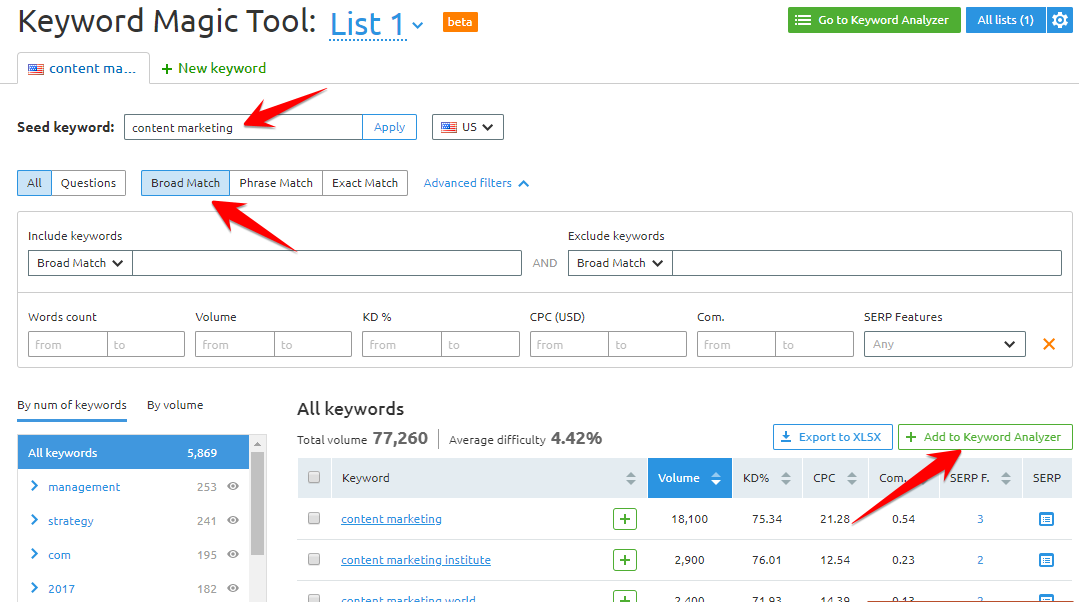
Combining the Keyword Magic tool and Keyword Analyzer allows you to carry out keyword research faster than you would with a combination of tools. You can easily sort through thousands of keywords and uncover long tail keywords without dealing with multiple spreadsheets.

The keyword analyzer sorts selected keywords according to volume, KD, and click potential. Using the Keyword Magic Tool, you can select a combination of phrases and the tool will suggest long tail combinations with the exact phrases people search for.

If you work with clients, then the SEMrush Report builder comes in handy for creating custom reports. All you have to do is select widgets relevant to your report and customize the settings. The report builder automatically updates the information whenever you need to generate a report.

You can also schedule the reports, or use them as templates for future reports.

Cyfe for all-in-one monitoring

One of the pains of SEO is that there is always so much information to track. From keeping an eye on analytics, to monitoring your rankings and catching up on advertising campaigns, there can be a lot of logging in and out of several dashboards.

This is where Cyfe comes in. Cyfe is an all-in-one business dashboard that allows you to keep track of important marketing metrics including SEO and SEM metrics. Cyfe’s strength lies in its ability to pull in data from several sources into one dashboard, giving you an eagle eye view of all your SEO efforts.

Cyfe’s pre-built widgets allows for easy monitoring of any metrics you may want to track. With the Moz widget, for example, you can monitor a website’s authority in search without the need for a paid Moz account.

By adding a widget for Google Search Console, you would receive updates on your site performance in Google search. You could also monitor your site’s performance across different search engines.

Another place Cyfe excels is in competitor tracking. With the Cyfe competitor dashboard and RSS feeds, you can monitor your competitor’s content, email and social media strategies at a glance.

Once you have configured all of your dashboard widgets, you can set up rule-based SMS alerts, allowing you to continue with business as usual, knowing you’ll get a mobile push notification when anomalies that demand human attention arise.

The bottom line in SEO is knowing what to fix on your site to boost performance in search. That means you need an excellent site audit process, especially one that you can put on repeat. For this, Screaming Frog SEO spider is a great choice.

Screaming Frog is a web crawling tool that checks for broken links, audits redirects, analyses page titles, meta data and discovers duplicate content. It can also generate XML sitemaps and integrates with Google Analytics, and you can even set it up for regularly scheduled crawls.

If you have ever tried to perform these activities manually, you would know how tedious they can be, especially for large websites. Screaming Frog saves you the time.

To generate a sitemap, all you have to do is crawl a site completely, and select the XML sitemap option. The tool also comes in handy when searching for and replacing links on your website.

Ahrefs for backlink analysis

The best way to jumpstart your SEO effort is to get backlinks from reputable websites. Ahrefs is one tool that can help you keep an eye on how well your efforts are paying off. The tool crawls 6 billion web pages daily and has an index of 3 trillion known URLs, making it the perfect option for backlink analysis.

With Ahrefs, you can automatically set the tool to monitor how well you are ranking in search, using the recently rebooted Rank Tracker tool. You can also get alerts for new keywords, new/lost backlinks and brand mentions.

Keeping an eye on the competition is also easy, as you can find content attracting the most backlinks in your niche and spy on your competitors to know where their links are coming from.

Conclusion

SEO is a tough nut, and there’s no magic way to automate all of it. To get the best results, you’ll still need to put in the required time and effort. What you can (and should) do, though, is to arm yourself with excellent tools that make the job easier and faster.

The SEMrush keyword research tool is a great option for intelligent keyword research while Ahrefs helps you track down your backlinks effortlessly.

Screaming Frog SEO Spider helps you stay up to date with your site performance through in-depth crawling, and for monitoring all your site metrics in one place, you can rely on Cyfe.

Which tools do you use to automate your SEO? Share your recommendations in the comments!

Related reading

Mobile SEO

This marketing news is not the copyright of Scott.Services – please click here to see the original source of this article. Author: Pius Boachie

For more SEO, PPC, internet marketing news please check out https://news.scott.services

Why not check out our SEO, PPC marketing services at https://www.scott.services

We’re also on:
https://www.facebook.com/scottdotservices/
https://twitter.com/scottdsmith
https://plus.google.com/112865305341039147737

#seoservices #seoservice #seocompany #seocompanies #seoagency #seoagencies #seoconsultant #seoconsultantsuk #seoconsultant #seoconsultantuk #seoexpert #seoexperts #seocompanyuk #seomarketing #seospecialist #seospecialists #seoservicesuk #seofreelancer #seopackages #seostrategy #smallbusinessseo #affordableseoagency #localseoservices #seocost #seopackagesuk #searchengineoptimisationcompany #seoexpertuk #seomarketingcompanies #freelanceseoconsultant #professionalseoservices #seoservicescompany #affordableseoservices #searchengineoptimisationconsultant #seomarketingagency #seomarketingservices #smallbusinessseoservices #completeseoservices #seoadvice #seoconsultingservices #professionalseocompany #googleseoconsultant #affordableseocompany #freelanceseoexpert #professionalseoconsultant #marketingnews #seonews #ppcnews #seo #searchengineoptimisation #searchengineoptimization #scottseo

The post The best tools for automating your SEO appeared first on Scott.Services Online Marketing News.


source https://news.scott.services/the-best-tools-for-automating-your-seo/

New and Improved Bing Ads Audience Targeting Reports

Bing recently announced the launch of Audience Segmentation, a new addition to the Segmentation feature to help advertisers get deeper insights into audiences from Remarketing for search, In-market Audiences, and Custom Audiences.

Before we jump in to reporting, let’s walk through a quick recap of those three available audiences.

Remarketing for search audience let you recapture customers who have previously visited your website. This allows you to reach back out to high-value audiences with optimized ad copy, meaning they have an increased ROI.

With In-market Audiences, you can find curated lists of users that have been found to be in-market for a certain purchase category. Bing Ads has created these lists and they are available directly in the interface. You do not need to build or import your own lists.

A custom audience is a type of remarketing list that is generated by using first-party data to create user segments. Here are a few examples of Custom Audience segments that can be used as a remarketing list: purchase history, renewal period and lifetime value.

Now on to something brand new…

Gone are the days of running multiple reports and mashing them together in able to get the full picture of your audience targeting performance.  We will now have comprehensive audience reporting in a single view.

Let’s say you’re selling running shoes online.  The marathon is coming up and you want to reach people who are either ready to buy or are loyal customers.  You’ve been focused on Remarketing for search to reach your loyal customers with good success and recently added In-Market Audiences to your existing campaigns, to reach people in the market for athletic shoes.

It’s been a couple of weeks and you want to know how it’s working out. Previously, to report on your audience performance you had to run Audience reports and Ad group reports and manually combine them, which took some time.  Now you can see the performance lift of each audience against a common baseline of non-targeted users using the new “Audience Segmentation reporting.”

The data shows that both your Remarketing for search audiences and In-market audiences have significantly out-performed users not in any audience segment. You may then decide to increase the bid boost appropriately for each of these lists in order to increase your Return on Ad Spend (ROAS).

Getting started with Audience Reporting via Audience Segmentation

The Audience Segmentation feature allows you to split your ad group performance data either by audience category or audience name to help you see how ad groups are performing with Remarketing for search, In-market Audiences or Custom audiences – and compared to non-targeted users.

Start with the Audience category to view data grouped by audience targeting feature type.  This will show you how Remarketing for search, In-market Audiences, Custom Audiences compare with one another – and to users not in segment.

A new row called Users not in audience segments is automatically created for you to view performance of those users not in any associated audience segments. Compare each of your audience category performance with user not in audience segments to identify which audience category is performing the best.

Then drill down by selecting Audience name to view performance of each audience to further analyze and identify top or poor performing audience within each category.

With this data in hand, you have a better idea on how your targeting strategy performs in action and can recognize new opportunities and areas for improvement.  Here are a few areas to explore:

  • Increase your bid boosts for those audience segments with strong performance.
  • If you’re using a 0% bid modifier or creating new associations, Bing suggests starting with 15% for Remarketing for search and 20% for In-market Audiences to utilize the benefits of audience targeting.
  • Expand your audience targeting coverage – associate your audience lists to additional ad groups, or if using In-market Audiences, identifying additional segments your business aligns with.
  • Review and refine remarketing list definitions where performance is lower to ensure how you’ve defined the list is correct.

A few additional notes provided by Bing…

  • As part of our global rollout, some Bing advertisers will start seeing this feature today, and everyone will have this new feature by early February.
  • The Audience Segmentation option is available on 6 tabs: Account Summary, Campaigns, Ad Groups, Ads, Keywords and Ad Extensions.
  • You can download the data for offline manipulation through “Download” from the toolbar.
  • The “Users not in audience segments line item is only generated when audience data is available for the selected criteria (i.e. campaign, ad group).
  • Data is available starting Jan 5, 2018 to use the Audience Segmentation feature; to report on your audience targeting performance prior you can utilize existing audience reports.

This marketing news is not the copyright of Scott.Services – please click here to see the original source of this article. Author: Bri Saxman

For more SEO, PPC, internet marketing news please check out https://news.scott.services

Why not check out our SEO, PPC marketing services at https://www.scott.services

We’re also on:
https://www.facebook.com/scottdotservices/
https://twitter.com/scottdsmith
https://plus.google.com/112865305341039147737

#seoservices #seoservice #seocompany #seocompanies #seoagency #seoagencies #seoconsultant #seoconsultantsuk #seoconsultant #seoconsultantuk #seoexpert #seoexperts #seocompanyuk #seomarketing #seospecialist #seospecialists #seoservicesuk #seofreelancer #seopackages #seostrategy #smallbusinessseo #affordableseoagency #localseoservices #seocost #seopackagesuk #searchengineoptimisationcompany #seoexpertuk #seomarketingcompanies #freelanceseoconsultant #professionalseoservices #seoservicescompany #affordableseoservices #searchengineoptimisationconsultant #seomarketingagency #seomarketingservices #smallbusinessseoservices #completeseoservices #seoadvice #seoconsultingservices #professionalseocompany #googleseoconsultant #affordableseocompany #freelanceseoexpert #professionalseoconsultant #marketingnews #seonews #ppcnews #seo #searchengineoptimisation #searchengineoptimization #scottseo

The post New and Improved Bing Ads Audience Targeting Reports appeared first on Scott.Services Online Marketing News.


source https://news.scott.services/new-and-improved-bing-ads-audience-targeting-reports/