The Digital Out-of-Home (DOOH) market is heating up. And, to keep up, DOOH ad platform Vistar Media has launched a private marketplace.
Called Marketplace Deals, it covers outdoor US and Canadian digital signage like billboards, bus shelter displays and screens in elevators and taxis.
In a private marketplace, ad buyers and inventory sellers know from whom they are buying or selling, as opposed to open digital ad exchanges where the identities of advertisers and inventory owners are less visible.
CEO Michael Provenano told me that Marketplace Deals is distinguished from other DOOH private marketplaces by two differentiators.
Barry Levine covers marketing technology for Third Door Media. Previously, he covered this space as a Senior Writer for VentureBeat, and he has written about these and other tech subjects for such publications as CMSWire and NewsFactor. He founded and led the web site/unit at PBS station Thirteen/WNET; worked as an online Senior Producer/writer for Viacom; created a successful interactive game, PLAY IT BY EAR: The First CD Game; founded and led an independent film showcase, CENTER SCREEN, based at Harvard and M.I.T.; and served over five years as a consultant to the M.I.T. Media Lab. You can find him at LinkedIn, and on Twitter at xBarryLevine.
Since the mid ’90s, the internet has been filled with examples of something tiny becoming something big — and changing everything. Ad blocking is another of those stories that will be told, in years to come, around smoldering tweet-fires by grumpy old digital marketers like me.
Ad blockers have already had a huge impact on the digital landscape. This impact could only grow larger if the popularity of blocking ads reaches a critical mass on mobile as well as desktop. For this article, I talked with numerous publishers, users, the Interactive Advertising Bureau, media agencies and Adblock Plus itself to get a complete view of the varying perspectives on ad blocking, and most importantly, to try to tackle where it will all wind up.
Ad-blocking background
Skip ahead to the next heading if you already know the ad-blocking basics. If not, ad blockers are desktop/mobile browser add-ons or standalone browsers that cause most paid advertising to completely vanish from your surfing experience.
Tired of ads intermingling with your search results? Install an ad blocker and enjoy ZERO sponsored ads. Weary of watching a 30-second Facebook video with a 15-second mid-stack ad shoved dead in the center? Simple fix: Download an ad blocker, and voila, video only — c’est la vie, Zuckerberg.
The same applies to most every site, from YouTube video ads to click-bait style (“see what happens next”) modules at the bottom or right rail of most popular content.
There are other reasons to download ad blockers as well — security reasons, like: stop the bad people from accessing my webcam. Did you know that even innocuous sites can open your mic or access your cam? Did you ever get a bizarre feeling that somehow all sorts of different places know you were looking at that “Nicolas Cage rainbow pillowcase?” HOW?
Well, a little plug-and-play add-on or mobile browser can help stop all of that dead in its tracks.
There are many instances (some intentional and some not so intentional) of ads creating malware issues. “Malvertising” has been found not just on seedy sites you would expect to have privacy or security issues with. Even The New York Times and the BBC last year had an issue when they inadvertently ran ads that attempted to hijack the computers of visitors.
Many well-recognized sites have had similar issues to varying degrees. Using ad blockers eliminates most of these issues from ever being a concern.
The user perspective
While there are many different reasons given for using an ad blocker, the bottom-line motivation is pretty simple. Either users are sick of being bombarded by ads and experiencing their effects on the user experience, or they have security or privacy concerns.
If I were writing a confession, I would tell a tale about how I nearly lost my sanity as my mobile phone choked on a 20-slide, “click-bait”-style gallery. It was ever resizing, lagging, and ads kept “enlarging” where the “next” button was located, causing me to click an ad instead of the next button. Yes, this was even on WiFi.
That was when I began using ad blockers on my desktop and phone. Maybe it was one of the first cases of PTAD (Post Traumatic Ad Disorder) ever recorded. I’m getting long in the tooth and don’t appreciate having my precious remaining moments sucked up by ads.
The publishers’ perspective
I’ve worked with some of the biggest names in media over the last 18 years and might be a little more empathetic to their plight than a typical consumer. Publishers seem to be getting it from all sides. The way people consume news has vastly changed and impacted many publications.
Then, you have instances of Google depriving the publications of more and more clicks over time from direct results (“answers”) to the “view original image” additions into Chrome. Now, many sites who actually do get a visit from a human fail to monetize the pageview because that person has ad blocking enabled.
I’ve reached out to numerous publications about the issue, and many of them either declined to comment or stopped responding when they heard about the topic of the article. Like saying “Candyman” three times in a mirror, it’s almost as if they don’t want to even utter the name, for fear it will have bad consequences.
Some publishers, such as Forbes and Business Insider, have taken fairly aggressive action by blocking those with ad blockers. Others, such as The Guardian, take a more subtle approach and attempt to appeal to a reader’s logic.
To be fair, many may have gone a bit too far with jamming ads into content or trying to inflate page views artificiallyusing tactics like multi-page slideshows. Unfortunately, whether or not they were part of the inception or rise in popularity of ad blockers, all publishers are now dealing with the effects.
Something I’ve seen lately are publications that attempt to trick ad blockers using various techniques. One maddening method I ran into involved about 20 to 30 separate scripts running that would auto-load and insert ads if one happened to get blocked. This was set up on a news site. When I attempted to block the actual ad object, another script and ad would be loaded in its place. I’ve dubbed this the “whack-a-mole” strategy. To me, it appeared to be an indicator of desperation.
Another interesting method publishers have been using is to use their own server as an ad server. This tricks the blockers into thinking the ad is not really an ad. While this method may trick casual users, advanced users can easily block those ad sections with a right click setting in their ad blocker.
Publications such as Wired and City A.M. at one time reportedly blocked ad-blocking readers, but have since stopped doing so. Other publications like Forbes and Business Insider have stayed the course, apparently still blocking all users with blockers, asking them to whitelist them or disable the blocker. While I understand the thinking, this approach seems to anger quite a few users, and there are many message boards and social chatter with derogatory posts raging about this practice.
As an aside, I think companies that employ this technique should be advised that using Google’s “cached” version of the page gets around the ad-block wall. Tighten that loophole up, and cast a scowl at your consultants.
I do occasionally see other approaches, like an “article limit,” which allows you to read a couple of articles free a month or other set period of time.
I contacted Alon Zieve, COO of Seeking Alpha, who appears to be navigating the ad-blocking issue in a logical way. Zieve reports that blockers have definitely had an impact on SA revenue. They’ve taken efforts to block certain ad-block users and offer them an option to whitelist or subscribe to the ad-free version. “Fortunately, because our users love our content, we have a relatively good take-up rate on these options.”
Interestingly, he finds that users actually have a hard time trying to figure out how to whitelist the site when they decide to do so. Seeking Alpha also has their own version of Google’s Contributor Service, a great email strategy, and other marketing strategies in place.
When asked about what publishers need to do to survive, Zieve responded, “At Seeking Alpha, our approach to survival is simple. Produce great, valuable content that our users love, and there will always be a way to monetize it.” Their multi-pronged approach appears to have been successful for them in mitigating the ad-block issue.
Adblock Plus’s perspective
I conducted a Skype interview with Ben Williams, director of communications at Adblock Plus. He had some interesting things to say about the history of Adblock Plus, the challenges, and where he thinks it will be going.
I happen to agree with Williams’s view that Adblock Plus was just answering the call for what was desperately wanted out there. The big bad wolves tried first to sue small companies into submission (some are still at it) and then, when that failed, some decided they would work with them.
Adblock Plus doesn’t appear to have any axes to grind. Williams was surprisingly zen about the lawsuits and negative press. In fact, the media outcry was met with Adblock Plus lightening up a bit and not blocking all ads, but setting the sensitivity setting (if you will) a little lower.
It’s also important to note that Adblock Plus can be paid to default whitelist your ads as long as they adhere to their quality guidelines, and many large players have done so.
Adblock Plus supports the new models of how publishers will get funded, and they don’t think the ad-blocking genie will ever get put back into the bottle. When asked for his thoughts on the “tug-of-war” that has happened in the past with publishers trying to get around ad blockers, Williams replied, “It doesn’t really serve the consumer very well.”
He added that instead of “jumping into a tech arms race, (publishers) should consider the fact that so many people are blocking ads and should make better ads.” He believes, for the most part, that’s what has been happening. There are some publishers out there that believe fighting the tide of ad blockers is their best option, but Williams thinks that might be a pretty bad way to treat their users.
When asked about the problem with apps and how they prevent ad blocking, he stated that there really isn’t anything that can be done about that yet. Adblock Plus used to have an app that allowed users to block those ads, but it was kicked out of the Play Store in 2011.
Williams does believe that many people are still using browsers to access sites and that the future of ad blocking on mobile is with the blocking browsers. When Twitter announced it will be using Safari for anyone following a link from iOS versions of its app, it was a huge lift to any one of Twitter’s 328 million users that may have ad blockers installed.
I asked Williams what he thought about Google announcing its own “ad-blocking” features on Chrome and what that would look like. He replied, “What Google has announced so far sounds more to me to be a pop-up blocker.” He believes the ad-blocking community is going to still want to block things like YouTube video ads.
Williams guesses but doesn’t know if those features will be included in the Chrome update. “It all depends on the implementation,” he said. My personal guess is that YouTube video ads won’t be defaulting to the off position — does anyone think they would?
Williams’s view on the future of ad blocking is that it isn’t going anywhere anytime time soon. He believes that recent moves from Apple and Twitter using Safari will only make blocking ads easier. Interestingly, when wondering where things will go on mobile devices, Williams tells us to “look to the East,” saying that people in China, Indonesia and India are blocking ads on their mobile devices at higher rates than we’ve ever seen on desktop.
A survey Adblock Plus recently conducted discovered why US users aren’t using mobile ad blockers the way they are in the East. Williams said the overwhelming response was that they “just didn’t know it exists.” If that survey is correct, I think a safe bet is that we’ll see a surge of mobile ad blocking in the US sometime in the near future.
Looking down the road, Williams feels the best way for publishers to approach their ad-blocking audience is to “reach them with a specialized experience that can also be profitable.” He feels that a “frictionless payment system” for publishers might work out well for those who understand they need to support content that they consume.
Media and agency perspectives
It’s no secret just how much companies like Google, Facebook and other big media players depend on ad revenues. In 2015, advertising generated close to to 90 percent of Google’s total revenue. Facebook makes 84 percent of its ad revenue from mobile. When you’re talking billions, even a small dent can make giants sit up and take notice.
One doesn’t need to be Sherlock Holmes to see a definitive pattern in all the recent moves from the big players. We’ve seen the IAB putting out its acronym-rich strategy in an attempt to slow an outbreak of mobile ad blocking by decreasing the demand for it. Google has been pushing the “contributor” service along with other moves that seem to telegraph a reaction to ad blocking such as:
I could talk about each one of these, but this article is already starting to get longer than “Les Misérables.” Each one of these moves appears to have some component that’s meant to deal with ad blocking in some fashion.
I corresponded with Dennis Buchheim, SVP and general manager of the IAB Tech Lab, about the Coalition for Better Ads (CBA). Buchheim reports that their global effort is focused on providing education and guidance on the user experience, along with guidelines for “better ads” — the goal of which is to slow the motivation to block ads.
Buchheim believes the “installation of ad-blocking technology is often motivated by consumers dealing with ad experiences from other parties who aren’t interested in adopting these guidelines.”
But what is a publisher to do? “IAB created the IAB Ad Blocking Primer to help guide their efforts. The primer describes the risks and benefits of a wide range of tactics, including subscription models and micropayment models, that can be employed,” he said.
The impact on other marketing channels is unclear. Does the more difficult ad landscape increase the spend for SEO, email, social and so on? While he is unclear if there has been a real impact to date, “presumably other channels that can demonstrate their effectiveness would secure increased spend, if digital ad inventory decreased dramatically because of blocking.”
“Before that happened, it’s likely that the price of digital ads would increase as volume decreased,” he added.
What about agencies?
If blocking ads reaches the same fever pitch here in North America and Europe as it has in the East, I can see many paid media reps stating, “Brother, can you spare a dime?” It’s quite difficult to know how successful all of the moves by Google and the IAB will be in slowing the adoption of mobile ad blocking. I, for one, believe it will eventually be on the majority of mobile devices.
I reached out to Andrew Goodman, founder of Page Zero Media, for an agency take on what comes next. His thoughts: “As device-specific computing gives way to futuristic home and mobile concepts, the Internet of Things, voice search, facial recognition, AI and machine learning, etc., the whole concept of interrupting people with advertising may be undermined.”
In the future, Goodman sees companies like Apple and Microsoft potentially in an advantageous position since they “can lean heavily on business models that provide function to consumers, rather than relying heavily on advertising to supplement whatever consumers might pay for function.”
Goodman sees “many current ad models and agencies as doomed within five years, unless they find new stuff to do.”
Closing thoughts
I don’t think ad blocking is going anywhere anytime soon. In fact, I’m predicting that in spite of all the measures the IAB and its members have taken to slow down the demand for ad blockers, mobile blocking will eventually be as common in the United States as it is in the East.
Efforts to slow the outbreak will delay the rate at which it’s adopted. However, as more and more US sites attempt to monetize their mobile content, mobile blocking will inevitably lose the war. For many users, this is a win-win scenario. They’ll see better and less annoying ads overall thanks to the CBA efforts — with or without a blocker in play.
Not to sound too unsympathetic, but I’m not breaking out a violin to play “My heart bleeds for Google and Facebook.” Even though it might put a dent in their pocketbooks, I’m predicting they’ll still come out of it just fine. I’ll play that violin for the many publishers who are deserving and in need of those ad dollars.
As for the Google “ad blocker,” I don’t think even Vegas would carry odds on whether or not that will block video ads from YouTube. Once upon a time, pop-ups were a big problem, and you could download a pop-up blocker plugin to prevent them — until most of the browsers included it by default. In this example, you solved the problem and eliminated a step for the end user.
I get the feeling that the announcement to incorporate the blocker into Chrome is a play to keep the unenlightened in the dark a bit longer. This way they can say, “Hey, yeah, I block ads” when in actuality, they don’t even know what a real blocker does. I don’t think this will have the prescribed effect they believe it will for very long.
I would love it if people began to embrace ad blockers as an effective protest tool. Hate fake news? Completely block the ads on that publication! You don’t have to cause a stink and hope advertisers pull their ads; you have the power with the click of a button to create the same effect.
Just remember to make sure you whitelist those publications you believe are deserving; many desperately need it.
As for the pubs that put up walls for ad blockers, I only see that as a Band-Aid that is easily peeled off. I can see an interesting future if, in fact, many large news sources go subscription only. I can almost see a Napster or BitTorrent for news emerging so that people can consume news without paying for it. Walls generally keep people out, though, not encourage them to walk a few miles to find another entrance.
I believe that the decrease of paid ads puts an increased importance on areas such as social, search, email and so on. Getting your content in front of a user will take more skills than bid, tools or resources to keep auctioning. I don’t know of many that consider an organic Google result for a term to be an ad — and that, in my opinion, is how the future of paid media, on the whole, should look: as innocuous as an answer that Alexa would give to the asker. Having a true, number one position for an important phrase really can’t be more valuable in a future without easily acquired sponsored ads, can it?
I would love to hear your thoughts on where you think this will all end up. Be sure to check out my video breakdown of the article as well:
Some opinions expressed in this article may be those of a guest author and not necessarily Marketing Land. Staff authors are listed here.
About The Author
Anthony Muller is one of the best-kept secrets in the SEO industry at the enterprise level. He is the founder of ZenSEM and, for over 17 years, the Zen Search Engine Marketer has gained clients through C-level referrals for the most part. He has worked with and coordinated the search strategies for many of the largest names in media, retail, and politics.
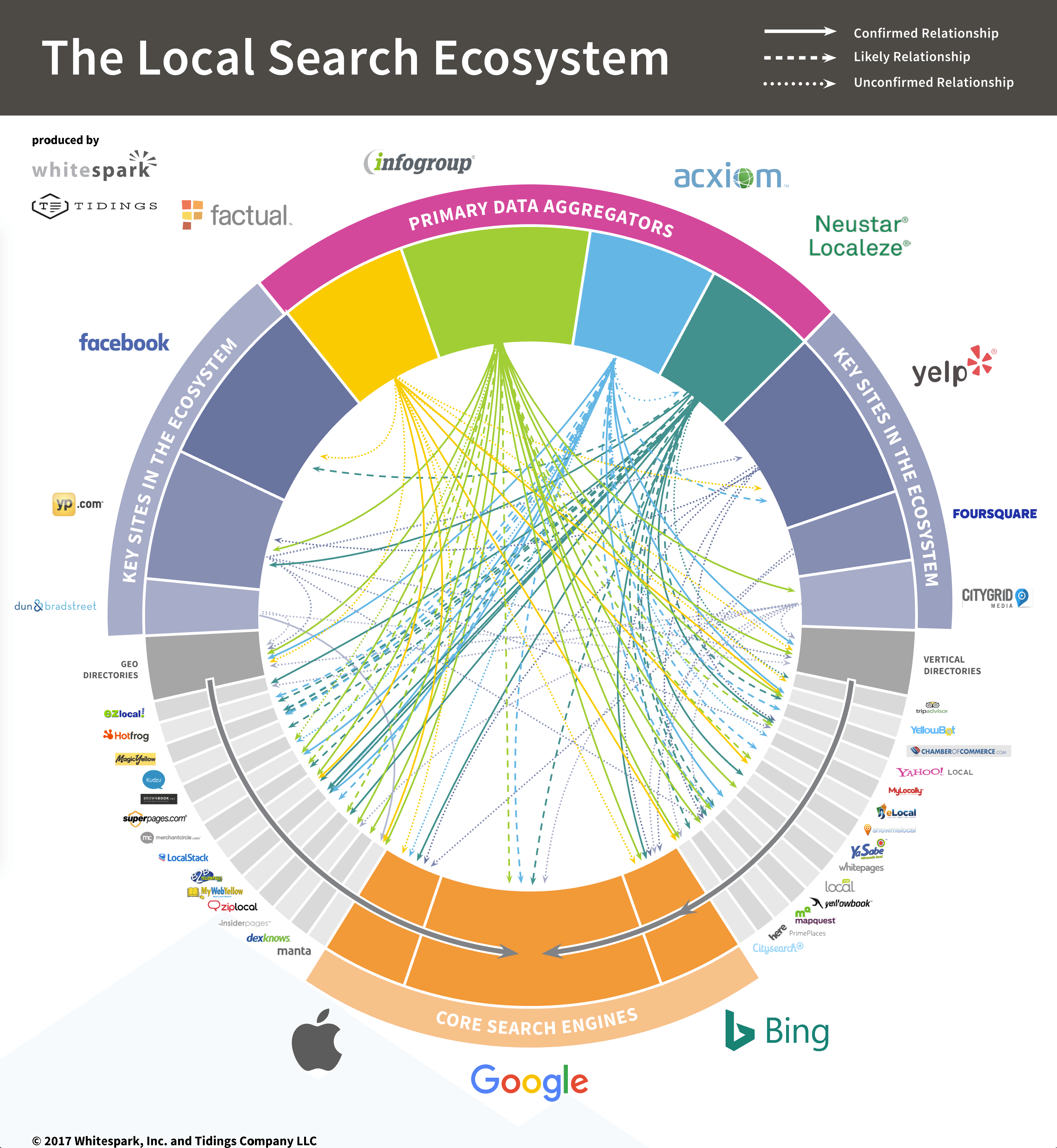
For those who missed it, Whitespark’s overhaul of the US Local Search Ecosystem interactive tool was recently released, and it does a fantastic job of showing how vast and complex the search industry has become. The ecosystem visualizes the web of search engines, data providers, publishers, directories and other businesses that use local data about businesses to power one simple action that people do every day: search online.
For example, the infographic identifies Infogroup, Acxiom, Neustar/Localeze and Factual as the primary data aggregators, which collect and validate location data from businesses and share that data with publishers such as Apple, Bing, Foursquare and Google. (I refer to data aggregators and large publishers collectively as data amplifiers because they share a business’s location data not just directly with searchers, but also with other apps, tools, websites and businesses that, in turn, reshare that data to people across the digital world.)
In Whitespark’s words, the ecosystem “shows how business information is distributed online, who the primary data providers are, how search engines use the data, and how it flows.” The interactive tool helps you understand the importance of sharing accurate location data and the consequences of maintaining inaccurate data.
For example, because data aggregators influence a web of businesses across the ecosystem, it’s imperative that businesses meet the data formatting requirements of each aggregator. And as you can see, the ecosystem is complex:
The Local Search Ecosystem [click to enlarge]
Local search expert David Mihm originally developed this infographic in 2009, and over the years, the ecosystem has changed dramatically to reflect the rich palette of destinations that people weave together throughout the process of discovery, as well as the number of companies that influence whether a business’s location data appears as it should when, say, a searcher finds them on Facebook, Yelp or Uber.
A post on the Whitespark blog by Nyagoslav Zhekov dramatizes this evolution, tracing some of the businesses that have joined and departed. For instance, back in 2009, Apple did not even appear on the ecosystem, and Myspace did. In 2017, Apple is one of the principal data amplifiers, and Myspace is not a factor. You can tell by a quick glance of the 2009 version of the infographic how far the industry as grown:
Now, here’s the interesting part: As far-reaching as the new infographic is, it’s just the tip of the iceberg. The infographic does not come close to identifying all the companies that license business information from data amplifiers or use it as a starting point to build out their own curated business directory. For instance, a quick glance at the following three lists of local citation sources shows dozens of additional places where business information exists:
Many of the businesses that appear on these lists overlap with those on Whitespark’s local search ecosystem, and they have the same role: receiving and sharing location data that influences which locations appear in search results. But many names on the top citations lists didn’t make the cut and are not part of the infographic. Why? Because of two factors that influence each other:
Consumers are using search in more far-reaching and sophisticated ways. They’re using apps, social media sites, websites, search engines and a host of other touch points to do increasingly refined searches for things to do, places to go, services to use and things to buy. They expect the digital world to provide instant access to restaurants, plumbers, museums, tattoo parlors, places for Magic the Gathering meet-ups, places to find spoken poetry and so on. Because of this behavior, the thousands of mobile app platforms, ad networks, navigation systems, data services, social media companies, search engines, directories and so on currently using business information provided by the data amplifiers would make the infographic difficult to comprehend — similar to the Marketing Technology Landscape.
At the same time, the ephemeral nature of many of these tools means that the infographic would rapidly be out of date as the various startups or branches of larger organizations either sunset or consolidate into a larger entity. I find it interesting that the fundamental reason the infographic can never be a truly representative look at the scale of the local search ecosystem is the exact reason that focusing your location data management on the data amplifiers is so critical today — something the infographic illustrates well.
The 2017 local search ecosystem is a brilliant foundation to get businesses grounded in the most influential sources of location data. But as the above examples demonstrate, the scope of location data companies far exceeds the Whitespark infographic. Put another way: Consider each wedge on the infographic to be a gateway to even more specialty sites by category.
The scope of location data directories, publishers and aggregators can seem overwhelming. But if you manage multiple brick-and-mortar storefronts, don’t despair. You need not have a presence on every directory on the lists I’ve cited. It’s far more important to focus your efforts on building relationships with data amplifiers. When you share your data with the core aggregators and publishers, you create two advantages for yourself:
Amplifiers do the heavy lifting for you by disseminating your data among all the places that require it, however obscure, where your data appears.
You stay up-to-date on the emerging technologies and products that the data amplifiers create. Google alone constantly updates its algorithms and products to improve search. By having a relationship with Google — such as publishing your data on Google My Business — you are on the ground floor when product updates happen and when Google launches new products.
Understand the scope and richness of the location data ecosystem. Make sure you are constantly optimizing your data and content to be found everywhere. And let the data amplifiers help you succeed across the ecosystem.
Some opinions expressed in this article may be those of a guest author and not necessarily Search Engine Land. Staff authors are listed here.
About The Author
Adam Dorfman is the Senior Vice President of Product & Technology at SIM Partners where he leads the teams responsible for the best in class local automation platform Velocity. Follow him on Twitter @phixed.
Put simply, black hat SEO includes any techniques that are against Google’s guidelines.
Some people view them as a fast track to achieve higher rankings.
In fact, many SEO practitioners believe black hat SEO tactics are useful and they encourage others to use them.
Some common black hat SEO practices involve:
cloaked content
automated link spamming
keyword stuffing
use of private blog networks (PBNs)
forum and social bookmarking
profile link spamming
and more.
Make no mistake, however:
If your site uses black hat SEO, and Google finds out algorithmically or manually, you will be penalized.
Sometimes, you may notice a site that ranks well and clearly uses these black hat techniques without penalty.
This can (and has) misled some SEO pros into reconsidering whether it’s worth a move to the dark side of black hat SEO.
Instead of immediately believing that these black hat techniques are good ideas just because you find them working on a certain website, let’s try to understand why situations like this happen.
Here are six reasons why a site using black hat SEO tactics may still rank well in search engine results.
1. The SEO Campaign Is Still in an Early Stage
SEO is a marathon, not a sprint.
Many black hat SEO techniques will cause a sudden boost in rankings.
This allows black hat SEO practitioners to provide much faster short-term results.
But these quick results will also disappear quickly.
If the sudden improvement in rankings was shown in a presentation, a conference, or a meeting with someone that only saw the rise in ranking, and never looked at how it progressed in the future, they will never see the performance in the long run, and will tend to believe only what they saw in the short period of time thinking it is safe to do this in the long haul.
Many black hat SEO practitioners are even aware of this yet do it anyway.
Why?
Some of them do the churn and burn type of SEO, where they typically can be ad publishers or affiliate marketers*; doing SEO on their own websites, on their own domain name. If the site gets a sudden boost, makes a profit, then crashes down in rankings and gets banned, they simply throw away the domain and start over with a new one.
It’s great that some random black hat SEO guy did something that gave quick, immediate gains.
But that doesn’t mean you can do it with your SEO clients.
You want to make sure your clients remain in the search results for the long run.
Slow and steady progress is better than quick and unstable growth that may give risky results.
*Not all affiliate marketers and ad publishers are black hat SEOs. But many SEOs that do the churn and burn are often affiliate marketers or ad publishers because they are not invested in the long-term survival of a domain name.
2. Some Industries Are Competitive & Spammier Than Others
Many industries use aggressive marketing strategies.
You’ve likely seen some of the largest offenders in your email spam folder.
Oftentimes, the people participating in industries that do aggressive black hat SEO typically use every digital marketing channel aggressively.
Take, for example, industries such as adult entertainment, online casino, prescription medicine, and even mortgage and loans. These fields often include black hat SEO as part of their online marketing arsenal.**
So many of the sites within these particular industries use black hat SEO tactics. Google doesn’t really have much of a choice other than to include these black hat sites in the top ranking simply because there is no one else to choose.
SEOs that see this in practice may initially believe the black hat practices work, especially when every one of the top results in a competitive market is using black hat strategies.
Fortunately, most of the tactics used in industries saturated with black hat practices simply won’t work in less aggressive industries.
What are the chance of you ever getting close to the top ranking sites using spammy tactics (as defined by Google)? Slim – especially for the long run.
**Sometimes the companies in these industries aren’t the ones doing black hat SEO, but it is the resellers, dealers, distributors, or affiliates of these companies.
3. The Targeted Market Is in a Less Competitive Geographic Area
When listening to conversations with other SEO professionals from other countries in casual discussions, to online forum chat rooms, and even formal conference presentations, you’ll sometimes notice one or two SEOs preaching about how they believe black hat techniques work.
They will show complete case studies and actual results; therefore, you cannot deny the fact that it did work.
But, don’t be tricked by this.
Not all countries are at the same SEO maturity level.
Thus, the lack of competition alone provides an environment in which a site doing any kind of SEO will rank higher than those with no SEO at all, even if the SEO is black hat.
There are still some countries that can get away with these techniques, not because Google has a different algorithm in each country (although they do have small tweaks here and there), but because there are far fewer websites competing for rankings.
When listening to other people about their black hat successes, try to consider all factors of their situation, including geographic location of the target audience.
4. They Are Targeting a Very Long-Tailed Keyword
Black hat or white hat SEO, if the keyword phrase is long enough, it is more than likely that this phrase is very unique to the site you are optimizing; therefore, you are likely to rank for this term regardless of the type of SEO you utilize.
If someone is preaching how great black hat SEO is – and is presenting their ranking for an eight-word keyword phrase that includes a word or two that is totally unique – that is not impressive at all.
Almost anyone doing SEO can achieve this.
Most SEOs are knowledgeable enough to not fall for this sham, but I know there are still many SEO newbies that might go down the wrong path if they are not fully aware.
5. Even If They Use Some Black Hat SEO Tactics, They Are Overpowered by Their White Hat SEO Tactics
Many SEO campaigns involve a variety of tactics and strategies.
SEO practitioners doing multiple things simultaneously can get confused about which tactics are actually helping SEO performance the most.
If an SEO did a hundred white hat tactics and one black hat tactic resulting in outstanding rankings, the white hat SEO might be overpowering the black hat SEO at a large scale.
But, depending on who is interpreting these SEO ranking factors, some might be putting too much focus on the black hat tactics identified and failing to look at the white hat tactics implemented, likewise falsely attributing the ranking success to the black hat tactics.
When looking at a site’s SEO performance, and even if you identified some black hat SEO going on, try to assess all ranking factors involved.
6. Google Hasn’t Detected It Yet and No One Has Reported It
Black hat SEO tactics tend to be be very old.
Google is well aware of these methods.
They don’t work anymore in the long term.
Yet, there are times when SEO practitioners discover a new black hat tactic and seem to get away with it.
The tactic’s newness is like a loophole that Google just doesn’t know how to handle it yet.
Other black hat SEOs may notice it, see it’s working, and start doing it as well.
When it starts to become a popular black hat SEO tactic, more SEOs start finding out about it and some may report it to Google’s Spam Report.
As more reports are submitted, and Google becomes aware of it, they might start taking manual actions and begin working on an algorithm update to prevent these tactics from working.
This is the whole basis of many of the biggest Google algorithm updates.
Google’s algorithms today help prevent many identified black hat SEO tactics that were rampant in the past.
Consider All Factors of the Situation Before Deciding If an SEO Technique Works
This advice applies to not only assessing black hat technique but any technique in general.
Conduct a good scientific analysis and look at all factors possible to be able to draw the right conclusions.
If a theory comes out of your observations, just remember a good theory is a repeatable one.
If you think a specific factor is the main cause of a ranking change, you can confirm that by trying your best to keep other factors constant while observing the effect of a specific factor and changing it.
For this year’s Halloween holiday, Google pulled together its full team of doodlers to develop and produce a ghost story.
The story — told in a YouTube video called “Jinx’s Night Out” — is about Jinx, the lonely ghost, who wants to be part of the trick-or-treating activities, but thinks he must first find a costume to hide his true identity.
“The Doodle team took their time crafting a bewitching storyline, adding a little hocus pocus to make the designs dreadfully engaging,” writes Google doodlers on their blog. “Each sequence has its own color scheme, bringing the characters to (after)life with an entirely new animation process.”
The YouTube video doubles as today’s doodle, and includes a sharing icon, along with a link that leads to “Halloween” search results.
Four doodle team members — Melissa Crowton, Cynthia Chen, Sophie Diao and Helene Lerous — worked on backgrounds and design for the “Jinx’s Night Out” mini-movie. Doodler My-Linh Le was the producer; D.E. Levison did the video’s music, and Paulette Penzvalto was the “Scribbler.”
The Doodle team shared everything from initial sketches for Jinx to the following story board on the Google Doodle Blog:
Here’s the final video that’s being shared on Google’s US home page today, in addition to a number of its international pages:
“No bones about it, this was one of the most enjoyable doodles we have worked on,” writes the Doodle team, offering a few words of advice, “Don’t be afraid to show who you really are or let superstition get in the way of a new friendship and you’ll be a graveyard smash.”
About The Author
Amy Gesenhues is Third Door Media’s General Assignment Reporter, covering the latest news and updates for Search Engine Land and Marketing Land. From 2009 to 2012, she was an award-winning syndicated columnist for a number of daily newspapers from New York to Texas. With more than ten years of marketing management experience, she has contributed to a variety of traditional and online publications, including MarketingProfs.com, SoftwareCEO.com, and Sales and Marketing Management Magazine. Read more of Amy’s articles.
When I began my career in digital marketing, I had a tough time describing what I did to other people. SEO wasn’t a known profession back then, and it certainly wasn’t something that you could easily bring up in conversation.
I remember the weird looks, the fake head nods, and the smiles from people acknowledging that I did something they hadn’t heard of, but politely not wanting to admit it.
As the years went on, things changed. People know what SEO is now, they care about it, they are worried about it, they are held against numbers that depend on it — it’s a thing. All because it was given a name.
When something doesn’t have a name, it’s not real, and as most things at their humble beginnings, SEO was no different. No one was worried about it, it was just this thing they had heard about that may or may not affect them sometime in the distant future.
Now it has a name. And everyone is interested in this set of rules and activities that result in “free” traffic to their websites and helps their bottom line.
What’s in a Name?
So why the diatribe about the name of the profession?
I want to get the point across that when you give something a name you make it real, which gives it power — and the largest mistake Google made in SEO was naming their algorithm updates.
Why?
Because it made algorithm names a thing, which gave them an inordinate amount of power over this profession that still exists today.
Going back to the Boston and Florida updates in 2003, up until the Penguin 4 in 2016, we have enjoyed a host of memorable names that have been applied to updates, and with every update came confusion, anger, and message boards filled with hate for Google.
Matt Cutts, the former head of the web spam team at Google, stepped in and became the scapegoat for all the ire that webmasters felt toward Google. Cutts did his best to answer questions about updates, what they were, why they were doing this — to no avail.
People were mad at these updates.
They ruined businesses.
SERPs became less predictable.
In short, Google had made organic search harder.
SEOs lashed out at Panda and Penguin in comment sections across the internet and spent days and months digging into each nuance to try and find the reason why their sites dropped and cursed Google every step along the way.
People got lost in that anger and over-analysis, and ultimately spent more time in search of silver bullets than they did accepting the real reason they got hit by the shift:
Their site probably sucks.
When you think about the amount of time and energy that is wasted on a daily, weekly, monthly, and annual basis investigating Google’s algorithms and how they may or may not have affected a site, the picture is worrisome.
What everyone should be doing is taking that time and energy and harnessing it into making their sites better, not complaining in comment sections.
We’re only hurting ourselves because while analysis into traffic drops is necessary, we need to control how far we follow that rabbit down the hole — and for the past few years, we’ve all been Alice.
We need a different perspective on algorithm changes.
Looking at It from a Different Perspective
One of the more impactful statements that I have heard in the last couple of years on this subject comes from the CEO of my company, Seth Besmertnik. He showed the featured image at the top of this post and said:
“There is only one algorithm that really matters. It’s the heart, mind, and soul of your customers.”
This really stuck with me. He has used it in several presentations since then, and I have even included it in a few of my monthly webinars, but that message has changed the way that I look at Google updating its algorithm:
Every algorithm update is a quality update.
Google hasn’t given an official name to an algorithm in quite some time, but folks in the industry have.
Pigeon, Possum, Fred, Columbus, etc. were never named by Google. They were all just labeled “Quality Updates.”
Folks in our industry took it upon themselves to give these updates a name, which gave them power and started the cycle of complaining and analysis paralysis all over again.
What if we all just thought about all algorithm updates as “quality updates” and not these separate entities that are working against us?
What if we took the changes in stride, and when we saw a decline we took action instead of going to comment sections, social media, or forums to complain?
A good example of this out in the real world:
I had a conversation with a friend the other day who was becoming increasingly worried about the shifts he was reading about from Glenn Gabe, president of G-Squared Interactive. He follows Gabe religiously and emailed me for advice on what he could do because he was seeing some fluctuations with his traffic.
I dug through his analytics and rankings and any other data I could get my hands on and realized that he had led me down the rabbit hole again. I then thought to myself, “this is an opportunity to change someone’s mind,” and I wrote him the following response:
I don’t see anything alarming, we are still up and pretty comparable to the previous weeks, so while tomorrow could look different, today we seem to be fine.
Have to look at your site through some blinders sometimes. Your site is not any other site on the web. All the work you have done has been towards upping the quality of the site, which is why you have done well. All of these algorithm shifts are quality updates, regardless if they have a name or specific purpose or not. Try not to obsess too much over them, it’s out of our control and all we can control is how well the site is taken care of.
As long as you keep down that road, you’ll be fine. Ups and downs will happen, but algo shifts are like death and taxes, there’s nothing we can do about them, so we might as well not worry about it.
His response?
Well put. Thanks.
I caught up with him a few days later and asked him how it was going. He told me his fears were dispelled and he wound up writing five really killer blog posts that are already seeing a lift for a few niche products he offers in his space.
He stopped worrying about an algorithm update, and he instead spent that time in a more productive manner which improved the quality of his site.
This is how we should be spending our time. This how I am telling my clients to spend their time.
If you are seeing declines when these shifts happen, you only need to do one thing:
Take a good hard look at your site and make it better.
Every update is a quality update, regardless of whether it has a name or specific function.
Stop spending your time searching for silver bullets and start making your site better.
Image Credit
Featured Image by Conductor. Used with permission.
Five years ago, Ceridian, a human resources management platform, acquired Dayforce, a cloud application focused on managing the entire employee process from hire to retire.
“Ceridian had always had its roots in payroll,” says Ceridian CMO Kristina Cleary. “It was actually founded in 1932, and has always managed payrolls for some of the world’s largest organizations.”
According to Cleary, Ceridian originally partnered with Dayforce to find a time and attendance-vendor to complement its payroll solutions. Before the acquisition, Cleary was the vice president of marketing for Dayforce.
“Ceridian, at the time, had been partnering with a bunch of other solutions that weren’t necessarily meeting the needs of its customers, so it was looking for a new solution.”
Cleary says Dayforce initially met with Ceridian during a trade show event. At first, the conversation centered on developing a partnership where Dayforce could fill in the gaps around the time and attendance management needs for Ceridian’s customers.
“What that turned into, about a year later, was a broader partnership where Dayforce had committed to actually building out a cloud payroll solutions for Ceridian — which became the end-to-end application that it is today,” says Cleary.
When Ceridian acquired Dayforce in 2012, Cleary was named the senior vice president of global marketing for Ceridian. In 2016, she was named CMO.
“Since the acquisition, I’ve assumed growing responsibilities, expanding my reach across our operations” says Cleary, “I have been able to take a look at all of our marketing operations, and identified the the areas of success, and obviously, areas where we can improve as well.”
With the acquisition now just over five years ago, Cleary has a large-scale view of what the branding process was like — bringing Dayforce into the Ceridian umbrella — and is sharing what she learned from the experience.
Amy Gesenhues is Third Door Media’s General Assignment Reporter, covering the latest news and updates for Marketing Land and Search Engine Land. From 2009 to 2012, she was an award-winning syndicated columnist for a number of daily newspapers from New York to Texas. With more than ten years of marketing management experience, she has contributed to a variety of traditional and online publications, including MarketingProfs.com, SoftwareCEO.com, and Sales and Marketing Management Magazine. Read more of Amy’s articles.


 Since the mid ’90s, the internet has been filled with examples of something tiny becoming something big — and changing everything. Ad blocking is another of those stories that will be told, in years to come, around smoldering tweet-fires by grumpy old digital marketers like me.